



 Chat with AI
Exam 33: The Trade-Off Between Inflation and Unemployment

Exam 1: What Is Economics261 Questions
Exam 2: The Economy: Myth and Reality185 Questions
Exam 3: The Fundamental Economic Problem: Scarcity and Choice290 Questions
Exam 4: Supply and Demand: an Initial Look337 Questions
Exam 21: An Introduction to Macroeconomics216 Questions
Exam 22: The Goals of Macroeconomic Policy212 Questions
Exam 23: Economic Growth: Theory and Policy228 Questions
Exam 24: Aggregate Demand and the Powerful Consumer219 Questions
Exam 25: Demand-Side Equilibrium: Unemployment or Inflation216 Questions
Exam 26: Bringing in the Supply Side: Unemployment and Inflation228 Questions
Exam 27: Managing Aggregate Demand: Fiscal Policy210 Questions
Exam 28: Money and the Banking System224 Questions
Exam 29: Monetary Policy: Conventional and Unconventional210 Questions
Exam 30: The Financial Crisis and the Great Recession66 Questions
Exam 31: The Debate Over Monetary and Fiscal Policy219 Questions
Exam 32: Budget Deficits in the Short and Long Run215 Questions
Exam 33: The Trade-Off Between Inflation and Unemployment219 Questions
Exam 34: International Trade and Comparative Advantage226 Questions
Exam 35: The International Monetary System: Order or Disorder218 Questions
Exam 36: Exchange Rates and the Macroeconomy219 Questions
Exam 37: Contemporary Issues in the Us Economy23 Questions
Select questions type


Fighting inflation by slowing the growth of aggregate demand is
(Multiple Choice)
4.9/5  (92)
(92) The main process by which a recessionary gap is eliminated is a(n)
(Multiple Choice)
4.9/5 (73)
(73) Keynesian economists generally agree that unemployment is more costly than inflation.
(True/False)
4.8/5 (73)
(73) If the fluctuations in the economy's real growth rate from year to year are caused primarily by variations in the rate at which aggregate demand increases, then data would show the
(Multiple Choice)
4.8/5 (73)
(73) Figure 33-6
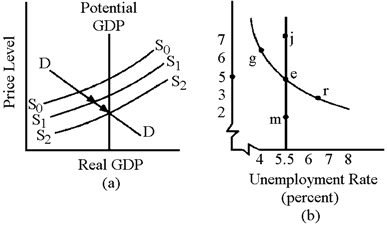 The long-run Phillips curve in Figure 33-6 (b) would include which of the following points?
 (Multiple Choice)
4.8/5 (79)
(79) Which of the following terms refers to provisions in a law or a contract whereby monetary payments are automatically adjusted whenever a specified price index changes?
(Multiple Choice)
4.8/5 (77)
(77) The economy's self-correcting mechanism ensures that neither recessionary nor inflationary gaps will be eliminated eventually.
(True/False)
4.7/5 (84)
(84) The economy's self-correcting mechanism tends to push the unemployment rate back to a specific rate of unemployment. How?
(Essay)
5.0/5 (75)
(75) What reasons would economists give for an increase in the natural rate of unemployment that could have occurred from 2007 to 2011? What argument would suggest that the natural rate of unemployment may not have risen?
(Essay)
4.7/5 (84)
(84) If expectations are rational, forecasting errors are pure random numbers.
(True/False)
4.8/5 (75)
(75) European governments accepted prolonged periods of unemployment in the 1990s in order to reduce inflation.
(True/False)
4.9/5 (82)
(82) Which of the following could trigger demand-side inflation?
(Multiple Choice)
4.8/5 (84)
(84) A movement from an upper point to a lower point on the Phillips curve shows
(Multiple Choice)
4.9/5 (83)
(83) If the income tax system were indexed, a person whose nominal income went up from $30,000 to $33,000 in a year when the price index rose by 10 percent would pay
(Multiple Choice)
4.9/5 (60)
(60) Adverse shocks such as the crop failures of 1972-1973 and the oil price increases of 1974 and 1979 pushed the economy's
(Multiple Choice)
5.0/5 (75)
(75) 
Filters
- Essay(0)
- Multiple Choice(0)
- Short Answer(0)
- True False(0)
- Matching(0)