



 Chat with AI
Exam 33: The Trade-Off Between Inflation and Unemployment

Exam 1: What Is Economics261 Questions
Exam 2: The Economy: Myth and Reality185 Questions
Exam 3: The Fundamental Economic Problem: Scarcity and Choice290 Questions
Exam 4: Supply and Demand: an Initial Look337 Questions
Exam 21: An Introduction to Macroeconomics216 Questions
Exam 22: The Goals of Macroeconomic Policy212 Questions
Exam 23: Economic Growth: Theory and Policy228 Questions
Exam 24: Aggregate Demand and the Powerful Consumer219 Questions
Exam 25: Demand-Side Equilibrium: Unemployment or Inflation216 Questions
Exam 26: Bringing in the Supply Side: Unemployment and Inflation228 Questions
Exam 27: Managing Aggregate Demand: Fiscal Policy210 Questions
Exam 28: Money and the Banking System224 Questions
Exam 29: Monetary Policy: Conventional and Unconventional210 Questions
Exam 30: The Financial Crisis and the Great Recession66 Questions
Exam 31: The Debate Over Monetary and Fiscal Policy219 Questions
Exam 32: Budget Deficits in the Short and Long Run215 Questions
Exam 33: The Trade-Off Between Inflation and Unemployment219 Questions
Exam 34: International Trade and Comparative Advantage226 Questions
Exam 35: The International Monetary System: Order or Disorder218 Questions
Exam 36: Exchange Rates and the Macroeconomy219 Questions
Exam 37: Contemporary Issues in the Us Economy23 Questions
Select questions type


Figure 33-8
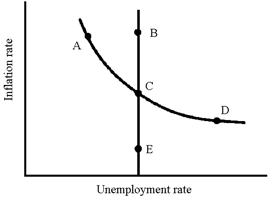 In Figure 33-8, which of the following points illustrate the expansionary monetary policies of the mid-1990s and the accompanying favorable supply shocks?
 (Multiple Choice)
4.9/5  (72)
(72) In the long run, the unemployment rate is independent of inflation, and the Phillips curve is vertical at the natural rate of unemployment.
(True/False)
4.8/5 (82)
(82) Figure 33-8
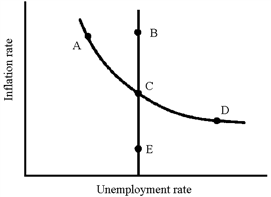 In Figure 33-8, the aggregate supply curve is shifting inward as we move from
 (Multiple Choice)
5.0/5 (73)
(73) When deciding on an appropriate course of action to counter a recessionary gap, which of the following do policymakers consider?
(Multiple Choice)
4.9/5 (61)
(61) The period from the late 1990s to the winter of 2000 was marked by falling unemployment rates and falling inflation rates as well. How does economic theory explain this apparent violation of the Phillips curve model?
(Essay)
4.8/5 (63)
(63) If aggregate demand had grown faster than it did from 2009 to 2010, then the U.S. economy would have experienced
(Multiple Choice)
4.8/5 (81)
(81) In the 1970s, why did the short-run Phillips curve fail to depict the unemployment-inflation trade-off?
(Essay)
4.8/5 (82)
(82) Stimulating demand will improve the unemployment picture but
(Multiple Choice)
4.9/5 (81)
(81) Which of the following is most likely to result in unemployment?
(Multiple Choice)
4.9/5 (66)
(66) Figure 33-6
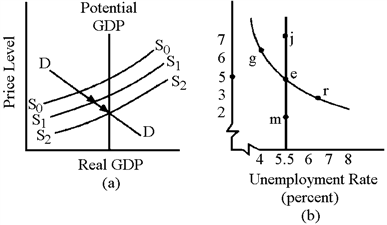 If the economy in 34-6 (b) is experiencing an inflationary gap (point g), the economy's self-correcting process will move unemployment to ____ and inflation to ____.
 (Multiple Choice)
4.8/5 (73)
(73) The main reason why the economy's aggregate supply curve slopes upward is that
(Multiple Choice)
4.9/5 (71)
(71) An increase in aggregate demand is most likely to cause an increase in the price level when the economy is
(Multiple Choice)
4.8/5 (69)
(69) Figure 33-5
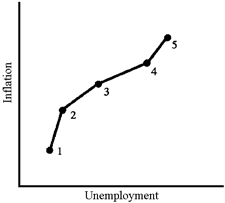 Over a five-year period, economists observed that the unemployment-inflation relationship appeared as in Figure 33-5. Economic theory would conclude that the period
 (Multiple Choice)
4.8/5 (99)
(99) Economist A. W. Phillips found a negative correlation between wage inflation and unemployment.
(True/False)
4.9/5 (85)
(85) The short-run relationship between inflation and unemployment is often called as the Phillips curve.
(True/False)
4.8/5 (85)
(85) Figure 33-2
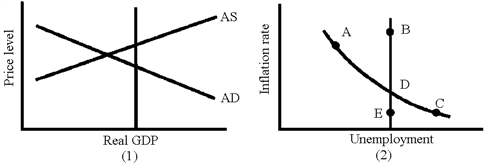 Given the situation in graph (1) in Figure 33-2, what action could be expected from the economy's self-correcting mechanism?
 (Multiple Choice)
4.9/5 (81)
(81) Empirical research suggests that the steepness of the aggregate supply curve depends on the
(Multiple Choice)
4.9/5 (92)
(92) If workers underestimate inflation, the aggregate supply curve will tend to be
(Multiple Choice)
4.9/5 (73)
(73) 
Filters
- Essay(0)
- Multiple Choice(0)
- Short Answer(0)
- True False(0)
- Matching(0)