



 Chat with AI
Exam 33: The Trade-Off Between Inflation and Unemployment

Exam 1: What Is Economics261 Questions
Exam 2: The Economy: Myth and Reality185 Questions
Exam 3: The Fundamental Economic Problem: Scarcity and Choice290 Questions
Exam 4: Supply and Demand: an Initial Look337 Questions
Exam 21: An Introduction to Macroeconomics216 Questions
Exam 22: The Goals of Macroeconomic Policy212 Questions
Exam 23: Economic Growth: Theory and Policy228 Questions
Exam 24: Aggregate Demand and the Powerful Consumer219 Questions
Exam 25: Demand-Side Equilibrium: Unemployment or Inflation216 Questions
Exam 26: Bringing in the Supply Side: Unemployment and Inflation228 Questions
Exam 27: Managing Aggregate Demand: Fiscal Policy210 Questions
Exam 28: Money and the Banking System224 Questions
Exam 29: Monetary Policy: Conventional and Unconventional210 Questions
Exam 30: The Financial Crisis and the Great Recession66 Questions
Exam 31: The Debate Over Monetary and Fiscal Policy219 Questions
Exam 32: Budget Deficits in the Short and Long Run215 Questions
Exam 33: The Trade-Off Between Inflation and Unemployment219 Questions
Exam 34: International Trade and Comparative Advantage226 Questions
Exam 35: The International Monetary System: Order or Disorder218 Questions
Exam 36: Exchange Rates and the Macroeconomy219 Questions
Exam 37: Contemporary Issues in the Us Economy23 Questions
Select questions type


In the rational expectations model, government control over aggregate demand
(Multiple Choice)
4.9/5  (85)
(85) What is the effect of supply-side inflation on the short-run Phillips curve?
(Essay)
4.9/5 (87)
(87) At the natural rate of unemployment, the long-run Phillips curve has a(n)
(Multiple Choice)
4.8/5 (65)
(65) Figure 33-8
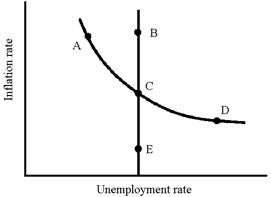 In Figure 33-8, which of the following movements illustrates the response of the economy to a stimulation of aggregate demand when workers systematically underpredict inflation?
 (Multiple Choice)
4.8/5 (86)
(86) Which of the following is most likely to lead to demand-side inflation?
(Multiple Choice)
4.9/5 (70)
(70) If you believe that expectations react quickly, you are likely a
(Multiple Choice)
4.8/5 (71)
(71) If AD and AS increase at exactly the same rate, the result will be
(Multiple Choice)
4.7/5 (81)
(81) Politicians and economists who are generally conservative tend to believe that
(Multiple Choice)
4.9/5 (82)
(82) If unemployment and inflation move inversely, then we can infer that business fluctuations are
(Multiple Choice)
4.8/5 (91)
(91) Most economists now agree that the Phillips curve demonstrates that there is
(Multiple Choice)
4.9/5 (84)
(84) What will tend to happen to wages if workers and employers foresee inflation?
(Multiple Choice)
4.7/5 (73)
(73) One of the reasons why the Phillips curve is no longer viewed as a "menu" of possible choices available to policymakers is that
(Multiple Choice)
4.8/5 (70)
(70) Figure 33-8
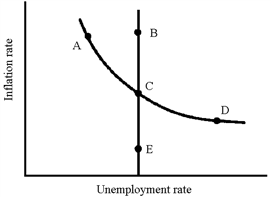 In Figure 33-8, which of the following movements reflects the Fed's anti-inflationary policy of the early 1980s and the following market adjustment?
 (Multiple Choice)
4.8/5 (81)
(81) An increase in AD will trigger less inflation under which of the following conditions?
(Multiple Choice)
4.9/5 (91)
(91) The suggestion that the Fed concentrate only on reducing inflation is an attempt to
(Multiple Choice)
4.8/5 (93)
(93) Who gains if inflation turns out to be higher than expected: the lender or borrower? What happens if inflation turns out to be lower than expected?
(Essay)
4.8/5 (67)
(67) Figure 33-8
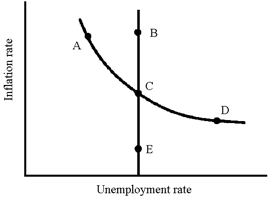 In Figure 33-8, which of the following movements illustrates the response of the economy to an increase in aggregate demand when expectations are "rational"?
 (Multiple Choice)
4.9/5 (68)
(68) 
Filters
- Essay(0)
- Multiple Choice(0)
- Short Answer(0)
- True False(0)
- Matching(0)