



 Chat with AI
Exam 41: Sensory Systems

Exam 1: Introduction to Biological Concepts and Research86 Questions
Exam 2: Life, Chemistry, and Water87 Questions
Exam 3: Biological Molecules: the Carbon Compounds of Life86 Questions
Exam 4: Cells87 Questions
Exam 5: Membranes and Transport88 Questions
Exam 6: Energy, Enzymes, and Biological Reactions87 Questions
Exam 7: Cellular Respiration: Harvesting Chemical Energy88 Questions
Exam 8: Photosynthesis83 Questions
Exam 9: Cell Communication87 Questions
Exam 10: Cell Division and Mitosis88 Questions
Exam 11: Meiosis: the Cellular Basis of Sexual Reproduction80 Questions
Exam 12: Mendel, Genes, and Inheritance79 Questions
Exam 13: Genes, Chromosomes, and Human Genetics92 Questions
Exam 14: Dna Structure, Replication, and Organization79 Questions
Exam 15: Gene Expression: From Dna to Protein83 Questions
Exam 16: Regulation of Gene Expression84 Questions
Exam 17: Bacterial and Viral Genetics85 Questions
Exam 18: Dna Technology: Making and Using Genetically Altered Organisms, and Other Applications90 Questions
Exam 19: Genomes and Proteomes81 Questions
Exam 20: The Development of Evolutionary Thought92 Questions
Exam 21: Microevolution: Genetic Changes Within Populations88 Questions
Exam 22: Speciation89 Questions
Exam 23: Paleobiology and Macroevolution87 Questions
Exam 24: Systematic Biology: Phylogeny and Classification95 Questions
Exam 25: The Origin of Life86 Questions
Exam 26: Prokaryotes and Viruses86 Questions
Exam 27: Protists90 Questions
Exam 28: Seedless Plants88 Questions
Exam 29: Seed Plants90 Questions
Exam 30: Fungi88 Questions
Exam 31: Animal Phylogeny, Acoelomates, and Protostomes95 Questions
Exam 32: Deuterostomes: Vertebrates and Their Closest Relatives93 Questions
Exam 33: The Plant Body90 Questions
Exam 34: Transport in Plants94 Questions
Exam 35: Plant Nutrition85 Questions
Exam 36: Reproduction and Development in Flowering Plants89 Questions
Exam 37: Plant Signals and Responses to the Environment90 Questions
Exam 38: Introduction to Animal Organization and Physiology87 Questions
Exam 39: Information Flow and the Neuron88 Questions
Exam 40: Nervous Systems88 Questions
Exam 41: Sensory Systems87 Questions
Exam 42: The Endocrine System94 Questions
Exam 43: Muscles, Bones, and Body Movements87 Questions
Exam 44: The Circulatory System87 Questions
Exam 45: Defenses Against Disease83 Questions
Exam 46: Gas Exchange: the Respiratory System87 Questions
Exam 47: Digestive Systems and Animal Nutrition92 Questions
Exam 48: Regulating the Internal Environment: Osmoregulation, Excretion, and Thermoregulation88 Questions
Exam 49: Animal Reproduction76 Questions
Exam 50: Animal Development88 Questions
Exam 51: Ecology and the Biosphere88 Questions
Exam 52: Population Ecology92 Questions
Exam 53: Population Interactions and Community Ecology89 Questions
Exam 54: Ecosystems90 Questions
Exam 55: Biodiversity and Conservation Biology89 Questions
Exam 56: Animal Behavior87 Questions
Select questions type


The loudness of a sound depends on the ____ of the sound wave.
(Multiple Choice)
4.9/5  (65)
(65) Which animal would you expect to have the most diverse olfactory receptors to enhance their sense of smell?
(Multiple Choice)
4.8/5 (81)
(81) If a person has fully functional eyes, except for the absence of a lens, they would ____.
(Multiple Choice)
4.8/5 (67)
(67) 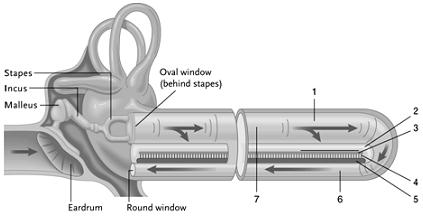 Figure 41.9
-Answer the question using the accompanying figure. Which label identifies the structure through which the vibrations of the oval window pass?
Figure 41.9
-Answer the question using the accompanying figure. Which label identifies the structure through which the vibrations of the oval window pass? (Multiple Choice)
4.9/5 (89)
(89) Mutations in opsin proteins in the cones will lead to ____.
(Multiple Choice)
4.7/5 (90)
(90)
Figure 41.9
-Answer the question using the accompanying figure. Which structure vibrates and bends the sensory hairs?
Figure 41.9
-Answer the question using the accompanying figure. Which structure vibrates and bends the sensory hairs? (Multiple Choice)
4.9/5 (82)
(82) The simplest eye structure, which is able to perceive light but not form an image, is called a(n) ____.
(Multiple Choice)
4.8/5 (87)
(87) Glaucoma is a disease of the eye, often caused by an increase in intraocular pressure. This increased intraocular pressure is most likely caused by ____.
(Multiple Choice)
4.8/5 (81)
(81)
Figure 41.9
-Answer the question using the accompanying figure. Which label identifies the sensory hair cells?
Figure 41.9
-Answer the question using the accompanying figure. Which label identifies the sensory hair cells? (Multiple Choice)
4.9/5 (89)
(89) Many invertebrates have separate and differentiated receptors for taste and smell, while others have a single receptor for both.
(True/False)
4.9/5 (78)
(78) Only ____ make direct contact with brain interneurons rather than afferent neurons.
(Multiple Choice)
4.9/5 (77)
(77) 
Filters
- Essay(0)
- Multiple Choice(0)
- Short Answer(0)
- True False(0)
- Matching(0)