



 Chat with AI
Exam 41: Sensory Systems

Exam 1: Introduction to Biological Concepts and Research86 Questions
Exam 2: Life, Chemistry, and Water87 Questions
Exam 3: Biological Molecules: the Carbon Compounds of Life86 Questions
Exam 4: Cells87 Questions
Exam 5: Membranes and Transport88 Questions
Exam 6: Energy, Enzymes, and Biological Reactions87 Questions
Exam 7: Cellular Respiration: Harvesting Chemical Energy88 Questions
Exam 8: Photosynthesis83 Questions
Exam 9: Cell Communication87 Questions
Exam 10: Cell Division and Mitosis88 Questions
Exam 11: Meiosis: the Cellular Basis of Sexual Reproduction80 Questions
Exam 12: Mendel, Genes, and Inheritance79 Questions
Exam 13: Genes, Chromosomes, and Human Genetics92 Questions
Exam 14: Dna Structure, Replication, and Organization79 Questions
Exam 15: Gene Expression: From Dna to Protein83 Questions
Exam 16: Regulation of Gene Expression84 Questions
Exam 17: Bacterial and Viral Genetics85 Questions
Exam 18: Dna Technology: Making and Using Genetically Altered Organisms, and Other Applications90 Questions
Exam 19: Genomes and Proteomes81 Questions
Exam 20: The Development of Evolutionary Thought92 Questions
Exam 21: Microevolution: Genetic Changes Within Populations88 Questions
Exam 22: Speciation89 Questions
Exam 23: Paleobiology and Macroevolution87 Questions
Exam 24: Systematic Biology: Phylogeny and Classification95 Questions
Exam 25: The Origin of Life86 Questions
Exam 26: Prokaryotes and Viruses86 Questions
Exam 27: Protists90 Questions
Exam 28: Seedless Plants88 Questions
Exam 29: Seed Plants90 Questions
Exam 30: Fungi88 Questions
Exam 31: Animal Phylogeny, Acoelomates, and Protostomes95 Questions
Exam 32: Deuterostomes: Vertebrates and Their Closest Relatives93 Questions
Exam 33: The Plant Body90 Questions
Exam 34: Transport in Plants94 Questions
Exam 35: Plant Nutrition85 Questions
Exam 36: Reproduction and Development in Flowering Plants89 Questions
Exam 37: Plant Signals and Responses to the Environment90 Questions
Exam 38: Introduction to Animal Organization and Physiology87 Questions
Exam 39: Information Flow and the Neuron88 Questions
Exam 40: Nervous Systems88 Questions
Exam 41: Sensory Systems87 Questions
Exam 42: The Endocrine System94 Questions
Exam 43: Muscles, Bones, and Body Movements87 Questions
Exam 44: The Circulatory System87 Questions
Exam 45: Defenses Against Disease83 Questions
Exam 46: Gas Exchange: the Respiratory System87 Questions
Exam 47: Digestive Systems and Animal Nutrition92 Questions
Exam 48: Regulating the Internal Environment: Osmoregulation, Excretion, and Thermoregulation88 Questions
Exam 49: Animal Reproduction76 Questions
Exam 50: Animal Development88 Questions
Exam 51: Ecology and the Biosphere88 Questions
Exam 52: Population Ecology92 Questions
Exam 53: Population Interactions and Community Ecology89 Questions
Exam 54: Ecosystems90 Questions
Exam 55: Biodiversity and Conservation Biology89 Questions
Exam 56: Animal Behavior87 Questions
Select questions type


What detects levels of molecules such as oxygen, carbon dioxide, and hydrogen ions in the body?
(Multiple Choice)
4.9/5  (87)
(87) Eyeglasses correct deficiencies in the function of the ____ in a near-sighted person.
(Multiple Choice)
4.9/5 (82)
(82)  Figure 41.9
-Answer the question using the accompanying figure. Which number identifies the structure that vibrates and DIRECTLY creates the pressure waves in the cochlear fluid?
Figure 41.9
-Answer the question using the accompanying figure. Which number identifies the structure that vibrates and DIRECTLY creates the pressure waves in the cochlear fluid? (Multiple Choice)
4.8/5 (74)
(74) Which receptors allow you to respond to changes in muscle load?
(Multiple Choice)
4.8/5 (79)
(79) Identify each numbered cell in the human eye shown in the following figure.
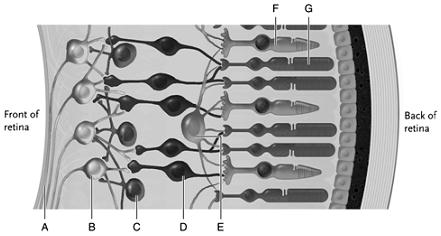
Correct Answer: Verified
Premises:
Responses:
(Matching)
4.9/5 (88)
(88) Figure 41.9
-Answer the question using the accompanying figure. Which number identifies the structure that transmits auditory signals to the brain?
Figure 41.9
-Answer the question using the accompanying figure. Which number identifies the structure that transmits auditory signals to the brain? (Multiple Choice)
4.8/5 (80)
(80) Which receptor type helps a gymnast to know when to unfold from a back flip?
(Multiple Choice)
4.9/5 (76)
(76) The position of the head with respect to gravity is detected by receptors in the basilar membrane.
(True/False)
4.8/5 (71)
(71) The optic nerve transmits information from the basilar membrane to the brain.
(True/False)
4.8/5 (83)
(83) After a robbery, two witnesses may describe the incident very differently from one another. Explain why.
(Essay)
4.8/5 (81)
(81) Each cone responds primarily to a single color. What kinds of cones are present in the human retina?
(Multiple Choice)
4.8/5 (83)
(83) Both rods and cones have four segments, each of which has a specialized function.
(True/False)
4.9/5 (78)
(78) Eye drops used by an ophthalmologist to dilate the eyes for an eye exam act on the nerves that control the ____.
(Multiple Choice)
4.8/5 (82)
(82) Which receptor type makes you aware that you just touched a hot object?
(Multiple Choice)
4.8/5 (84)
(84) 
Filters
- Essay(0)
- Multiple Choice(0)
- Short Answer(0)
- True False(0)
- Matching(0)