



 Chat with AI
Exam 19: Genomes and Proteomes

Exam 1: Introduction to Biological Concepts and Research86 Questions
Exam 2: Life, Chemistry, and Water87 Questions
Exam 3: Biological Molecules: the Carbon Compounds of Life86 Questions
Exam 4: Cells87 Questions
Exam 5: Membranes and Transport88 Questions
Exam 6: Energy, Enzymes, and Biological Reactions87 Questions
Exam 7: Cellular Respiration: Harvesting Chemical Energy88 Questions
Exam 8: Photosynthesis83 Questions
Exam 9: Cell Communication87 Questions
Exam 10: Cell Division and Mitosis88 Questions
Exam 11: Meiosis: the Cellular Basis of Sexual Reproduction80 Questions
Exam 12: Mendel, Genes, and Inheritance79 Questions
Exam 13: Genes, Chromosomes, and Human Genetics92 Questions
Exam 14: Dna Structure, Replication, and Organization79 Questions
Exam 15: Gene Expression: From Dna to Protein83 Questions
Exam 16: Regulation of Gene Expression84 Questions
Exam 17: Bacterial and Viral Genetics85 Questions
Exam 18: Dna Technology: Making and Using Genetically Altered Organisms, and Other Applications90 Questions
Exam 19: Genomes and Proteomes81 Questions
Exam 20: The Development of Evolutionary Thought92 Questions
Exam 21: Microevolution: Genetic Changes Within Populations88 Questions
Exam 22: Speciation89 Questions
Exam 23: Paleobiology and Macroevolution87 Questions
Exam 24: Systematic Biology: Phylogeny and Classification95 Questions
Exam 25: The Origin of Life86 Questions
Exam 26: Prokaryotes and Viruses86 Questions
Exam 27: Protists90 Questions
Exam 28: Seedless Plants88 Questions
Exam 29: Seed Plants90 Questions
Exam 30: Fungi88 Questions
Exam 31: Animal Phylogeny, Acoelomates, and Protostomes95 Questions
Exam 32: Deuterostomes: Vertebrates and Their Closest Relatives93 Questions
Exam 33: The Plant Body90 Questions
Exam 34: Transport in Plants94 Questions
Exam 35: Plant Nutrition85 Questions
Exam 36: Reproduction and Development in Flowering Plants89 Questions
Exam 37: Plant Signals and Responses to the Environment90 Questions
Exam 38: Introduction to Animal Organization and Physiology87 Questions
Exam 39: Information Flow and the Neuron88 Questions
Exam 40: Nervous Systems88 Questions
Exam 41: Sensory Systems87 Questions
Exam 42: The Endocrine System94 Questions
Exam 43: Muscles, Bones, and Body Movements87 Questions
Exam 44: The Circulatory System87 Questions
Exam 45: Defenses Against Disease83 Questions
Exam 46: Gas Exchange: the Respiratory System87 Questions
Exam 47: Digestive Systems and Animal Nutrition92 Questions
Exam 48: Regulating the Internal Environment: Osmoregulation, Excretion, and Thermoregulation88 Questions
Exam 49: Animal Reproduction76 Questions
Exam 50: Animal Development88 Questions
Exam 51: Ecology and the Biosphere88 Questions
Exam 52: Population Ecology92 Questions
Exam 53: Population Interactions and Community Ecology89 Questions
Exam 54: Ecosystems90 Questions
Exam 55: Biodiversity and Conservation Biology89 Questions
Exam 56: Animal Behavior87 Questions
Select questions type


During a microarray analysis, cDNAs made from normal cells are stained with a green fluor and cDNAs from abnormal cells are stained with a red fluor. Which of the following statements is true about the results of this experiment?
(Multiple Choice)
4.8/5  (86)
(86) Which pre-mRNA processing mechanism allows different proteins to be produced from the same DNA sequence?
(Multiple Choice)
4.9/5 (94)
(94) Which element of a dideoxy sequencing reaction allows for visualization of the DNA sequence?
(Multiple Choice)
4.9/5 (78)
(78) Human and chimpanzee genomes share 96% DNA sequence identity. What most likely causes humans to be phenotypically distinct from chimpanzees?
(Multiple Choice)
4.8/5 (93)
(93) The _____ technique is most effective for transcriptomics studies in non-model organisms because _____.
(Multiple Choice)
4.9/5 (89)
(89) Genes with novel functions are most commonly produced by ____.
(Multiple Choice)
5.0/5 (84)
(84) Which domain(s) have densely packed genomes with little noncoding space?
(Multiple Choice)
4.9/5 (83)
(83) A scientist obtains the DNA sequence data for a bacterial plasmid. The data include As, Ts, and Gs, but no Cs. What is the most likely cause of this result?
(Multiple Choice)
4.7/5 (83)
(83) When copies of a gene are found at different locations on the same or different chromosomes, the phenomenon is called _____.
(Multiple Choice)
4.9/5 (79)
(79) The goal(s) of proteomics include(s) the determination of protein_____.
(Multiple Choice)
4.8/5 (86)
(86) 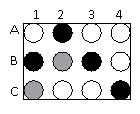 A portion of a microarray is shown above in which the expression of genes on human chromosome 21 was examined in normal brain cells (cDNAs labeled with a white fluor) or brain cells from an individual with a neurological disorder (cDNAs labeled with a black fluor).
Which genes are over-expressed in the abnormal cells compared to the normal cells?
A portion of a microarray is shown above in which the expression of genes on human chromosome 21 was examined in normal brain cells (cDNAs labeled with a white fluor) or brain cells from an individual with a neurological disorder (cDNAs labeled with a black fluor).
Which genes are over-expressed in the abnormal cells compared to the normal cells? (Multiple Choice)
4.9/5 (77)
(77) Which technique can most accurately quantify RNA and determine levels of gene expression?
(Multiple Choice)
4.8/5 (89)
(89) Which organism has the largest number of protein-coding genes?
(Multiple Choice)
4.7/5 (77)
(77) Microarrays let us identify which DNA sequences are present in a particular cell type under certain conditions. How can microarrays help us understand cellular functions?
(Multiple Choice)
4.7/5 (74)
(74) 
Filters
- Essay(0)
- Multiple Choice(0)
- Short Answer(0)
- True False(0)
- Matching(0)