



 Chat with AI
Exam 13: Genes, Chromosomes, and Human Genetics

Exam 1: Introduction to Biological Concepts and Research86 Questions
Exam 2: Life, Chemistry, and Water87 Questions
Exam 3: Biological Molecules: the Carbon Compounds of Life86 Questions
Exam 4: Cells87 Questions
Exam 5: Membranes and Transport88 Questions
Exam 6: Energy, Enzymes, and Biological Reactions87 Questions
Exam 7: Cellular Respiration: Harvesting Chemical Energy88 Questions
Exam 8: Photosynthesis83 Questions
Exam 9: Cell Communication87 Questions
Exam 10: Cell Division and Mitosis88 Questions
Exam 11: Meiosis: the Cellular Basis of Sexual Reproduction80 Questions
Exam 12: Mendel, Genes, and Inheritance79 Questions
Exam 13: Genes, Chromosomes, and Human Genetics92 Questions
Exam 14: Dna Structure, Replication, and Organization79 Questions
Exam 15: Gene Expression: From Dna to Protein83 Questions
Exam 16: Regulation of Gene Expression84 Questions
Exam 17: Bacterial and Viral Genetics85 Questions
Exam 18: Dna Technology: Making and Using Genetically Altered Organisms, and Other Applications90 Questions
Exam 19: Genomes and Proteomes81 Questions
Exam 20: The Development of Evolutionary Thought92 Questions
Exam 21: Microevolution: Genetic Changes Within Populations88 Questions
Exam 22: Speciation89 Questions
Exam 23: Paleobiology and Macroevolution87 Questions
Exam 24: Systematic Biology: Phylogeny and Classification95 Questions
Exam 25: The Origin of Life86 Questions
Exam 26: Prokaryotes and Viruses86 Questions
Exam 27: Protists90 Questions
Exam 28: Seedless Plants88 Questions
Exam 29: Seed Plants90 Questions
Exam 30: Fungi88 Questions
Exam 31: Animal Phylogeny, Acoelomates, and Protostomes95 Questions
Exam 32: Deuterostomes: Vertebrates and Their Closest Relatives93 Questions
Exam 33: The Plant Body90 Questions
Exam 34: Transport in Plants94 Questions
Exam 35: Plant Nutrition85 Questions
Exam 36: Reproduction and Development in Flowering Plants89 Questions
Exam 37: Plant Signals and Responses to the Environment90 Questions
Exam 38: Introduction to Animal Organization and Physiology87 Questions
Exam 39: Information Flow and the Neuron88 Questions
Exam 40: Nervous Systems88 Questions
Exam 41: Sensory Systems87 Questions
Exam 42: The Endocrine System94 Questions
Exam 43: Muscles, Bones, and Body Movements87 Questions
Exam 44: The Circulatory System87 Questions
Exam 45: Defenses Against Disease83 Questions
Exam 46: Gas Exchange: the Respiratory System87 Questions
Exam 47: Digestive Systems and Animal Nutrition92 Questions
Exam 48: Regulating the Internal Environment: Osmoregulation, Excretion, and Thermoregulation88 Questions
Exam 49: Animal Reproduction76 Questions
Exam 50: Animal Development88 Questions
Exam 51: Ecology and the Biosphere88 Questions
Exam 52: Population Ecology92 Questions
Exam 53: Population Interactions and Community Ecology89 Questions
Exam 54: Ecosystems90 Questions
Exam 55: Biodiversity and Conservation Biology89 Questions
Exam 56: Animal Behavior87 Questions
Select questions type


When one parental allele is expressed and the other is silenced, the phenomenon is called ____.
(Multiple Choice)
4.9/5  (81)
(81) Individuals with extra or missing copies of one or more chromosomes are called ____.
(Multiple Choice)
4.8/5 (68)
(68) If a hypothetical human female of genotype XX had no Barr body in any of her cells, ---____.
(Multiple Choice)
4.8/5 (70)
(70) Suppose that in studies of genes on the same chromosome you find the following recombination frequencies:
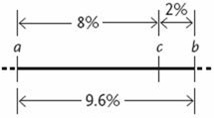 Figure 13.2
Why is the total distance between a and b less than the distance between a and c plus the distance between c and b ?
Figure 13.2
Why is the total distance between a and b less than the distance between a and c plus the distance between c and b ? (Multiple Choice)
4.8/5 (76)
(76) In Drosophila melanogaster, the gene for eye color is located on the X chromosome. The allele for red eye color (Xw+) is dominant over the allele for white eye color (Xw). You examine a vial of 100 flies that are all offspring from a single genetic cross. You find only red-eyed females and red-eyed males present. Flies from the vial were allowed to interbreed, and in the next generation you find only red-eyed females, but you find both red-eyed and white-eyed males. The genotypes of the original parents were ____.
(Multiple Choice)
4.9/5 (89)
(89) In Drosophila melanogaster, the allele for long wings is dominant over the allele for vestigial wings, and the allele for a gray body is dominant over the allele for a black body. A testcross was done to check for genetic linkage between the genes for these traits, with the following results for the offspring: 410 flies with long wings and a gray body
105 flies with long wings and a black body
390 flies with vestigial wings and a black body
95 flies with vestigial wings and a gray body
Which of the choices below best represents the map distance between the genes for these two traits?
(Multiple Choice)
4.8/5 (84)
(84) Prenatal diagnosis techniques, such as amniocentesis and chorionic villus sampling, remove cells produced by the embryo. These cells are then used ____.
(Multiple Choice)
4.9/5 (79)
(79) In humans, males are the ____ sex, and females are the ____ sex.
(Multiple Choice)
4.9/5 (78)
(78) 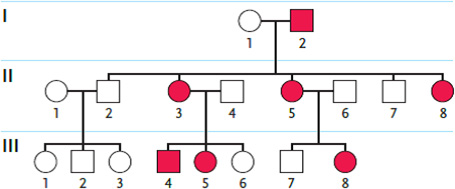 Figure 13.7
Examine the pedigree in the accompanying figure. Individuals affected by the genetic condition in question are indicated by filled squares or circles. Which inheritance pattern is most likely correct for this condition in this family?
Figure 13.7
Examine the pedigree in the accompanying figure. Individuals affected by the genetic condition in question are indicated by filled squares or circles. Which inheritance pattern is most likely correct for this condition in this family? (Multiple Choice)
4.8/5 (83)
(83) In Drosophila melanogaster, the gene for eye color is located on the X chromosome. The allele for red eye color (Xw+) is dominant over the allele for white eye color (Xw). You examine a vial of 100 flies that are all offspring from a single genetic cross. You see only red-eyed females and white-eyed males present. The genotypes of the parents were ____.
(Multiple Choice)
4.7/5 (65)
(65) 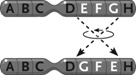 Figure 13.4
The change in the chromosome depicted between the top and the bottom in the accompanying figure represents a(n) ____.
Figure 13.4
The change in the chromosome depicted between the top and the bottom in the accompanying figure represents a(n) ____. (Multiple Choice)
4.9/5 (74)
(74) About 4% of individuals of Northern European descent are carriers for ____, an autosomal recessive genetic disorder in which a defective membrane transport protein leads to deficient chloride levels in extracellular fluids.
(Multiple Choice)
4.8/5 (77)
(77) You are a genetic counselor, and a couple comes to you with concerns that if they have a child together, he or she could have hemophilia. The man has an X-linked recessive form of hemophilia, but the woman does not. Genetic tests reveal the woman is not a carrier for hemophilia. How should you advise them?
(Multiple Choice)
4.9/5 (83)
(83) Why are mitochondrial genes inherited in a non-Mendelian pattern?
(Multiple Choice)
4.7/5 (79)
(79) 
Filters
- Essay(0)
- Multiple Choice(0)
- Short Answer(0)
- True False(0)
- Matching(0)