



 Chat with AI
Exam 13: Genes, Chromosomes, and Human Genetics

Exam 1: Introduction to Biological Concepts and Research86 Questions
Exam 2: Life, Chemistry, and Water87 Questions
Exam 3: Biological Molecules: the Carbon Compounds of Life86 Questions
Exam 4: Cells87 Questions
Exam 5: Membranes and Transport88 Questions
Exam 6: Energy, Enzymes, and Biological Reactions87 Questions
Exam 7: Cellular Respiration: Harvesting Chemical Energy88 Questions
Exam 8: Photosynthesis83 Questions
Exam 9: Cell Communication87 Questions
Exam 10: Cell Division and Mitosis88 Questions
Exam 11: Meiosis: the Cellular Basis of Sexual Reproduction80 Questions
Exam 12: Mendel, Genes, and Inheritance79 Questions
Exam 13: Genes, Chromosomes, and Human Genetics92 Questions
Exam 14: Dna Structure, Replication, and Organization79 Questions
Exam 15: Gene Expression: From Dna to Protein83 Questions
Exam 16: Regulation of Gene Expression84 Questions
Exam 17: Bacterial and Viral Genetics85 Questions
Exam 18: Dna Technology: Making and Using Genetically Altered Organisms, and Other Applications90 Questions
Exam 19: Genomes and Proteomes81 Questions
Exam 20: The Development of Evolutionary Thought92 Questions
Exam 21: Microevolution: Genetic Changes Within Populations88 Questions
Exam 22: Speciation89 Questions
Exam 23: Paleobiology and Macroevolution87 Questions
Exam 24: Systematic Biology: Phylogeny and Classification95 Questions
Exam 25: The Origin of Life86 Questions
Exam 26: Prokaryotes and Viruses86 Questions
Exam 27: Protists90 Questions
Exam 28: Seedless Plants88 Questions
Exam 29: Seed Plants90 Questions
Exam 30: Fungi88 Questions
Exam 31: Animal Phylogeny, Acoelomates, and Protostomes95 Questions
Exam 32: Deuterostomes: Vertebrates and Their Closest Relatives93 Questions
Exam 33: The Plant Body90 Questions
Exam 34: Transport in Plants94 Questions
Exam 35: Plant Nutrition85 Questions
Exam 36: Reproduction and Development in Flowering Plants89 Questions
Exam 37: Plant Signals and Responses to the Environment90 Questions
Exam 38: Introduction to Animal Organization and Physiology87 Questions
Exam 39: Information Flow and the Neuron88 Questions
Exam 40: Nervous Systems88 Questions
Exam 41: Sensory Systems87 Questions
Exam 42: The Endocrine System94 Questions
Exam 43: Muscles, Bones, and Body Movements87 Questions
Exam 44: The Circulatory System87 Questions
Exam 45: Defenses Against Disease83 Questions
Exam 46: Gas Exchange: the Respiratory System87 Questions
Exam 47: Digestive Systems and Animal Nutrition92 Questions
Exam 48: Regulating the Internal Environment: Osmoregulation, Excretion, and Thermoregulation88 Questions
Exam 49: Animal Reproduction76 Questions
Exam 50: Animal Development88 Questions
Exam 51: Ecology and the Biosphere88 Questions
Exam 52: Population Ecology92 Questions
Exam 53: Population Interactions and Community Ecology89 Questions
Exam 54: Ecosystems90 Questions
Exam 55: Biodiversity and Conservation Biology89 Questions
Exam 56: Animal Behavior87 Questions
Select questions type


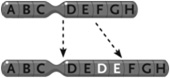 Figure 13.5
The change in the chromosome depicted between the top and the bottom in the accompanying figure represents a(n) ____.
Figure 13.5
The change in the chromosome depicted between the top and the bottom in the accompanying figure represents a(n) ____. (Multiple Choice)
4.9/5  (92)
(92) It has been known for some time that fetal cells can be found in a pregnant woman's bloodstream, sometimes years after a pregnancy. A new technique has been developed that allows scientists to isolate these fetal cells from a pregnant woman's blood. Why would this be a useful new tool for parents interested in genetic testing of their fetus?
(Essay)
4.9/5 (87)
(87) 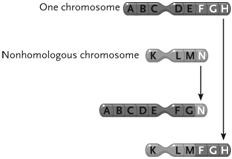 Figure 13.3
The change in the chromosomes depicted between the top and the bottom in the accompanying figure represents a(n) ____.
Figure 13.3
The change in the chromosomes depicted between the top and the bottom in the accompanying figure represents a(n) ____. (Multiple Choice)
4.9/5 (78)
(78) About half of all flowering plant species, including many important crop plants, are ____.
(Multiple Choice)
4.8/5 (87)
(87) In placental mammals, such as humans, the dosage compensation mechanism to equalize expression of sex-linked genes in males and females involves ____.
(Multiple Choice)
4.7/5 (76)
(76) In Drosophila melanogaster, the allele for red eyes is dominant over the allele for purple eyes, and the allele for a gray body is dominant over the allele for a black body. A testcross was done to check for genetic linkage between the genes for these traits. The results for the offspring are listed as follows: 478 flies with red eyes and a gray body
27 flies with red eyes and a black body
462 flies with purple eyes and a black body
33 flies with purple eyes and a gray body
Which of the choices below best represents the map distance between the genes for these two traits?
(Multiple Choice)
4.9/5 (73)
(73) The map distances for four linked genes are as follows: A is 22 cM from B, B is 7 cM from C, C is 9 cM from D, B is 2 cM from D, A is 20 cM from D, and A is 29 cM from C. Based on these data, what is the order of these four genes on the chromosome?
(Multiple Choice)
4.7/5 (84)
(84) 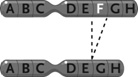 Figure 13.6
The change in the chromosome depicted between the top and the bottom in the accompanying figure represents a(n) ____.
Figure 13.6
The change in the chromosome depicted between the top and the bottom in the accompanying figure represents a(n) ____. (Multiple Choice)
4.8/5 (84)
(84) In birds and butterflies, males contain ____ sex chromosomes and females contain ____ sex chromosomes.
(Multiple Choice)
4.9/5 (81)
(81) Exceptions to the principle of independent assortment were discovered and explained by ____ as resulting from genes being physically associated with each other on the same chromosome.
(Multiple Choice)
4.8/5 (74)
(74) Suppose that in studies of genes on the same chromosome you find the following recombination frequencies:
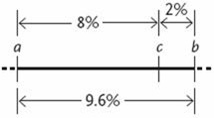 Figure 13.1
In this case, it would be proper to say that a , c , and b are ____.
Figure 13.1
In this case, it would be proper to say that a , c , and b are ____. (Multiple Choice)
4.8/5 (81)
(81) Genetic studies of an animal show that eye color is controlled by an autosomal gene with the dominant allele ( R ) for red eye color and the recessive allele ( r ) for yellow eye color. A second autosomal gene has the dominant allele ( T ) for paws with thumbs and the recessive allele ( t ) for paws without thumbs. The genetic cross RRTT x rrtt creates offspring with genotype RrTt . One of those dihybrids is mated in a testcross ( RrTt x rrtt ). Based on the principle of independent assortment, the testcross should produce offspring with the phenotype ratio ____.
(Multiple Choice)
4.9/5 (80)
(80) 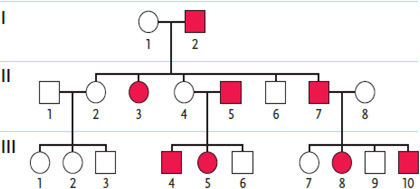 Figure 13.6
Examine the pedigree in the accompanying figure. Individuals affected by the genetic condition in question are indicated by filled squares or circles. Which inheritance pattern is most likely correct for this condition in this family?
Figure 13.6
Examine the pedigree in the accompanying figure. Individuals affected by the genetic condition in question are indicated by filled squares or circles. Which inheritance pattern is most likely correct for this condition in this family? (Multiple Choice)
4.9/5 (85)
(85) In cells of human individuals with three or more X chromosomes, ____.
(Multiple Choice)
4.9/5 (74)
(74) You are a genetic counselor, and a couple comes to you with concerns that if they have a child together, he or she could have hemophilia. Neither of them has hemophilia, but the woman's biological father did have an X-linked recessive form of hemophilia. How should you advise them?
(Multiple Choice)
4.8/5 (84)
(84) A certain genetic disorder appears to be inherited from mother to child. What are two possible modes of inheritance for this disorder?
(Essay)
4.8/5 (71)
(71) Most hospitals in the United States routinely test all newborns for ____, an autosomal recessive disorder in which a metabolic abnormality causes a buildup of compounds that damage brain tissue and can lead to mental retardation, unless a restricted diet is followed.
(Multiple Choice)
4.7/5 (80)
(80) Individuals with three or more copies of each of their chromosomes are called ____.
(Multiple Choice)
4.8/5 (92)
(92) Two genes are on the same chromosome, yet crossing-over occurs between them every time meiosis occurs. Are these genes linked or unlinked and why?
(Essay)
4.9/5 (85)
(85) 
Filters
- Essay(0)
- Multiple Choice(0)
- Short Answer(0)
- True False(0)
- Matching(0)