



 Chat with AI
Exam 13: Genes, Chromosomes, and Human Genetics

Exam 1: Introduction to Biological Concepts and Research86 Questions
Exam 2: Life, Chemistry, and Water87 Questions
Exam 3: Biological Molecules: the Carbon Compounds of Life86 Questions
Exam 4: Cells87 Questions
Exam 5: Membranes and Transport88 Questions
Exam 6: Energy, Enzymes, and Biological Reactions87 Questions
Exam 7: Cellular Respiration: Harvesting Chemical Energy88 Questions
Exam 8: Photosynthesis83 Questions
Exam 9: Cell Communication87 Questions
Exam 10: Cell Division and Mitosis88 Questions
Exam 11: Meiosis: the Cellular Basis of Sexual Reproduction80 Questions
Exam 12: Mendel, Genes, and Inheritance79 Questions
Exam 13: Genes, Chromosomes, and Human Genetics92 Questions
Exam 14: Dna Structure, Replication, and Organization79 Questions
Exam 15: Gene Expression: From Dna to Protein83 Questions
Exam 16: Regulation of Gene Expression84 Questions
Exam 17: Bacterial and Viral Genetics85 Questions
Exam 18: Dna Technology: Making and Using Genetically Altered Organisms, and Other Applications90 Questions
Exam 19: Genomes and Proteomes81 Questions
Exam 20: The Development of Evolutionary Thought92 Questions
Exam 21: Microevolution: Genetic Changes Within Populations88 Questions
Exam 22: Speciation89 Questions
Exam 23: Paleobiology and Macroevolution87 Questions
Exam 24: Systematic Biology: Phylogeny and Classification95 Questions
Exam 25: The Origin of Life86 Questions
Exam 26: Prokaryotes and Viruses86 Questions
Exam 27: Protists90 Questions
Exam 28: Seedless Plants88 Questions
Exam 29: Seed Plants90 Questions
Exam 30: Fungi88 Questions
Exam 31: Animal Phylogeny, Acoelomates, and Protostomes95 Questions
Exam 32: Deuterostomes: Vertebrates and Their Closest Relatives93 Questions
Exam 33: The Plant Body90 Questions
Exam 34: Transport in Plants94 Questions
Exam 35: Plant Nutrition85 Questions
Exam 36: Reproduction and Development in Flowering Plants89 Questions
Exam 37: Plant Signals and Responses to the Environment90 Questions
Exam 38: Introduction to Animal Organization and Physiology87 Questions
Exam 39: Information Flow and the Neuron88 Questions
Exam 40: Nervous Systems88 Questions
Exam 41: Sensory Systems87 Questions
Exam 42: The Endocrine System94 Questions
Exam 43: Muscles, Bones, and Body Movements87 Questions
Exam 44: The Circulatory System87 Questions
Exam 45: Defenses Against Disease83 Questions
Exam 46: Gas Exchange: the Respiratory System87 Questions
Exam 47: Digestive Systems and Animal Nutrition92 Questions
Exam 48: Regulating the Internal Environment: Osmoregulation, Excretion, and Thermoregulation88 Questions
Exam 49: Animal Reproduction76 Questions
Exam 50: Animal Development88 Questions
Exam 51: Ecology and the Biosphere88 Questions
Exam 52: Population Ecology92 Questions
Exam 53: Population Interactions and Community Ecology89 Questions
Exam 54: Ecosystems90 Questions
Exam 55: Biodiversity and Conservation Biology89 Questions
Exam 56: Animal Behavior87 Questions
Select questions type


Which condition would most likely lead to an apparently normal human female?
(Multiple Choice)
4.9/5  (97)
(97) Suppose that you have discovered a new mutant in Drosophila melanogaster . The trait is known to be sex linked. Which crosses should you perform to determine if the mutant trait is recessive or dominant?
(Essay)
4.9/5 (75)
(75) 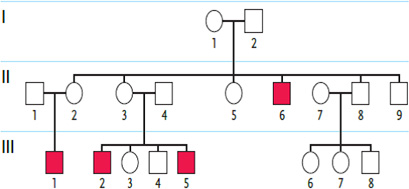 2014
Examine the pedigree in the accompanying figure. Individuals affected by the genetic condition in question are indicated by filled squares or circles. Which inheritance pattern is most likely correct for this condition in this family?
2014
Examine the pedigree in the accompanying figure. Individuals affected by the genetic condition in question are indicated by filled squares or circles. Which inheritance pattern is most likely correct for this condition in this family? (Multiple Choice)
4.7/5 (76)
(76) About 10-15% of African Americans in the US are carriers for ____, an autosomal recessive genetic disorder in which a defective version of the hemoglobin protein is produced.
(Multiple Choice)
4.7/5 (79)
(79) Which statement correctly describes the inheritance of sex chromosomes?
(Multiple Choice)
4.8/5 (88)
(88) You are a genetic counselor, and a couple comes to you with concerns that if they have a child together, he or she could have hemophilia. The woman has an X-linked recessive form of hemophilia, but the man does not. How should you advise them?
(Multiple Choice)
4.9/5 (86)
(86) This autosomal dominant genetic trait is associated with a gene on human chromosome 4 and causes a type of dwarfing due to defective cartilage formation.
(Multiple Choice)
4.9/5 (75)
(75) Carriers of the sickle-cell allele have a genetic advantage because they have ____.
(Multiple Choice)
4.9/5 (82)
(82) 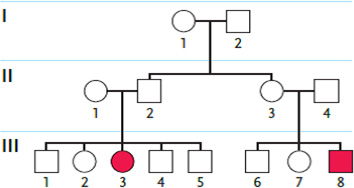 2014
Examine the pedigree in the accompanying figure. Individuals affected by the genetic condition in question are indicated by filled squares or circles. Which inheritance pattern is most likely correct for this condition in this family?
2014
Examine the pedigree in the accompanying figure. Individuals affected by the genetic condition in question are indicated by filled squares or circles. Which inheritance pattern is most likely correct for this condition in this family? (Multiple Choice)
4.9/5 (67)
(67) As an undergraduate research assistant, you are given a genetic mapping project. You are told that genes a and b are 7.4 map units from each other and that genes b and c are 5.7 map units from each other. You perform a testcross to determine the map distance between a and c . Which of the following results would indicate that c lies between a and b ?
(Multiple Choice)
4.8/5 (81)
(81) A woman with normal blood clotting mates with a man who also has normal blood clotting. Their first child is a boy who has hemophilia. Tests show that the child's hemophilia is X-linked and that he has normal genetic inheritance. You can predict that if the couple has more children together, then it is likely that ____.
(Multiple Choice)
4.9/5 (79)
(79) Genetic studies of an animal show that eye color is controlled by an autosomal gene with the dominant allele ( R ) for red eye color and the recessive allele ( r ) for yellow eye color. A second autosomal gene has the dominant allele ( T ) for paws with thumbs and the recessive allele ( t ) for paws without thumbs. The genetic cross RRTT x rrtt creates offspring with genotype RrTt . One of those dihybrids is mated in a testcross ( RrTt x rrtt ). If the two genes are completely linked (no recombination occurs between them), then the testcross should produce offspring with the phenotype ratio ____.
(Multiple Choice)
5.0/5 (98)
(98) In humans, an extra copy of chromosome 21 typically leads to moderate to severe mental retardation and sterility, as well as to a greater likelihood of heart defects and other problems. This disorder is known as ____.
(Multiple Choice)
4.9/5 (75)
(75) Your cousin learns that she is a carrier for phenylketonuria (PKU). Her husband's biological mother has PKU. She asks you to explain what this could mean if she and her husband have children and asks what, if anything, could be done to best protect any child that may have. What would you tell her?
(Essay)
4.7/5 (85)
(85) Recombination frequency for two genes is a function of the ____.
(Multiple Choice)
4.9/5 (82)
(82) In humans, sex determination generally depends upon the ____.
(Multiple Choice)
4.7/5 (83)
(83) Which process exchanges alleles between homologous chromosomes?
(Multiple Choice)
4.8/5 (91)
(91) The presence of genes that encode many types of hemoglobin in mammals, but not in other vertebrates that evolved earlier, is evidence of ____ of genetic material.
(Multiple Choice)
4.7/5 (82)
(82) 
Filters
- Essay(0)
- Multiple Choice(0)
- Short Answer(0)
- True False(0)
- Matching(0)