



 Chat with AI
Exam 18: Modern Cosmology

Exam 1: Here and Now50 Questions
Exam 2: A Users Guide to the Sky68 Questions
Exam 3: Moon Phases and Eclipses68 Questions
Exam 4: Origins of Modern Astronomy64 Questions
Exam 5: Gravity76 Questions
Exam 6: Light and Telescopes69 Questions
Exam 7: Atoms and Spectra73 Questions
Exam 8: The Sun72 Questions
Exam 9: The Family of Stars70 Questions
Exam 10: The Interstellar Medium51 Questions
Exam 11: Formation and Structure of Stars44 Questions
Exam 12: Stellar Evolution51 Questions
Exam 13: Deaths of Stars74 Questions
Exam 14: Neutron Stars and Black Holes69 Questions
Exam 15: The Milky Way Galaxy73 Questions
Exam 16: Galaxies75 Questions
Exam 17: Supermassive Black Holes and Active Galaxies68 Questions
Exam 18: Modern Cosmology71 Questions
Exam 19: Origin of the Solar System and Extrasolar Planets69 Questions
Exam 20: Earth the Active Planet71 Questions
Exam 21: The Moon and Mercury71 Questions
Exam 22: Venus and Mars67 Questions
Exam 23: Jupiter and Saturn68 Questions
Exam 24: Uranus Neptune Pluto and the Kuiper Belt70 Questions
Exam 25: Meteorites Asteroids and Comets65 Questions
Exam 26: Astrobiology68 Questions
Select questions type


The fact that the properties of the Universe are close to the dividing line between open and closed Universes refers to the _______________ problem.
(Short Answer)
4.7/5  (85)
(85) The proper interpretation of the Hubble law (which relates the redshift of a galaxy to its distance) is that as time goes on, galaxies are____.
(Multiple Choice)
4.7/5 (72)
(72) How did dark matter behave differently from normal matter during the early stages of the big bang, and how is this important for the formation of stars and galaxies?
(Essay)
4.8/5 (68)
(68) The cosmological principle states that any observer in any galaxy sees the same general properties for the Universe.
(True/False)
4.9/5 (86)
(86) The heaviest element created in the big bang, in tiny amounts, is _______________.
(Short Answer)
4.9/5 (79)
(79) The big bang only created hydrogen and helium (with miniscule amounts of lithium) because____.
(Multiple Choice)
4.9/5 (85)
(85) 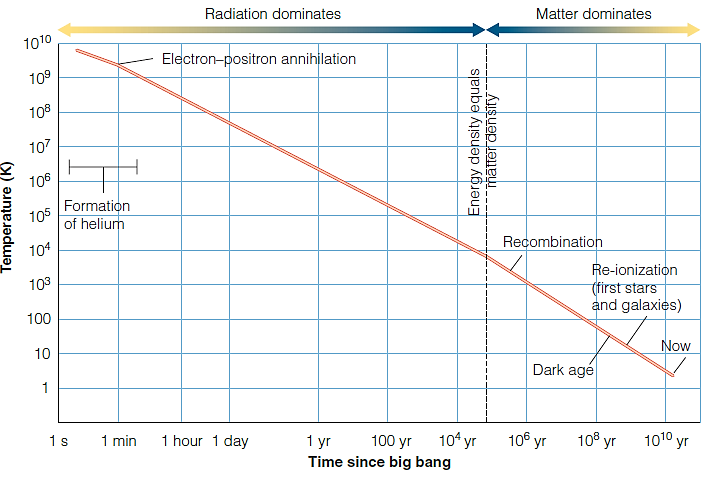 Figure 18-12 (for the following questions) The change from a radiation-dominated to a matter-dominated Universe occurred at a temperature closest to ____ of degrees Kelvin.
 (Multiple Choice)
4.7/5 (74)
(74) The evolution of the distribution of dark and normal matter were____.
(Multiple Choice)
4.8/5 (70)
(70) Why do astronomers conclude that the Universe is filled with dark energy? Discuss two of the primary reasons.
(Essay)
4.9/5 (71)
(71) The cosmic microwave background radiation comes from the time when neutral hydrogen atoms formed in the process of _______________.
(Short Answer)
4.7/5 (66)
(66) The radiation detected by Penzias and Wilson is sometime referred to as CMBR, which stands for _______________ radiation.
(Short Answer)
4.9/5 (89)
(89) The four fundamental forces in the Universe are the ___ forces.
(Multiple Choice)
4.9/5 (80)
(80) Tiny amounts of lithium and beryllium were formed in the big bang.
(True/False)
4.9/5 (87)
(87) The Universe is _______________ because it looks the same in any direction you observe it.
(Short Answer)
4.7/5 (84)
(84) The recombination era of the big bang was very important in several ways. Explain what happened during this time and what observable effects of the era existed.
(Essay)
4.7/5 (77)
(77) 
Filters
- Essay(0)
- Multiple Choice(0)
- Short Answer(0)
- True False(0)
- Matching(0)