



 Chat with AI
Exam 5: Gravity

Exam 1: Here and Now50 Questions
Exam 2: A Users Guide to the Sky68 Questions
Exam 3: Moon Phases and Eclipses68 Questions
Exam 4: Origins of Modern Astronomy64 Questions
Exam 5: Gravity76 Questions
Exam 6: Light and Telescopes69 Questions
Exam 7: Atoms and Spectra73 Questions
Exam 8: The Sun72 Questions
Exam 9: The Family of Stars70 Questions
Exam 10: The Interstellar Medium51 Questions
Exam 11: Formation and Structure of Stars44 Questions
Exam 12: Stellar Evolution51 Questions
Exam 13: Deaths of Stars74 Questions
Exam 14: Neutron Stars and Black Holes69 Questions
Exam 15: The Milky Way Galaxy73 Questions
Exam 16: Galaxies75 Questions
Exam 17: Supermassive Black Holes and Active Galaxies68 Questions
Exam 18: Modern Cosmology71 Questions
Exam 19: Origin of the Solar System and Extrasolar Planets69 Questions
Exam 20: Earth the Active Planet71 Questions
Exam 21: The Moon and Mercury71 Questions
Exam 22: Venus and Mars67 Questions
Exam 23: Jupiter and Saturn68 Questions
Exam 24: Uranus Neptune Pluto and the Kuiper Belt70 Questions
Exam 25: Meteorites Asteroids and Comets65 Questions
Exam 26: Astrobiology68 Questions
Select questions type


The force due to the gravity between two objects depends on the ____,

Free
(Multiple Choice)
4.8/5  (74)
(74) Correct Answer: Verified
B
An object's momentum is equal to its ____.
Free
(Multiple Choice)
4.7/5 (89)
(89) Correct Answer:Verified
VerifiedD
An object in a closed orbit under the influence of an attractive force that follows the inverse square law must behave a(n) _______________ path.
Free
(Short Answer)
4.8/5 (89)
(89) Correct Answer:Verified
Verifiedelliptical
How can tidal forces affect the rotation of celestial bodies and their orbital motion?
(Essay)
4.9/5 (69)
(69) The velocity required to escape an astronomical body is known as the _______________.
(Short Answer)
4.9/5 (82)
(82) One of the first tests of the general theory of relativity was the ____.
(Multiple Choice)
5.0/5 (83)
(83) A(n) ____ orbit is one where the orbiting object is always above the same location on Earth's surface.
(Multiple Choice)
4.8/5 (86)
(86) The apparent positions of stars around the sun during an eclipse have been used to prove the general theory of relativity.
(True/False)
4.9/5 (86)
(86) _______________ occur when tides caused by the Sun and Moon partially cancel out.
(Short Answer)
4.9/5 (85)
(85) The first postulate of special relativity states that ____.
(Multiple Choice)
4.8/5 (82)
(82) 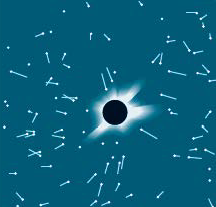 Figure 5-15 Consider the accompanying figure. Due to the curvature of space-time by the sun, light from stars that pass near the edge of the sun will ____.
 (Multiple Choice)
5.0/5 (84)
(84) Newton concluded that some force must act on the Moon because ____.
(Multiple Choice)
4.9/5 (75)
(75) Explain why the term acceleration is important to the first postulate of special relativity.
(Essay)
4.9/5 (86)
(86) Describe two experiments that provide evidence of space-time curvature by the presence of a mass.
(Essay)
4.9/5 (57)
(57) What is an example of the conservation of angular momentum?
(Multiple Choice)
5.0/5 (74)
(74) The M oon pulls more strongly on Earth's near and far side than on its center.
(True/False)
4.8/5 (74)
(74) How does gravity explain the presence of the tides we experience on Earth?
(Essay)
4.8/5 (64)
(64) 
Filters
- Essay(0)
- Multiple Choice(0)
- Short Answer(0)
- True False(0)
- Matching(0)