



 Chat with AI
Exam 8: The Sun

Exam 1: Here and Now50 Questions
Exam 2: A Users Guide to the Sky68 Questions
Exam 3: Moon Phases and Eclipses68 Questions
Exam 4: Origins of Modern Astronomy64 Questions
Exam 5: Gravity76 Questions
Exam 6: Light and Telescopes69 Questions
Exam 7: Atoms and Spectra73 Questions
Exam 8: The Sun72 Questions
Exam 9: The Family of Stars70 Questions
Exam 10: The Interstellar Medium51 Questions
Exam 11: Formation and Structure of Stars44 Questions
Exam 12: Stellar Evolution51 Questions
Exam 13: Deaths of Stars74 Questions
Exam 14: Neutron Stars and Black Holes69 Questions
Exam 15: The Milky Way Galaxy73 Questions
Exam 16: Galaxies75 Questions
Exam 17: Supermassive Black Holes and Active Galaxies68 Questions
Exam 18: Modern Cosmology71 Questions
Exam 19: Origin of the Solar System and Extrasolar Planets69 Questions
Exam 20: Earth the Active Planet71 Questions
Exam 21: The Moon and Mercury71 Questions
Exam 22: Venus and Mars67 Questions
Exam 23: Jupiter and Saturn68 Questions
Exam 24: Uranus Neptune Pluto and the Kuiper Belt70 Questions
Exam 25: Meteorites Asteroids and Comets65 Questions
Exam 26: Astrobiology68 Questions
Select questions type


The Babcock model of the solar magnetic cycle explains the sunspot cycle as primarily a consequence of the Sun's ____.

Free
(Multiple Choice)
4.8/5  (91)
(91) Correct Answer: Verified
C
Granulation is evidence that energy in the photosphere ____.
Free
(Multiple Choice)
4.8/5 (78)
(78) Correct Answer:Verified
VerifiedE
During nuclear fusion, four hydrogen nuclei fuse into how many helium?
Free
(Multiple Choice)
4.8/5 (74)
(74) Correct Answer:Verified
VerifiedA
The _______________ is a thin layer of gas from which Earth receives most of the Sun's light.
(Short Answer)
4.9/5 (69)
(69) When the Sun generates its own energy, it uses weak forces to bind together atomic nuclei.
(True/False)
4.7/5 (66)
(66) Nuclear fusion within the Sun proceeds step by step in a series of reactions called the neutron-neutron chain.
(True/False)
5.0/5 (91)
(91) Stars, like our Sun, generate their energy by way of nuclear _______________.
(Short Answer)
4.8/5 (67)
(67) Granulation is caused by convection currents just below the photosphere.
(True/False)
4.9/5 (79)
(79) What is released from the proton-proton chain and is immediately absorbed by the surrounding gas, thereby heating it?
(Multiple Choice)
5.0/5 (78)
(78) What forms of electromagnetic radiation from the Sun's emissions do we experience here on Earth? Illustrate how we know this to be the case with one practical example for each form.
(Essay)
4.8/5 (62)
(62) Match the solar characteristic to its definition.
Correct Answer:Verified
VerifiedPremises:
Responses:
(Matching)
4.8/5 (79)
(79) When two arches in a magnetic field encounter each other, ____ can cause powerful eruptions called ____.
(Multiple Choice)
4.8/5 (81)
(81) Spicules can trigger communications blackouts and auroras on Earth.
(True/False)
4.8/5 (83)
(83) The images produced by _______________ reveal streamers in the corona that follow magnetic lines of force in the Sun's magnetic field.
(Short Answer)
4.9/5 (84)
(84) What occurs during nuclear fusion within the Sun and how much energy is produced?
(Essay)
4.9/5 (72)
(72) 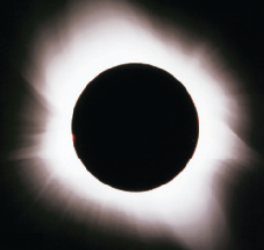 Figure 8-1b
Which layer of the Sun's atmosphere is represented in the accompanying visual-wavelength image?
Figure 8-1b
Which layer of the Sun's atmosphere is represented in the accompanying visual-wavelength image? (Multiple Choice)
4.9/5 (91)
(91) In order for nuclear fusion to occur, atomic nuclei must overcome the ____ by colliding violently.
(Multiple Choice)
4.9/5 (83)
(83) 
Filters
- Essay(0)
- Multiple Choice(0)
- Short Answer(0)
- True False(0)
- Matching(0)