



 Chat with AI
Exam 9: The Family of Stars

Exam 1: Here and Now50 Questions
Exam 2: A Users Guide to the Sky68 Questions
Exam 3: Moon Phases and Eclipses68 Questions
Exam 4: Origins of Modern Astronomy64 Questions
Exam 5: Gravity76 Questions
Exam 6: Light and Telescopes69 Questions
Exam 7: Atoms and Spectra73 Questions
Exam 8: The Sun72 Questions
Exam 9: The Family of Stars70 Questions
Exam 10: The Interstellar Medium51 Questions
Exam 11: Formation and Structure of Stars44 Questions
Exam 12: Stellar Evolution51 Questions
Exam 13: Deaths of Stars74 Questions
Exam 14: Neutron Stars and Black Holes69 Questions
Exam 15: The Milky Way Galaxy73 Questions
Exam 16: Galaxies75 Questions
Exam 17: Supermassive Black Holes and Active Galaxies68 Questions
Exam 18: Modern Cosmology71 Questions
Exam 19: Origin of the Solar System and Extrasolar Planets69 Questions
Exam 20: Earth the Active Planet71 Questions
Exam 21: The Moon and Mercury71 Questions
Exam 22: Venus and Mars67 Questions
Exam 23: Jupiter and Saturn68 Questions
Exam 24: Uranus Neptune Pluto and the Kuiper Belt70 Questions
Exam 25: Meteorites Asteroids and Comets65 Questions
Exam 26: Astrobiology68 Questions
Select questions type


All stars produce an absorption spectra.

Free
(True/False)
4.9/5  (81)
(81) Correct Answer: Verified
True
The least common type of star is a(n) ____.
Free
(Multiple Choice)
4.9/5 (87)
(87) Correct Answer:Verified
VerifiedC
List the three types of binary stars.
Free
(Short Answer)
4.9/5 (74)
(74) Correct Answer:Verified
Verifiedvisual binary, spectroscopic binary, eclipsing binary
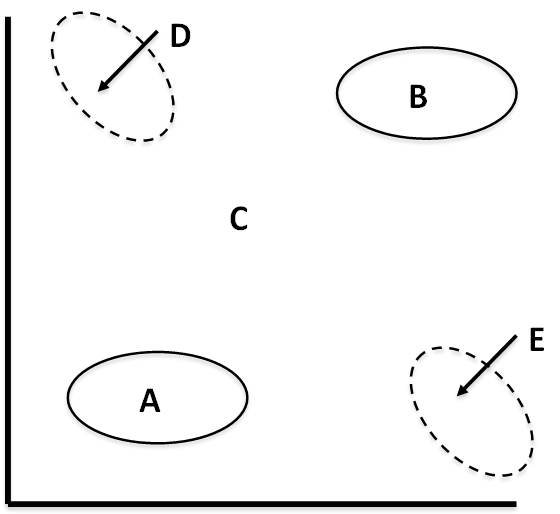 In the above, which figure represents stars with the longest main-sequence lifetimes? Note: (C) represents the entire main sequence while (D) and (E) represent only small parts of the main sequence.
 (Multiple Choice)
4.9/5 (82)
(82) Star A has an apparent visual magnitude of +5 and an absolute visual magnitude of -4. What is the distance to Star A?
(Essay)
4.8/5 (93)
(93) Remember Kepler's third law, which relates the period of revolution to the average distance to a planet. How do we modify that law to use with binary stars?
(Multiple Choice)
4.8/5 (76)
(76) How do astronomers determine the distance to stars that are farther than 100 parsecs away?
(Multiple Choice)
4.8/5 (78)
(78) S tars of low luminosity will always have large positive absolute magnitude.
(True/False)
4.8/5 (79)
(79)  can be used to calculate a star's _____.
If two stars are emitting the same amount of light, the star that is farther will appear dimmer.
(True/False)
4.9/5 (70)
(70) The stellar parallax limit for ground-based telescopes is accurate for stars closer than ____.
(Multiple Choice)
4.8/5 (77)
(77) 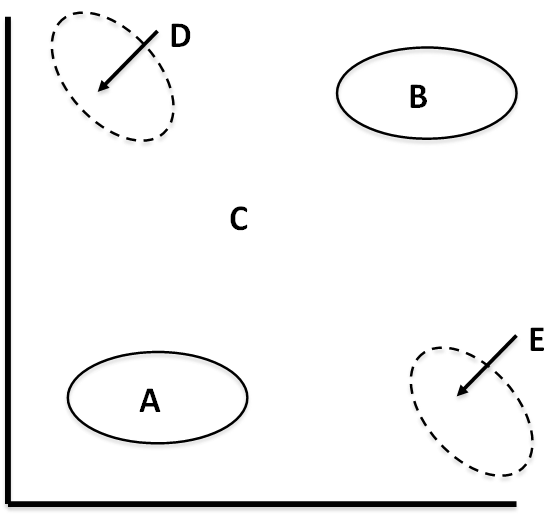 The horizontal axis in the accompanying figure is labeled _____.
 (Multiple Choice)
4.9/5 (90)
(90) Th e apparen t magnitud e o f a sta r observe d fro m a distanc e o f 1 0 pc is called _____.
(Short Answer)
4.8/5 (79)
(79) 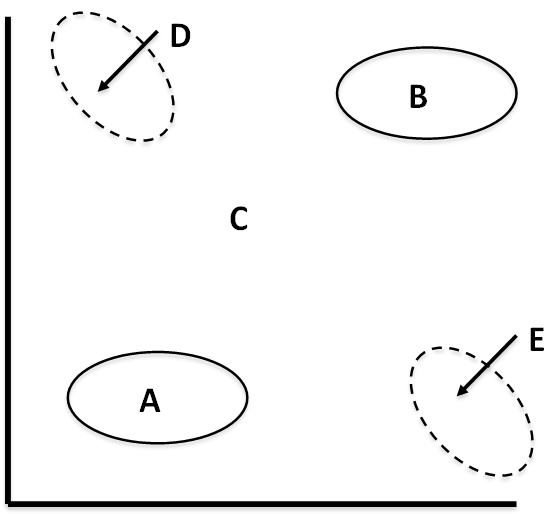 The vertical axis in the accompanying figure is labeled _____.
 (Multiple Choice)
4.8/5 (86)
(86) A star has a parallax angle of 0.019 seconds of arc. How far away is this star from Earth?
(Short Answer)
4.7/5 (83)
(83) 
Filters
- Essay(0)
- Multiple Choice(0)
- Short Answer(0)
- True False(0)
- Matching(0)