



 Chat with AI
Exam 18: Modern Cosmology

Exam 1: Here and Now50 Questions
Exam 2: A Users Guide to the Sky68 Questions
Exam 3: Moon Phases and Eclipses68 Questions
Exam 4: Origins of Modern Astronomy64 Questions
Exam 5: Gravity76 Questions
Exam 6: Light and Telescopes69 Questions
Exam 7: Atoms and Spectra73 Questions
Exam 8: The Sun72 Questions
Exam 9: The Family of Stars70 Questions
Exam 10: The Interstellar Medium51 Questions
Exam 11: Formation and Structure of Stars44 Questions
Exam 12: Stellar Evolution51 Questions
Exam 13: Deaths of Stars74 Questions
Exam 14: Neutron Stars and Black Holes69 Questions
Exam 15: The Milky Way Galaxy73 Questions
Exam 16: Galaxies75 Questions
Exam 17: Supermassive Black Holes and Active Galaxies68 Questions
Exam 18: Modern Cosmology71 Questions
Exam 19: Origin of the Solar System and Extrasolar Planets69 Questions
Exam 20: Earth the Active Planet71 Questions
Exam 21: The Moon and Mercury71 Questions
Exam 22: Venus and Mars67 Questions
Exam 23: Jupiter and Saturn68 Questions
Exam 24: Uranus Neptune Pluto and the Kuiper Belt70 Questions
Exam 25: Meteorites Asteroids and Comets65 Questions
Exam 26: Astrobiology68 Questions
Select questions type


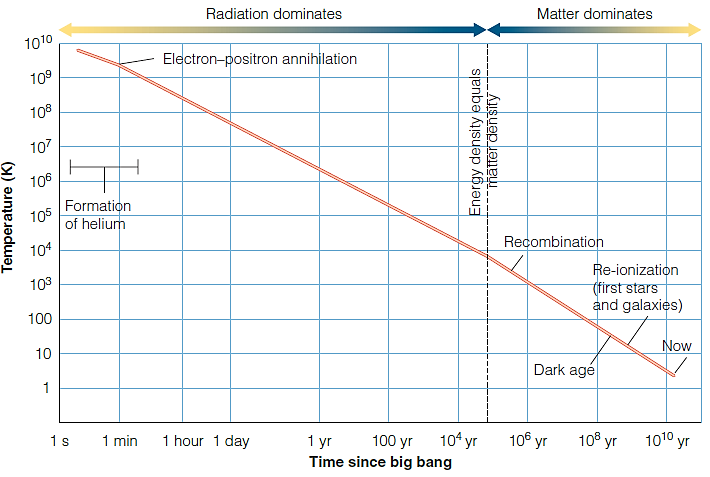 Figure 18-12 (for the following questions) The re-ionization of the Universe occurredclosest to ____ degrees Kelvin.
Free
(Multiple Choice)
4.7/5  (82)
(82) Correct Answer: Verified
D
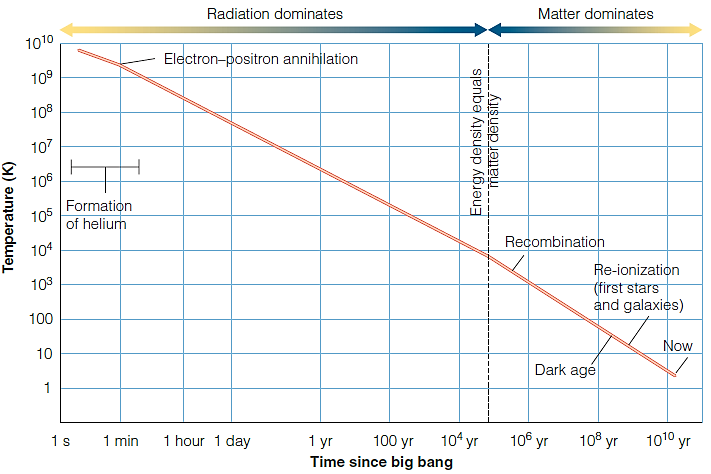 Figure 18-12 (for the following questions) The Universe had a temperature of a few hundred million degrees K at approximately ____ after the big bang.
Free
(Multiple Choice)
4.8/5 (77)
(77) Correct Answer:Verified
VerifiedC
When matter and antimatter particles combine, the two particles annihilate each other and convert their mass into energy in the form of two gamma rays.
Free
(True/False)
4.9/5 (77)
(77) Correct Answer:Verified
VerifiedTrue
In the very first phase after the big bang, when the Universe was about a microsecond old, space was filled with____.
(Multiple Choice)
4.8/5 (87)
(87) The "big bang" was an explosion of material that created galaxies flying away from the center of the explosion.
(True/False)
4.8/5 (69)
(69) Ordinary matter makes up approximately ____percent of the critical density of the Universe.
(Multiple Choice)
4.8/5 (70)
(70) The density of the Universe comes from baryonic matter, non-baryonic dark matter, and dark energy. What percentage of the density of the Universe do each of the three represent?
(Essay)
4.7/5 (77)
(77) What are the four fundamental forces in the Universe and how did they affect the first steps of the big bang and the inflation of the Universe?
(Essay)
4.8/5 (81)
(81) Dark energy accounts for about 70% of the critical density of the Universe.
(True/False)
4.8/5 (83)
(83) The fact that the cosmic microwave background radiation has almost exactly the same temperature in every direction is referred to as the _______________ problem.
(Short Answer)
4.9/5 (73)
(73) The separation of the strong force and the electroweak force ____.
(Multiple Choice)
4.8/5 (79)
(79) The proper interpretation of a what a galaxy's redshift measures is ____.
(Multiple Choice)
4.9/5 (80)
(80) In the early universe, the electromagnetic and strong nuclear forces were joined together to make the electrostrong force.
(True/False)
4.9/5 (91)
(91) Why did the big bang only create hydrogen, helium, and trace amounts of lithium?
(Essay)
4.9/5 (81)
(81) The gas created by the big bang was so hot that it was completely _______________ until the Universe was no longer radiation-dominated.
(Short Answer)
4.9/5 (72)
(72) 
Filters
- Essay(0)
- Multiple Choice(0)
- Short Answer(0)
- True False(0)
- Matching(0)