



 Chat with AI
Exam 9: The Family of Stars

Exam 1: Here and Now50 Questions
Exam 2: A Users Guide to the Sky68 Questions
Exam 3: Moon Phases and Eclipses68 Questions
Exam 4: Origins of Modern Astronomy64 Questions
Exam 5: Gravity76 Questions
Exam 6: Light and Telescopes69 Questions
Exam 7: Atoms and Spectra73 Questions
Exam 8: The Sun72 Questions
Exam 9: The Family of Stars70 Questions
Exam 10: The Interstellar Medium51 Questions
Exam 11: Formation and Structure of Stars44 Questions
Exam 12: Stellar Evolution51 Questions
Exam 13: Deaths of Stars74 Questions
Exam 14: Neutron Stars and Black Holes69 Questions
Exam 15: The Milky Way Galaxy73 Questions
Exam 16: Galaxies75 Questions
Exam 17: Supermassive Black Holes and Active Galaxies68 Questions
Exam 18: Modern Cosmology71 Questions
Exam 19: Origin of the Solar System and Extrasolar Planets69 Questions
Exam 20: Earth the Active Planet71 Questions
Exam 21: The Moon and Mercury71 Questions
Exam 22: Venus and Mars67 Questions
Exam 23: Jupiter and Saturn68 Questions
Exam 24: Uranus Neptune Pluto and the Kuiper Belt70 Questions
Exam 25: Meteorites Asteroids and Comets65 Questions
Exam 26: Astrobiology68 Questions
Select questions type


If a star has an apparent magnitude of +5 and an absolute magnitude of -10, what can we say about that star?
(Multiple Choice)
4.8/5  (83)
(83) The spectral classification of stars started with the amount of hydrogen present in their spectra, but a better method now uses the amount of oxygen in the star's spectra.
(True/False)
4.9/5 (76)
(76) The Hertzsprung-Russell diagram can be labeled many different ways. Which coordinates CANNOT be used on an H-R diagram?
(Multiple Choice)
4.9/5 (84)
(84) The Hertzsprung-Russell Diagram is a plot for stars using absolute magnitude versus temperature.
(True/False)
4.9/5 (74)
(74) Explain why the current spectral classification letters are all jumbled and not in alphabetical order.
(Essay)
4.7/5 (76)
(76) 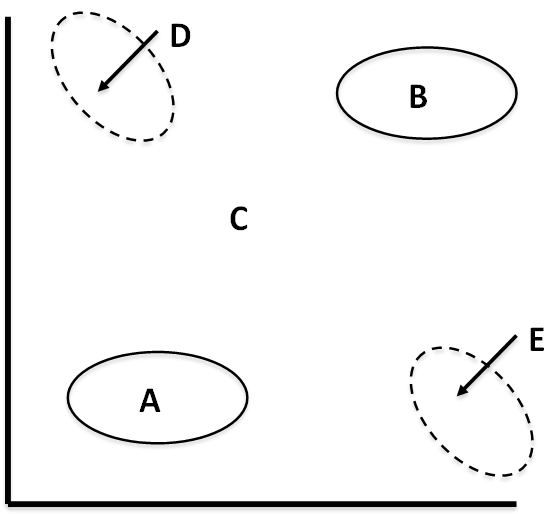 In the accompanying figure, which region represents white dwarfs? Note: (C) represents the entire main sequence while (D) and (E) represent only small parts of the main sequence.
 (Multiple Choice)
4.9/5 (71)
(71) 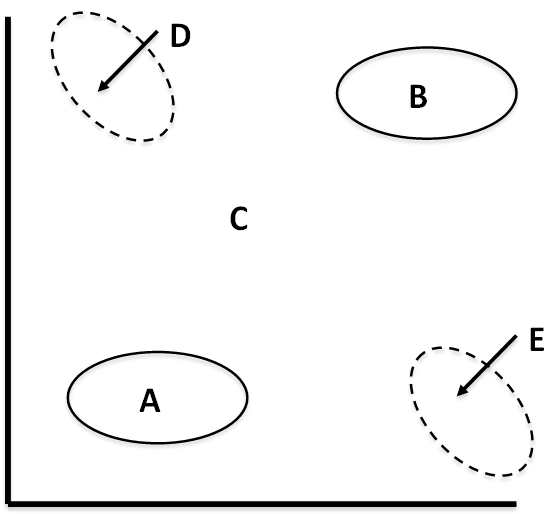 In the accompanying figure, which region represents stars that have ceased ongoing nuclear fusion? Note: (C) represents the entire main sequence while (D) and (E) represent only small parts of the main sequence.
 (Multiple Choice)
4.9/5 (72)
(72) On the H-R diagram, lines of constant radius are illustrated as _____.
(Multiple Choice)
4.9/5 (77)
(77) Veg a i s a n A 0 main sequence star . Base d o n thi s informatio n, whic h statement is true?
(Multiple Choice)
4.8/5 (75)
(75) In which spectral sequence are the hottest stars categorized?
(Multiple Choice)
4.7/5 (93)
(93) 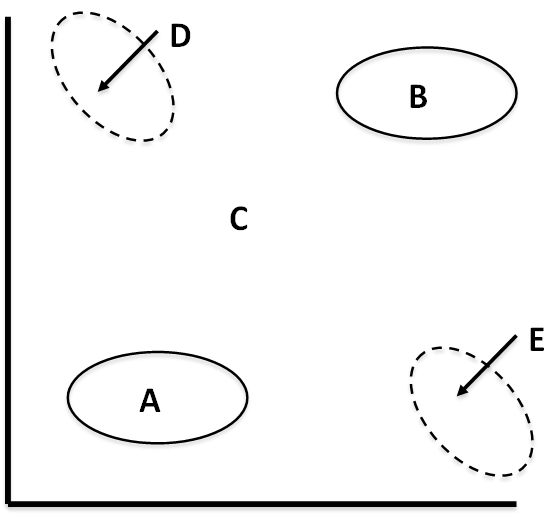 The sloped lines from top left to bottom right in the accompanying figure are labeled ____.
 (Multiple Choice)
4.9/5 (74)
(74) Careful measurements reveal that a star maintains a steady apparent brightness at most times, except that at precise intervals of 93 hours. the star becomes dimmer for about 2 hours. The most likely explanation for this is that the star ________.
(Multiple Choice)
4.9/5 (80)
(80) 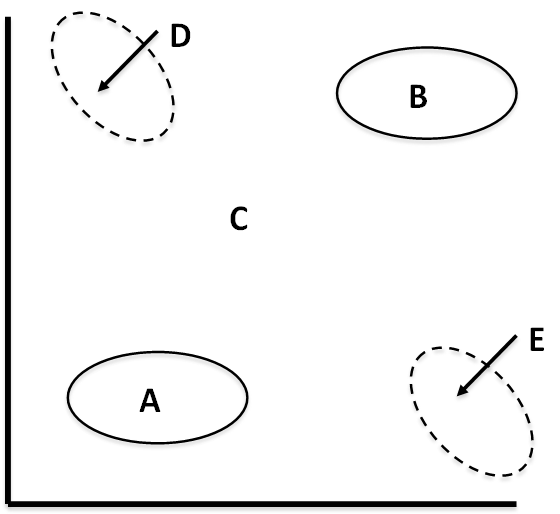 In the accompanying figure, which region represents approximately 80 percent of normal stars? Note: (C) represents the entire main sequence while (D) and (E) represent only small parts of the main sequence.
 (Multiple Choice)
4.9/5 (81)
(81) A star's absolute visual magnitude depends only on the star's ______ and _____.
(Multiple Choice)
4.8/5 (75)
(75) Hydrogen lines are weak in the spectra of hot O-type stars because ____.
(Multiple Choice)
4.9/5 (74)
(74) Star B has an apparent visual magnitude of +5 and is at a distance of 330 pc. What is the absolute visual magnitude of Star B?
(Essay)
4.8/5 (82)
(82) 
Filters
- Essay(0)
- Multiple Choice(0)
- Short Answer(0)
- True False(0)
- Matching(0)