



 Chat with AI
Exam 9: The Family of Stars

Exam 1: Here and Now50 Questions
Exam 2: A Users Guide to the Sky68 Questions
Exam 3: Moon Phases and Eclipses68 Questions
Exam 4: Origins of Modern Astronomy64 Questions
Exam 5: Gravity76 Questions
Exam 6: Light and Telescopes69 Questions
Exam 7: Atoms and Spectra73 Questions
Exam 8: The Sun72 Questions
Exam 9: The Family of Stars70 Questions
Exam 10: The Interstellar Medium51 Questions
Exam 11: Formation and Structure of Stars44 Questions
Exam 12: Stellar Evolution51 Questions
Exam 13: Deaths of Stars74 Questions
Exam 14: Neutron Stars and Black Holes69 Questions
Exam 15: The Milky Way Galaxy73 Questions
Exam 16: Galaxies75 Questions
Exam 17: Supermassive Black Holes and Active Galaxies68 Questions
Exam 18: Modern Cosmology71 Questions
Exam 19: Origin of the Solar System and Extrasolar Planets69 Questions
Exam 20: Earth the Active Planet71 Questions
Exam 21: The Moon and Mercury71 Questions
Exam 22: Venus and Mars67 Questions
Exam 23: Jupiter and Saturn68 Questions
Exam 24: Uranus Neptune Pluto and the Kuiper Belt70 Questions
Exam 25: Meteorites Asteroids and Comets65 Questions
Exam 26: Astrobiology68 Questions
Select questions type


On the H-R diagram, 90 percent of all stars are _______________.
(Short Answer)
4.7/5  (81)
(81) Our Sun's spectral temperature type is classified as a(n) ____ on the spectral sequence.
(Multiple Choice)
5.0/5 (88)
(88) 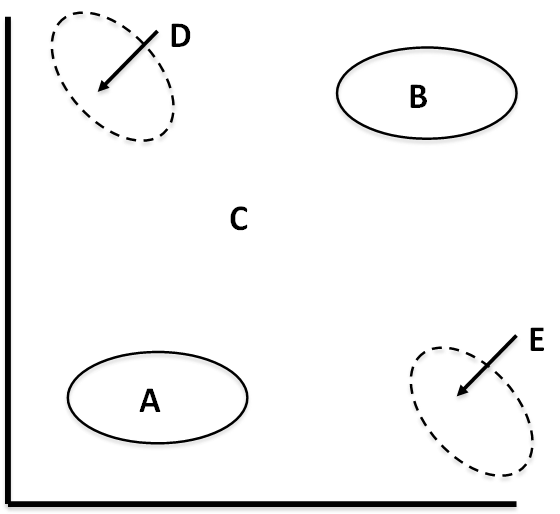 In the accompanying figure, which region represents supergiant stars? Note: (C) represents the entire main sequence while (D) and (E) represent only small parts of the main sequence.
 (Multiple Choice)
4.9/5 (72)
(72) Recently discovered brown dwarfs have spectra similar to cool O-type stars.
(True/False)
4.8/5 (92)
(92) Any star that is more luminous than the Sun, but has the same temperature as the Sun, is a(n) ____.
(Multiple Choice)
4.9/5 (70)
(70) The luminosity (L) of a star is the total energy the star radiates in _______________.
(Short Answer)
4.8/5 (79)
(79) The classification of stellar spectra started with the amount of hydrogen in the star's spectrum; however, now a better scheme uses the star's _____.
(Multiple Choice)
4.8/5 (74)
(74) The horizontal axis (X-axis) of the Hertzsprung-Russell diagram is labeled with _______________.
(Short Answer)
4.9/5 (72)
(72) If luminosity depends on radius and temperature, what does flux depend on? _______________
(Short Answer)
4.9/5 (85)
(85) 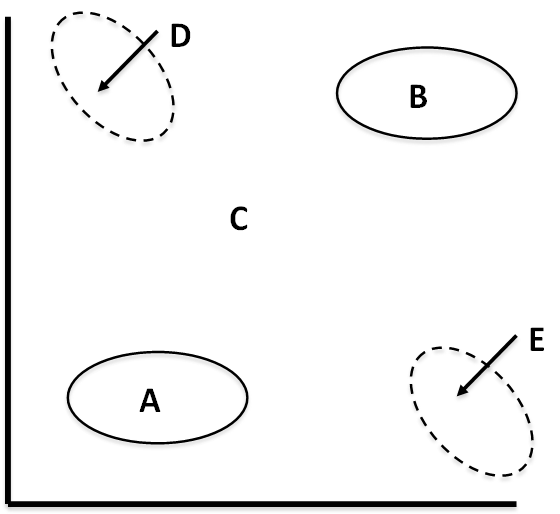 In the accompanying figure, which region represents stars that are extremely bright and emit most of their radiation as ultraviolet light? Note: (C) represents the entire main sequence while (D) and (E) represent only small parts of the main sequence?
 (Multiple Choice)
4.9/5 (92)
(92) 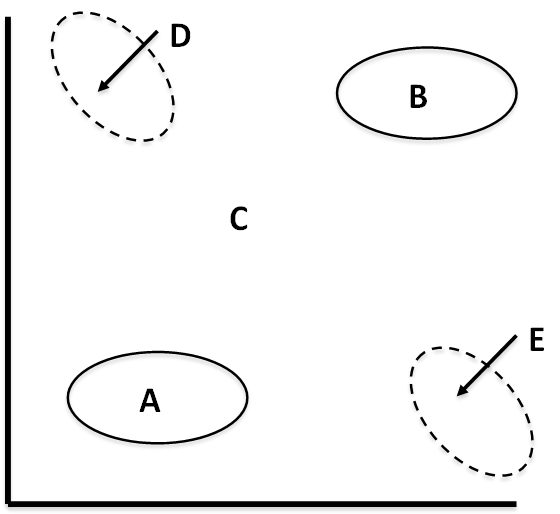 In the accompanying figure, which region represents the largest diameter stars? Note: (C) represents the entire main sequence while (D) and (E) represent only small parts of the main sequence.
 (Multiple Choice)
5.0/5 (81)
(81) A star's absolute brightness is calculated at a standard distance of 10 parsecs.
(True/False)
4.8/5 (74)
(74) Which type of binary system have pairs of stars that are so close together that they look like one single point?
(Multiple Choice)
4.8/5 (74)
(74) How did astronomers discover the relationship between spectral type and mass for main sequence stars?
(Multiple Choice)
4.8/5 (75)
(75) Determine the mass of a theorized black hole from the following information. The mass of the companion main sequence star is 6 solar masses. The observed period and semi-major axis of the binary system are 3.5 years and 5.5 AUs, respectively.
(Essay)
4.9/5 (58)
(58) Stellar spectra started with the amount of hydrogen found in the star's spectrum and started with the letters A through Q. What are the current letters used to classify stellar spectra?
(Short Answer)
5.0/5 (69)
(69) Groombridge 34 i s an M2 main sequence star . Base d o n thi s informatio n, whic h statement is true?
(Multiple Choice)
4.8/5 (99)
(99) The luminosity class is assigned to a star by studying the absorption lines in the spectrum of the star.
(True/False)
4.8/5 (91)
(91) 
Filters
- Essay(0)
- Multiple Choice(0)
- Short Answer(0)
- True False(0)
- Matching(0)