



 Chat with AI
Exam 12: Stellar Evolution

Exam 1: Here and Now50 Questions
Exam 2: A Users Guide to the Sky68 Questions
Exam 3: Moon Phases and Eclipses68 Questions
Exam 4: Origins of Modern Astronomy64 Questions
Exam 5: Gravity76 Questions
Exam 6: Light and Telescopes69 Questions
Exam 7: Atoms and Spectra73 Questions
Exam 8: The Sun72 Questions
Exam 9: The Family of Stars70 Questions
Exam 10: The Interstellar Medium51 Questions
Exam 11: Formation and Structure of Stars44 Questions
Exam 12: Stellar Evolution51 Questions
Exam 13: Deaths of Stars74 Questions
Exam 14: Neutron Stars and Black Holes69 Questions
Exam 15: The Milky Way Galaxy73 Questions
Exam 16: Galaxies75 Questions
Exam 17: Supermassive Black Holes and Active Galaxies68 Questions
Exam 18: Modern Cosmology71 Questions
Exam 19: Origin of the Solar System and Extrasolar Planets69 Questions
Exam 20: Earth the Active Planet71 Questions
Exam 21: The Moon and Mercury71 Questions
Exam 22: Venus and Mars67 Questions
Exam 23: Jupiter and Saturn68 Questions
Exam 24: Uranus Neptune Pluto and the Kuiper Belt70 Questions
Exam 25: Meteorites Asteroids and Comets65 Questions
Exam 26: Astrobiology68 Questions
Select questions type


A open star cluster will have a(n) _____________ turn-off point than an older star cluster.
(Short Answer)
4.9/5  (75)
(75) Helium fusion is sometimes referred to as the _______________ because three helium nuclei are needed to make a carbon nucleus, and because the helium nucleus is called an alpha particle.
(Short Answer)
4.8/5 (84)
(84) All the elements heavier than helium on the periodic table, including the ones in your body, were created in the cores of massive stars.
(True/False)
4.7/5 (74)
(74) A(n) _______________star is any star that changes its brightness significantly and repeatedly.
(Short Answer)
4.8/5 (82)
(82) 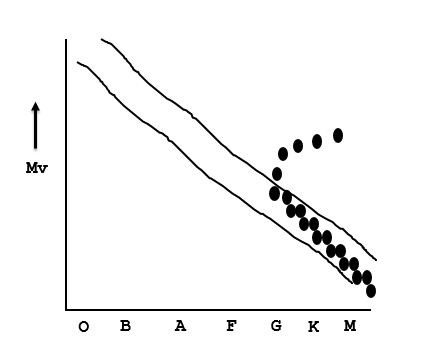 Figure: Main-Sequence Stars What is the approximate age of the star cluster in the accompanying figure?
 (Multiple Choice)
4.7/5 (75)
(75) To determine the structure of the interior of a star, astronomers must balance density, luminosity, and ____.
(Multiple Choice)
4.9/5 (81)
(81) The two elements a one-solar-mass star uses over the course of its entire evolution are _______________ and _____________.
(Short Answer)
4.8/5 (80)
(80) As a star like the Sun exhausts hydrogen in its core, the outer layers of the star become hotter and more luminous.
(True/False)
4.8/5 (72)
(72) 
Filters
- Essay(0)
- Multiple Choice(0)
- Short Answer(0)
- True False(0)
- Matching(0)