



 Chat with AI
Exam 12: Stellar Evolution

Exam 1: Here and Now50 Questions
Exam 2: A Users Guide to the Sky68 Questions
Exam 3: Moon Phases and Eclipses68 Questions
Exam 4: Origins of Modern Astronomy64 Questions
Exam 5: Gravity76 Questions
Exam 6: Light and Telescopes69 Questions
Exam 7: Atoms and Spectra73 Questions
Exam 8: The Sun72 Questions
Exam 9: The Family of Stars70 Questions
Exam 10: The Interstellar Medium51 Questions
Exam 11: Formation and Structure of Stars44 Questions
Exam 12: Stellar Evolution51 Questions
Exam 13: Deaths of Stars74 Questions
Exam 14: Neutron Stars and Black Holes69 Questions
Exam 15: The Milky Way Galaxy73 Questions
Exam 16: Galaxies75 Questions
Exam 17: Supermassive Black Holes and Active Galaxies68 Questions
Exam 18: Modern Cosmology71 Questions
Exam 19: Origin of the Solar System and Extrasolar Planets69 Questions
Exam 20: Earth the Active Planet71 Questions
Exam 21: The Moon and Mercury71 Questions
Exam 22: Venus and Mars67 Questions
Exam 23: Jupiter and Saturn68 Questions
Exam 24: Uranus Neptune Pluto and the Kuiper Belt70 Questions
Exam 25: Meteorites Asteroids and Comets65 Questions
Exam 26: Astrobiology68 Questions
Select questions type


Cepheid and RR Lyrae variable stars change their brightness by ____.
(Multiple Choice)
4.7/5  (59)
(59) Variables of a certain type are called Cepheid variables because the first one discovered was in the _____________ Cepheus.
(Short Answer)
4.8/5 (89)
(89) Explain how the age of a star cluster provides evidence of stellar evolution.
(Essay)
4.8/5 (80)
(80) The energy emitted from the surface of a main sequence star is less than the energy generated in the core.
(True/False)
4.9/5 (80)
(80) Stellar models can easily be accomplished by using a simple hand calculator.
(True/False)
4.9/5 (76)
(76) Why are massive stars more luminous than low mass stars? That is, why is there a mass-luminosity relation?
(Essay)
4.8/5 (77)
(77) Cepheid variables can be used to determine distances because their _____________ can be determined from their _____________.
(Short Answer)
4.8/5 (76)
(76) Because of the period-luminosity relation for Cepheids and RR Lyrae variable stars, astronomers are able to _____
(Multiple Choice)
4.8/5 (81)
(81) The fusion of helium into carbon will take a temperature of at least
(Multiple Choice)
4.8/5 (90)
(90) Where are the Cepheid and RR Lyrae variable stars located on the H-R Diagram?
(Multiple Choice)
4.8/5 (78)
(78) The lower limit for a main sequence star is _______________ solar masses.
(Short Answer)
4.9/5 (80)
(80) The Instability Strip on the H-R Diagram is the location for what type of stars _______________.
(Short Answer)
4.9/5 (88)
(88) 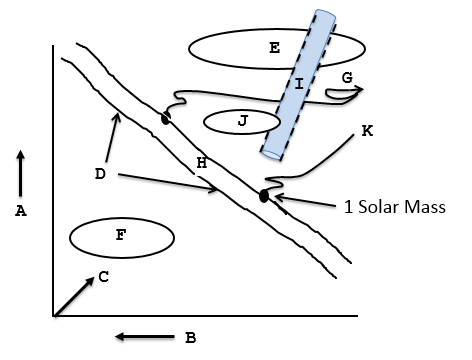 Match the following list of events or labels to the location on the figure. The figure represents the post-main-sequence phase of a large mass star (upper curve) and a low mass star (lower curve). Use one letter for each question. "A", "B", and "C" are the axes of the diagram.
Correct Answer: Verified
Premises:
Responses:
(Matching)
4.8/5 (72)
(72) The helium flash stage will always completely destroy a star and any planets nearby it
(True/False)
4.9/5 (82)
(82) Observing star clusters will give astronomers needed data for stellar evolution because all the stars are the same age.
(True/False)
4.8/5 (75)
(75) 
Filters
- Essay(0)
- Multiple Choice(0)
- Short Answer(0)
- True False(0)
- Matching(0)