



 Chat with AI
Exam 14: Oligopoly and Strategic Behavior

Exam 1: Limits, Alternatives, and Choices107 Questions
Exam 2: The Market System and the Circular Flow287 Questions
Exam 3: Demand, Supply, and Market Equilibrium151 Questions
Exam 4: Market Failures Caused by Externalities Asymmetric Information229 Questions
Exam 5: Public Goods, Public Choice, and Government Failure268 Questions
Exam 6: Elasticity399 Questions
Exam 7: Utility Maximization358 Questions
Exam 8: Behavioral Economics311 Questions
Exam 9: Businesses and the Costs of Production445 Questions
Exam 10: Pure Competition in the Short Run342 Questions
Exam 11: Pure Competition in the Long Run250 Questions
Exam 12: Pure Monopoly407 Questions
Exam 13: Monopolistic Competition279 Questions
Exam 14: Oligopoly and Strategic Behavior362 Questions
Exam 15: Technology, RD, and Efficiency309 Questions
Exam 16: The Demand for Resources359 Questions
Exam 17: Wage Determination168 Questions
Exam 18: Rent, Interest, and Profit305 Questions
Exam 19: Natural Resource and Energy Economics337 Questions
Exam 20: Public Finance: Expenditures and Taxes336 Questions
Exam 21: Antitrust Policy and Regulation264 Questions
Exam 22: Agriculture: Economics and Policy265 Questions
Exam 23: Income Inequality, Poverty, and Discrimination324 Questions
Exam 24: Health Care280 Questions
Exam 25: Immigration259 Questions
Exam 26: International Trade347 Questions
Exam 27: The Balance of Payments, Exchange Rates, and Trade Deficits318 Questions
Exam 28: The Economics of Developing Countries277 Questions
Select questions type


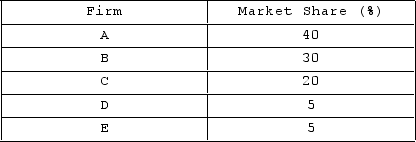 Suppose that Firm B in this table was found guilty of antitrust violations and split into two firms with equal market share. This would cause the Herfindahl index to
 (Multiple Choice)
5.0/5  (75)
(75) Use your basic knowledge and your understanding of market structures to answer this question. Which of the following companies most closely approximates a differentiated oligopolist in a highly concentrated industry?
(Multiple Choice)
4.8/5 (92)
(92) Which of the following best describes the efficiency results in oligopoly?
(Multiple Choice)
4.9/5 (87)
(87) When near-monopolies, like Google in Internet search and Amazon in online shopping, start infringing on each other's turf, what kind of competition results?
(Multiple Choice)
4.9/5 (99)
(99) An industry having a four-firm concentration ratio of 32 percent
(Multiple Choice)
4.9/5 (81)
(81) Industry Y is dominated by five large firms that hold market shares of 20, 20, 25, 10, and 25 percent. The four-firm concentration ratio for this industry is
(Multiple Choice)
4.8/5 (79)
(79) Suppose that an industry is characterized by a few firms and price leadership. We would expect that
(Multiple Choice)
4.7/5 (80)
(80) Price leadership in an oligopoly entails an implicit or tacit form of collusion.
(True/False)
4.8/5 (68)
(68) One common factor that often weakens collusion among cartel members is the incentive to cheat.
(True/False)
4.8/5 (83)
(83) Informal collusion to restrict output and increase prices is sometimes referred to as a
(Multiple Choice)
4.9/5 (88)
(88) If one player in a game has a dominant strategy, the other player must also have a dominant strategy.
(True/False)
4.7/5 (70)
(70) In a zero-sum game, the gains by one player will be exactly offset by the losses of the other.
(True/False)
5.0/5 (78)
(78) 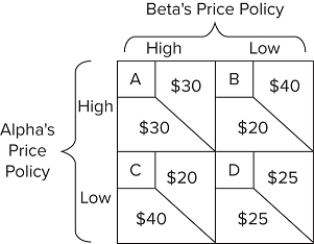 The payoff matrix represents
One inherent factor that tends to destroy collusion among oligopolists is the
(Multiple Choice)
4.9/5 (65)
(65) 
Filters
- Essay(0)
- Multiple Choice(0)
- Short Answer(0)
- True False(0)
- Matching(0)