



 Chat with AI
Exam 14: Oligopoly and Strategic Behavior

Exam 1: Limits, Alternatives, and Choices107 Questions
Exam 2: The Market System and the Circular Flow287 Questions
Exam 3: Demand, Supply, and Market Equilibrium151 Questions
Exam 4: Market Failures Caused by Externalities Asymmetric Information229 Questions
Exam 5: Public Goods, Public Choice, and Government Failure268 Questions
Exam 6: Elasticity399 Questions
Exam 7: Utility Maximization358 Questions
Exam 8: Behavioral Economics311 Questions
Exam 9: Businesses and the Costs of Production445 Questions
Exam 10: Pure Competition in the Short Run342 Questions
Exam 11: Pure Competition in the Long Run250 Questions
Exam 12: Pure Monopoly407 Questions
Exam 13: Monopolistic Competition279 Questions
Exam 14: Oligopoly and Strategic Behavior362 Questions
Exam 15: Technology, RD, and Efficiency309 Questions
Exam 16: The Demand for Resources359 Questions
Exam 17: Wage Determination168 Questions
Exam 18: Rent, Interest, and Profit305 Questions
Exam 19: Natural Resource and Energy Economics337 Questions
Exam 20: Public Finance: Expenditures and Taxes336 Questions
Exam 21: Antitrust Policy and Regulation264 Questions
Exam 22: Agriculture: Economics and Policy265 Questions
Exam 23: Income Inequality, Poverty, and Discrimination324 Questions
Exam 24: Health Care280 Questions
Exam 25: Immigration259 Questions
Exam 26: International Trade347 Questions
Exam 27: The Balance of Payments, Exchange Rates, and Trade Deficits318 Questions
Exam 28: The Economics of Developing Countries277 Questions
Select questions type


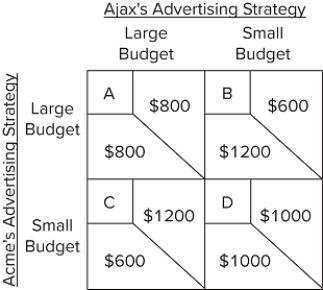 Refer to the game theory matrix, where the numerical data show the profits resulting from alternative combinations of advertising strategies for Ajax and Acme. Ajax's profits are shown in the upper right part of each cell; Acme's profits are shown in the lower left. Without collusion, the outcome of the game
 (Multiple Choice)
4.9/5  (92)
(92) 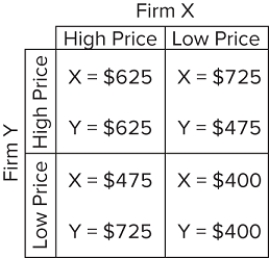 Answer the question based on the payoff matrix for a duopoly in which the numbers indicate the profit in thousands of dollars for a high-price or a low-price strategy. If both firms collude to maximize joint profits, the total profits for the two firms will be
 (Multiple Choice)
4.8/5 (73)
(73) Advertising may be an efficiency-enhancing activity when it results in the following, except when it
(Multiple Choice)
4.9/5 (83)
(83) Generally speaking, oligopolistic industries producing raw materials and semifinished goods usually offer differentiated products, while oligopolists producing consumer goods usually offer standardized products.
(True/False)
4.9/5 (68)
(68) The copper, aluminum, cement, and industrial alcohol industries are examples of
(Multiple Choice)
4.8/5 (78)
(78) 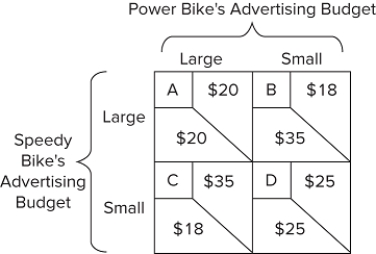 Refer to the payoff matrix. Suppose that Speedy Bike and Power Bike are the only two bicycle manufacturing firms serving the market. Both can choose large or small advertising budgets. If this is a repeated game with no cooperation or reciprocity, cell A
 (Multiple Choice)
4.8/5 (83)
(83) Suppose the only three existing manufacturers of video game players signed a written contract by which each agreed to charge the same price for products and to distribute their products only in the geographical area assigned them in the contract. This best describes
(Multiple Choice)
4.9/5 (85)
(85)  The Herfindahl index for the industry described in this table is
 (Multiple Choice)
4.9/5 (88)
(88) 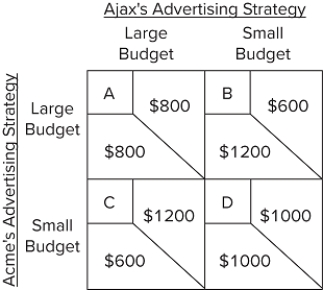 Refer to the game theory matrix, where the numerical data show the profits resulting from alternative combinations of advertising strategies for Ajax and Acme. Ajax's profits are shown in the upper right part of each cell; Acme's profits are shown in the lower left. With collusion and no cheating, the outcome of the game is cell
 (Multiple Choice)
4.8/5 (86)
(86) Suppose the Herfindahl indexes for industries A, B, and C are 2,200, 2,000, and 1,600, respectively. These data imply
(Multiple Choice)
4.9/5 (71)
(71) If a product such as cement or bricks is costly to ship and, therefore, markets are very localized, the national concentration ratio for that industry
(Multiple Choice)
4.9/5 (80)
(80) Which constitutes an obstacle to collusion among oligopolists?
(Multiple Choice)
4.8/5 (82)
(82) If oligopolistic firms facing similar cost and demand conditions successfully collude, price and output results in this industry will be most accurately predicted by which of the following models?
(Multiple Choice)
4.8/5 (74)
(74) Mutual interdependence means that oligopolistic producers rely primarily on price competition in determining their shares of the total market for their product.
(True/False)
4.8/5 (70)
(70) A two-player game in which one player's gain is not completely offset by the other player's loss is called a
(Multiple Choice)
4.8/5 (84)
(84) What two generalizations can be made about the pricing behavior of oligopolists?
(Essay)
4.9/5 (69)
(69) When oligopolists collude, they collectively tend to achieve similar results as a monopolist.
(True/False)
4.9/5 (82)
(82) 
Filters
- Essay(0)
- Multiple Choice(0)
- Short Answer(0)
- True False(0)
- Matching(0)