



 Chat with AI
Exam 14: Oligopoly and Strategic Behavior

Exam 1: Limits, Alternatives, and Choices107 Questions
Exam 2: The Market System and the Circular Flow287 Questions
Exam 3: Demand, Supply, and Market Equilibrium151 Questions
Exam 4: Market Failures Caused by Externalities Asymmetric Information229 Questions
Exam 5: Public Goods, Public Choice, and Government Failure268 Questions
Exam 6: Elasticity399 Questions
Exam 7: Utility Maximization358 Questions
Exam 8: Behavioral Economics311 Questions
Exam 9: Businesses and the Costs of Production445 Questions
Exam 10: Pure Competition in the Short Run342 Questions
Exam 11: Pure Competition in the Long Run250 Questions
Exam 12: Pure Monopoly407 Questions
Exam 13: Monopolistic Competition279 Questions
Exam 14: Oligopoly and Strategic Behavior362 Questions
Exam 15: Technology, RD, and Efficiency309 Questions
Exam 16: The Demand for Resources359 Questions
Exam 17: Wage Determination168 Questions
Exam 18: Rent, Interest, and Profit305 Questions
Exam 19: Natural Resource and Energy Economics337 Questions
Exam 20: Public Finance: Expenditures and Taxes336 Questions
Exam 21: Antitrust Policy and Regulation264 Questions
Exam 22: Agriculture: Economics and Policy265 Questions
Exam 23: Income Inequality, Poverty, and Discrimination324 Questions
Exam 24: Health Care280 Questions
Exam 25: Immigration259 Questions
Exam 26: International Trade347 Questions
Exam 27: The Balance of Payments, Exchange Rates, and Trade Deficits318 Questions
Exam 28: The Economics of Developing Countries277 Questions
Select questions type


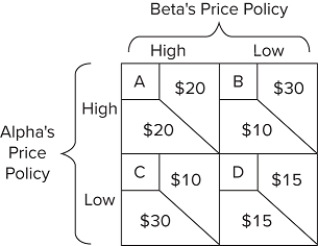 Refer to the diagram, where the numerical data show profits in millions of dollars. Beta's profits are shown in the northeast corner and Alpha's profits in the southwest corner of each cell. Which cell represents a Nash equilibrium?
 (Multiple Choice)
4.8/5  (71)
(71) 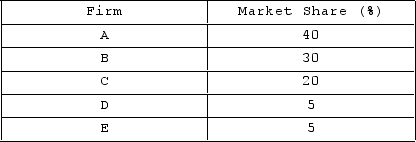 This industry shown in this table illustrates
A cartel of four firms that controls 100 percent of the sales in a market, and faces the same cost schedules of a monopolist, will set a price somewhat lower than the monopoly price for its product.
(True/False)
4.7/5 (81)
(81) What obstacles might a group of oligopolists encounter in forming a cartel?
(Essay)
4.7/5 (77)
(77) 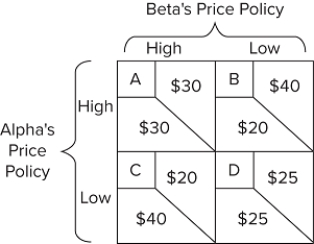 Refer to the payoff matrix. Suppose that Alpha and Beta agree that they will both pursue a high-price strategy. If Beta then cheats on the agreement in order to increase profits, which of the following is true?
 (Multiple Choice)
4.9/5 (75)
(75) Industry Y is dominated by five large firms that hold market shares of 20, 20, 25, 25, and 10. The Herfindahl index for this industry is
(Multiple Choice)
4.9/5 (81)
(81) Suppose the Herfindahl indexes for industries A, B, and C are 7,200, 5,000, and 1,500, respectively. These data imply
(Multiple Choice)
4.9/5 (73)
(73) In game theory, each player is assumed to have the following, except
(Multiple Choice)
4.7/5 (80)
(80) The incentive to cheat within a cartel increases with an increase in the following factors, except
(Multiple Choice)
4.8/5 (69)
(69) Which of the following is an illustration of differentiated oligopoly?
(Multiple Choice)
4.9/5 (65)
(65) Other things equal, cartels and similar collusive arrangements are easier to establish and maintain
(Multiple Choice)
4.8/5 (68)
(68) One would expect that collusion among oligopolistic producers would be easiest to achieve in which of the following cases?
(Multiple Choice)
4.8/5 (85)
(85) Which of the following industries is an illustration of homogeneous oligopoly?
(Multiple Choice)
4.8/5 (86)
(86) The four-firm concentration ratio for the national industry does not capture the effects of all of the following, except
(Multiple Choice)
4.9/5 (95)
(95) 
Filters
- Essay(0)
- Multiple Choice(0)
- Short Answer(0)
- True False(0)
- Matching(0)