



 Chat with AI
Exam 14: Oligopoly and Strategic Behavior

Exam 1: Limits, Alternatives, and Choices107 Questions
Exam 2: The Market System and the Circular Flow287 Questions
Exam 3: Demand, Supply, and Market Equilibrium151 Questions
Exam 4: Market Failures Caused by Externalities Asymmetric Information229 Questions
Exam 5: Public Goods, Public Choice, and Government Failure268 Questions
Exam 6: Elasticity399 Questions
Exam 7: Utility Maximization358 Questions
Exam 8: Behavioral Economics311 Questions
Exam 9: Businesses and the Costs of Production445 Questions
Exam 10: Pure Competition in the Short Run342 Questions
Exam 11: Pure Competition in the Long Run250 Questions
Exam 12: Pure Monopoly407 Questions
Exam 13: Monopolistic Competition279 Questions
Exam 14: Oligopoly and Strategic Behavior362 Questions
Exam 15: Technology, RD, and Efficiency309 Questions
Exam 16: The Demand for Resources359 Questions
Exam 17: Wage Determination168 Questions
Exam 18: Rent, Interest, and Profit305 Questions
Exam 19: Natural Resource and Energy Economics337 Questions
Exam 20: Public Finance: Expenditures and Taxes336 Questions
Exam 21: Antitrust Policy and Regulation264 Questions
Exam 22: Agriculture: Economics and Policy265 Questions
Exam 23: Income Inequality, Poverty, and Discrimination324 Questions
Exam 24: Health Care280 Questions
Exam 25: Immigration259 Questions
Exam 26: International Trade347 Questions
Exam 27: The Balance of Payments, Exchange Rates, and Trade Deficits318 Questions
Exam 28: The Economics of Developing Countries277 Questions
Select questions type


Evaluate the statement: "A market that produces an identical product cannot be an oligopoly. "
(Essay)
4.9/5  (79)
(79) 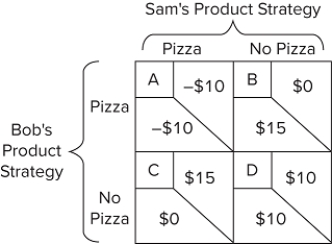 Refer to the payoff matrix. Bob's Burgers and Sam's Sandwiches are competing restaurants in a small town. Both are considering adding pizza to their line of products. If this is a one-time simultaneous game,
 (Multiple Choice)
4.7/5 (76)
(76) 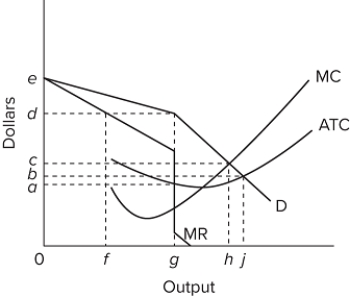 Refer to the diagram. This firm's demand and marginal revenue curves are based on the assumption that
 (Multiple Choice)
4.8/5 (73)
(73) A game has a Nash equilibrium when the two players' dominant strategies
(Multiple Choice)
4.9/5 (76)
(76) In game theory, a "payoff matrix" is a table that shows the following, except
(Multiple Choice)
4.9/5 (81)
(81) Two important characteristics of oligopolists are that they have significant control over price and that there is mutual interdependence among them.
(True/False)
4.8/5 (96)
(96) A zero-sum game is one where a player will always end up gaining nothing, regardless of his strategy.
(True/False)
4.9/5 (72)
(72) You are told that the four-firm concentration ratio in an industry is 16. Based on this information you can conclude that
(Multiple Choice)
4.7/5 (77)
(77) The kinked-demand curve model applies to a noncollusive oligopoly situation.
(True/False)
4.8/5 (79)
(79) A game where players or firms select their optimal strategies for a single time period without regard for possible interactions in subsequent periods is called a
(Multiple Choice)
4.8/5 (81)
(81) Which statement concerning the kinked demand curve model of oligopoly is false?
(Multiple Choice)
4.8/5 (91)
(91) Game-theory models analyze the interdependence of oligopolists' strategies.
(True/False)
4.9/5 (86)
(86)  Suppose that Firm C in this table was found guilty of antitrust violations and split into two firms with equal market share. This would cause the Herfindahl index to
 (Multiple Choice)
4.9/5 (83)
(83) Homogeneous oligopoly exists where a small number of firms are
(Multiple Choice)
4.9/5 (75)
(75) The kinked-demand curve of an oligopolist is based on the assumption that
(Multiple Choice)
4.7/5 (71)
(71) 
Filters
- Essay(0)
- Multiple Choice(0)
- Short Answer(0)
- True False(0)
- Matching(0)