



 Chat with AI
Exam 14: Oligopoly and Strategic Behavior

Exam 1: Limits, Alternatives, and Choices107 Questions
Exam 2: The Market System and the Circular Flow287 Questions
Exam 3: Demand, Supply, and Market Equilibrium151 Questions
Exam 4: Market Failures Caused by Externalities Asymmetric Information229 Questions
Exam 5: Public Goods, Public Choice, and Government Failure268 Questions
Exam 6: Elasticity399 Questions
Exam 7: Utility Maximization358 Questions
Exam 8: Behavioral Economics311 Questions
Exam 9: Businesses and the Costs of Production445 Questions
Exam 10: Pure Competition in the Short Run342 Questions
Exam 11: Pure Competition in the Long Run250 Questions
Exam 12: Pure Monopoly407 Questions
Exam 13: Monopolistic Competition279 Questions
Exam 14: Oligopoly and Strategic Behavior362 Questions
Exam 15: Technology, RD, and Efficiency309 Questions
Exam 16: The Demand for Resources359 Questions
Exam 17: Wage Determination168 Questions
Exam 18: Rent, Interest, and Profit305 Questions
Exam 19: Natural Resource and Energy Economics337 Questions
Exam 20: Public Finance: Expenditures and Taxes336 Questions
Exam 21: Antitrust Policy and Regulation264 Questions
Exam 22: Agriculture: Economics and Policy265 Questions
Exam 23: Income Inequality, Poverty, and Discrimination324 Questions
Exam 24: Health Care280 Questions
Exam 25: Immigration259 Questions
Exam 26: International Trade347 Questions
Exam 27: The Balance of Payments, Exchange Rates, and Trade Deficits318 Questions
Exam 28: The Economics of Developing Countries277 Questions
Select questions type


Game-theory analyzes oligopoly behavior by using concepts derived from the study of games-of-chance such as dice games, solitaire, and roulette.
(True/False)
4.9/5  (81)
(81) A sequential game can be modeled in two forms: payoff-matrix form and game-tree form.
(True/False)
4.9/5 (72)
(72) 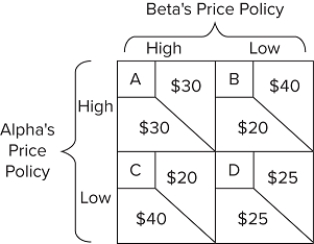 Refer to the payoff matrix. Which cell represents the equilibrium outcome of this game?
 (Multiple Choice)
4.7/5 (68)
(68) A strategy that is better than any alternative strategy-regardless of what the other firm does-is called a
(Multiple Choice)
5.0/5 (88)
(88) 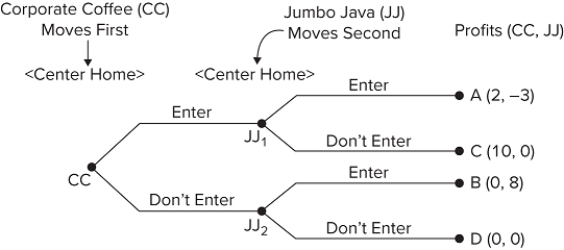 The diagram shows the extensive form version of a strategic game between the two nationally dominant coffee sellers, Corporate Coffee and Jumbo Java, both of whom are considering opening coffee shops in a new town. The payoffs represent, in thousands per month, the profit (or loss)the firm will realize from its decision. Which of the following statements is true about this game?
 (Multiple Choice)
4.9/5 (71)
(71) If an oligopolist's demand curve has a "kink" in it, then over some interval,
(Multiple Choice)
4.8/5 (82)
(82) If an oligopolist's competitors follow its price cuts but ignore its price increases, the oligopolist would end up holding its price constant even if its marginal cost changes.
(True/False)
4.8/5 (57)
(57) 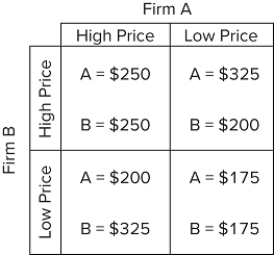 Answer the question based on the payoff matrix for a duopoly in which the numbers indicate the profit in millions of dollars for each firm. If the two firms collude to maximize joint profits, the total profits for the two firms will be
 (Multiple Choice)
4.9/5 (87)
(87) If an oligopolist is faced with a marginal revenue curve that has a gap in it, we may assume that
(Multiple Choice)
4.8/5 (87)
(87) Monopolistic competition and oligopoly are more common in the real world than pure competition and monopoly.
(True/False)
4.8/5 (76)
(76) The kinked-demand curve model helps to explain price rigidity because
(Multiple Choice)
4.9/5 (67)
(67) 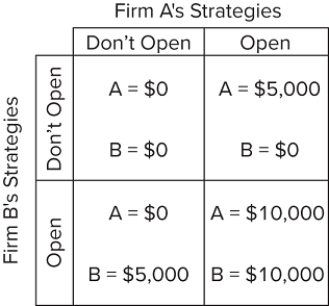 Answer the question based on the payoff matrix for a duopoly in which the numbers indicate the profit from either opening a coffee shop in a small town or not opening the coffee shop. If the firms are playing a sequential game, then
 (Multiple Choice)
4.8/5 (67)
(67) The Herfindahl index for an industry is 2,550. Which of the following sets of market shares and industry with four firms would produce such an index?
(Multiple Choice)
4.9/5 (74)
(74) 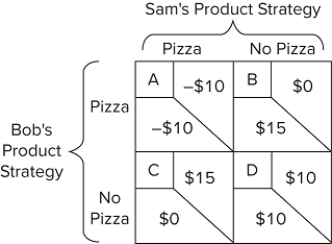 Refer to the payoff matrix. Bob's Burgers and Sam's Sandwiches are competing restaurants in a small town. Both are considering adding pizza to their line of products. If this is a sequential game,
 (Multiple Choice)
4.8/5 (68)
(68) Potential entry by new firms and competition from imports tend to worsen the economic inefficiency in an oligopoly.
(True/False)
5.0/5 (76)
(76) The high concentration ratio for the aluminum industry understates the competition in that industry that comes from the copper industry. This is an example of
(Multiple Choice)
4.8/5 (59)
(59) If the four-firm concentration ratio for industry X is 60,
(Multiple Choice)
4.9/5 (79)
(79) 
Filters
- Essay(0)
- Multiple Choice(0)
- Short Answer(0)
- True False(0)
- Matching(0)