



 Chat with AI
Exam 14: Oligopoly and Strategic Behavior

Exam 1: Limits, Alternatives, and Choices107 Questions
Exam 2: The Market System and the Circular Flow287 Questions
Exam 3: Demand, Supply, and Market Equilibrium151 Questions
Exam 4: Market Failures Caused by Externalities Asymmetric Information229 Questions
Exam 5: Public Goods, Public Choice, and Government Failure268 Questions
Exam 6: Elasticity399 Questions
Exam 7: Utility Maximization358 Questions
Exam 8: Behavioral Economics311 Questions
Exam 9: Businesses and the Costs of Production445 Questions
Exam 10: Pure Competition in the Short Run342 Questions
Exam 11: Pure Competition in the Long Run250 Questions
Exam 12: Pure Monopoly407 Questions
Exam 13: Monopolistic Competition279 Questions
Exam 14: Oligopoly and Strategic Behavior362 Questions
Exam 15: Technology, RD, and Efficiency309 Questions
Exam 16: The Demand for Resources359 Questions
Exam 17: Wage Determination168 Questions
Exam 18: Rent, Interest, and Profit305 Questions
Exam 19: Natural Resource and Energy Economics337 Questions
Exam 20: Public Finance: Expenditures and Taxes336 Questions
Exam 21: Antitrust Policy and Regulation264 Questions
Exam 22: Agriculture: Economics and Policy265 Questions
Exam 23: Income Inequality, Poverty, and Discrimination324 Questions
Exam 24: Health Care280 Questions
Exam 25: Immigration259 Questions
Exam 26: International Trade347 Questions
Exam 27: The Balance of Payments, Exchange Rates, and Trade Deficits318 Questions
Exam 28: The Economics of Developing Countries277 Questions
Select questions type


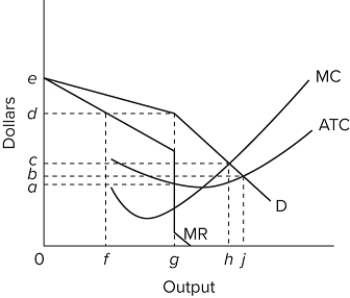 Refer to the diagram. Equilibrium price is

If three or four homogeneous oligopolists collude, the resulting price and production outcomes will be similar to those of pure monopoly.
(True/False)
5.0/5  (79)
(79) 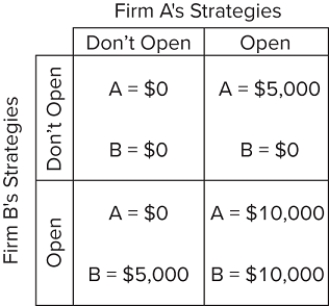 Answer the question based on the payoff matrix for a duopoly in which the numbers indicate the profit from either opening a coffee shop in a small town or not opening the coffee shop. If both firms choose their strategies simultaneously, then
 (Multiple Choice)
4.7/5 (83)
(83) Game theory is best suited to analyze the pricing behavior of
(Multiple Choice)
4.8/5 (79)
(79) Zippy's and Tony's are rival pizza restaurants in a small town. (Together they form a local duopoly.)Zippy's management determines that if it increases its advertising expenditures, it will increase profits regardless of whether Tony's increases its advertising budget. Based on this information, we can conclude that
(Multiple Choice)
4.8/5 (63)
(63) The U.S. steel industry is an example of homogeneous oligopoly.
(True/False)
4.8/5 (90)
(90) Which of the following factors tends to foster the development of an oligopoly?
(Multiple Choice)
4.8/5 (75)
(75) Mutual interdependence refers to the situation when entry by new firms into an industry will tend to shrink the profits of existing firms.
(True/False)
4.8/5 (74)
(74) Answer the question based on the payoff matrices for a repeated game involving two firms that are considering introducing new products to the market. The numbers indicate the profit from following either a strategy to introduce a new product or a strategy to not introduce a new product.First game. 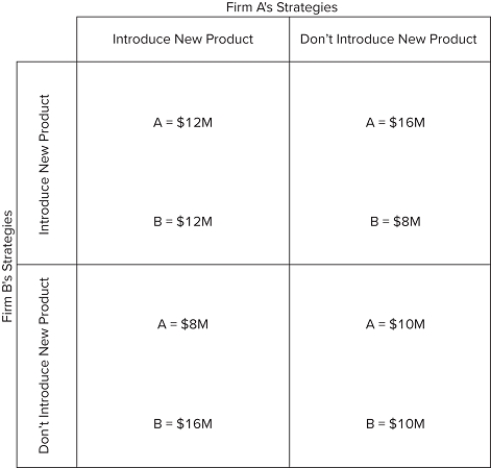 Second game.
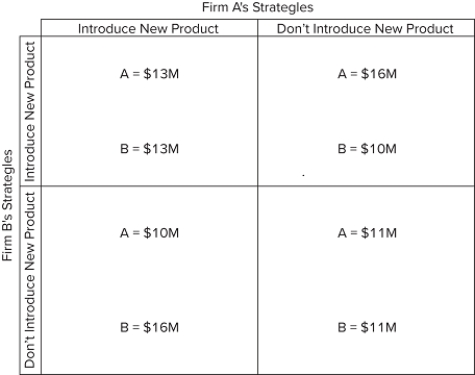 In the first game,
Second game. In the first game, (Multiple Choice)
4.8/5 (84)
(84) The Herfindahl index for an industry is 3,000. Which of the following sets of market shares and industry with four firms would produce such an index?
(Multiple Choice)
4.9/5 (68)
(68) 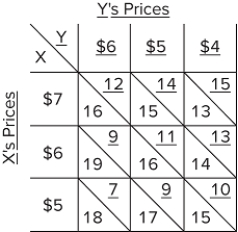 Refer to the profits-payoff table for a duopoly. If initially firm X's price was $6 and Y's price was $5,
 (Multiple Choice)
4.8/5 (83)
(83) 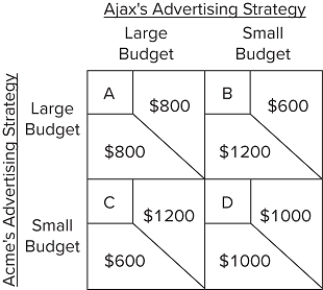 Refer to the game theory matrix, where the numerical data show the profits resulting from alternative combinations of advertising strategies for Ajax and Acme. Ajax's profits are shown in the upper right part of each cell; Acme's profits are shown in the lower left. Without collusion, Nash equilibrium is represented by which cell?
 (Multiple Choice)
4.9/5 (91)
(91) 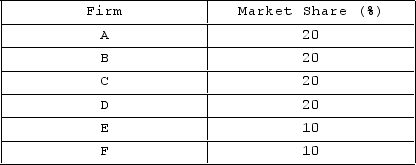 The industry characterized by these data is
What would you expect the concentration ratio and Herfindahl index of the Internet search industry to look like?
(Essay)
4.9/5 (78)
(78) 
Filters
- Essay(0)
- Multiple Choice(0)
- Short Answer(0)
- True False(0)
- Matching(0)