



 Chat with AI
Exam 14: Oligopoly and Strategic Behavior

Exam 1: Limits, Alternatives, and Choices107 Questions
Exam 2: The Market System and the Circular Flow287 Questions
Exam 3: Demand, Supply, and Market Equilibrium151 Questions
Exam 4: Market Failures Caused by Externalities Asymmetric Information229 Questions
Exam 5: Public Goods, Public Choice, and Government Failure268 Questions
Exam 6: Elasticity399 Questions
Exam 7: Utility Maximization358 Questions
Exam 8: Behavioral Economics311 Questions
Exam 9: Businesses and the Costs of Production445 Questions
Exam 10: Pure Competition in the Short Run342 Questions
Exam 11: Pure Competition in the Long Run250 Questions
Exam 12: Pure Monopoly407 Questions
Exam 13: Monopolistic Competition279 Questions
Exam 14: Oligopoly and Strategic Behavior362 Questions
Exam 15: Technology, RD, and Efficiency309 Questions
Exam 16: The Demand for Resources359 Questions
Exam 17: Wage Determination168 Questions
Exam 18: Rent, Interest, and Profit305 Questions
Exam 19: Natural Resource and Energy Economics337 Questions
Exam 20: Public Finance: Expenditures and Taxes336 Questions
Exam 21: Antitrust Policy and Regulation264 Questions
Exam 22: Agriculture: Economics and Policy265 Questions
Exam 23: Income Inequality, Poverty, and Discrimination324 Questions
Exam 24: Health Care280 Questions
Exam 25: Immigration259 Questions
Exam 26: International Trade347 Questions
Exam 27: The Balance of Payments, Exchange Rates, and Trade Deficits318 Questions
Exam 28: The Economics of Developing Countries277 Questions
Select questions type


 Refer to the data. Suppose that firms A and F merged into a single firm. The four-firm concentration ratio and the Herfindahl index would be
 (Multiple Choice)
4.9/5  (65)
(65) Nash equilibrium is an outcome of a game from which neither rival will want to deviate.
(True/False)
4.9/5 (62)
(62) In some games, one firm may avoid taking advantage of another firm because it knows that the other firm can take advantage of it in subsequent games. This behavior is called
(Multiple Choice)
4.7/5 (64)
(64) 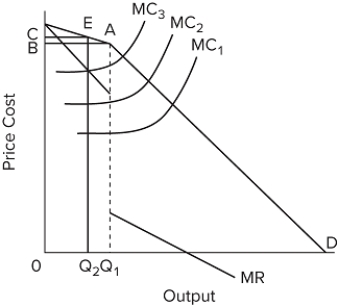 On the graph, if the oligopolist's MC curve shifts from MC ₁ to MC ₂, the firm will charge
 (Multiple Choice)
4.9/5 (69)
(69) Industries X and Y both have four-firm concentration ratios of 53 percent, but the Herfindahl index for X is 1,965, while that for Y is 2,019. These data suggest
(Multiple Choice)
4.7/5 (85)
(85) Assume six firms composing an industry have market shares of 30, 30, 10, 10, 10, and 10 percent. The Herfindahl index for this industry is
(Multiple Choice)
4.8/5 (87)
(87) Aluminum competes with copper in the market for power transmission lines. This illustrates
(Multiple Choice)
4.8/5 (84)
(84) Differentiated oligopoly exists where a small number of firms are
(Multiple Choice)
4.8/5 (81)
(81) Patents and copyrights were established by the government to reduce oligopoly and monopoly power.
(True/False)
4.8/5 (83)
(83) Game theory, which is used in studying oligopoly behavior, originated from the study of games such as the following, except
(Multiple Choice)
4.8/5 (89)
(89) How is the prisoner's dilemma similar to two firms competing for market share as described in the text?
(Essay)
4.8/5 (81)
(81) A potential negative effect of advertising for society is that it can
(Multiple Choice)
4.8/5 (70)
(70) 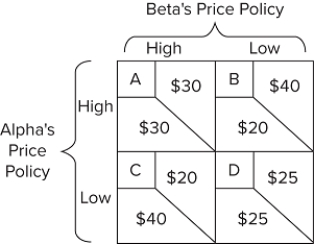 In this payoff matrix,
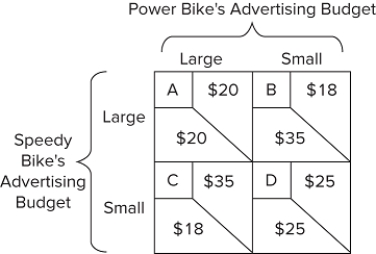 Refer to the payoff matrix. Suppose that Speedy Bike and Power Bike are the only two bicycle manufacturing firms serving the market. Both can choose large or small advertising budgets. If this is a repeated game and the firms cooperate to maximize profits, which of the following outcomes would we expect to occur?
 (Multiple Choice)
4.9/5 (76)
(76) Firms are more likely to collude when the economy is in a recession.
(True/False)
4.8/5 (75)
(75) 
Filters
- Essay(0)
- Multiple Choice(0)
- Short Answer(0)
- True False(0)
- Matching(0)