



 Chat with AI
Exam 14: Oligopoly and Strategic Behavior

Exam 1: Limits, Alternatives, and Choices107 Questions
Exam 2: The Market System and the Circular Flow287 Questions
Exam 3: Demand, Supply, and Market Equilibrium151 Questions
Exam 4: Market Failures Caused by Externalities Asymmetric Information229 Questions
Exam 5: Public Goods, Public Choice, and Government Failure268 Questions
Exam 6: Elasticity399 Questions
Exam 7: Utility Maximization358 Questions
Exam 8: Behavioral Economics311 Questions
Exam 9: Businesses and the Costs of Production445 Questions
Exam 10: Pure Competition in the Short Run342 Questions
Exam 11: Pure Competition in the Long Run250 Questions
Exam 12: Pure Monopoly407 Questions
Exam 13: Monopolistic Competition279 Questions
Exam 14: Oligopoly and Strategic Behavior362 Questions
Exam 15: Technology, RD, and Efficiency309 Questions
Exam 16: The Demand for Resources359 Questions
Exam 17: Wage Determination168 Questions
Exam 18: Rent, Interest, and Profit305 Questions
Exam 19: Natural Resource and Energy Economics337 Questions
Exam 20: Public Finance: Expenditures and Taxes336 Questions
Exam 21: Antitrust Policy and Regulation264 Questions
Exam 22: Agriculture: Economics and Policy265 Questions
Exam 23: Income Inequality, Poverty, and Discrimination324 Questions
Exam 24: Health Care280 Questions
Exam 25: Immigration259 Questions
Exam 26: International Trade347 Questions
Exam 27: The Balance of Payments, Exchange Rates, and Trade Deficits318 Questions
Exam 28: The Economics of Developing Countries277 Questions
Select questions type


An industry having a four-firm concentration ratio of 85 percent
(Multiple Choice)
4.9/5  (84)
(84) Mutual interdependence means that each firm in an oligopoly
(Multiple Choice)
5.0/5 (74)
(74) In game theory, sequential games can be displayed or summarized in two forms,
(Multiple Choice)
4.9/5 (77)
(77) In repeated games, credible threats are necessary for the players to reach a Nash equilibrium.
(True/False)
4.9/5 (75)
(75) If an oligopoly is faced with a kinked-demand curve that is relatively elastic above and relatively inelastic below the going price, then it will
(Multiple Choice)
4.9/5 (77)
(77) In a duopoly, if one firm increases its price, then the other firm can
(Multiple Choice)
4.8/5 (74)
(74) The first mover in a sequential game always has the advantage over the second mover.
(True/False)
4.8/5 (76)
(76) The Organization of Petroleum Exporting Countries (OPEC)is an international cartel. If the cartel were to hire a consulting firm to monitor the production rates of member countries, the economic reason for this monitoring would be to
(Multiple Choice)
5.0/5 (81)
(81) Suppose an oligopolistic producer assumes its rivals will ignore a price increase but match a price cut. In this case the firm perceives its
(Multiple Choice)
4.7/5 (63)
(63) 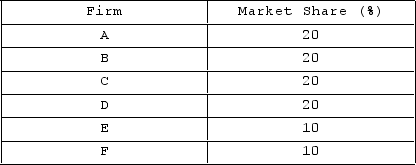 The four-firm concentration ratio for the industry described in this table is
 (Multiple Choice)
4.9/5 (81)
(81) 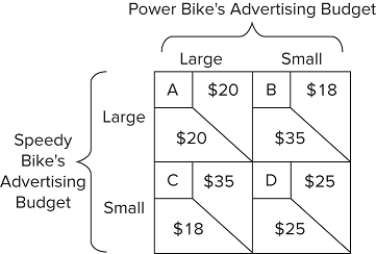 Refer to the payoff matrix. Suppose that Speedy Bike and Power Bike are the only two bicycle manufacturing firms serving the market. Both can choose large or small advertising budgets. Is there a Nash equilibrium solution to this game?
 (Multiple Choice)
4.7/5 (82)
(82) In 2018, advertising expenditures in the United States were
(Multiple Choice)
4.8/5 (78)
(78) Describe the essential features of the kinked-demand model of oligopoly pricing.
(Essay)
4.9/5 (71)
(71) In which of these continuums of degrees of competition (lowest to highest)is oligopoly properly placed?
(Multiple Choice)
4.8/5 (70)
(70) One major problem with four-firm concentration ratios is that they fail to take into account
(Multiple Choice)
4.7/5 (84)
(84) 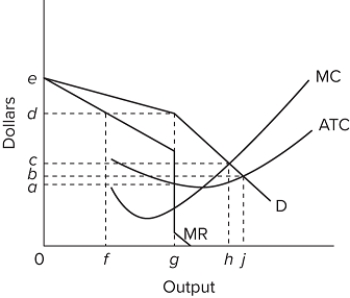 Refer to the diagram. In equilibrium the firm

Filters
- Essay(0)
- Multiple Choice(0)
- Short Answer(0)
- True False(0)
- Matching(0)