



 Chat with AI
Exam 20: Public Finance: Expenditures and Taxes

Exam 1: Limits, Alternatives, and Choices107 Questions
Exam 2: The Market System and the Circular Flow287 Questions
Exam 3: Demand, Supply, and Market Equilibrium151 Questions
Exam 4: Market Failures Caused by Externalities Asymmetric Information229 Questions
Exam 5: Public Goods, Public Choice, and Government Failure268 Questions
Exam 6: Elasticity399 Questions
Exam 7: Utility Maximization358 Questions
Exam 8: Behavioral Economics311 Questions
Exam 9: Businesses and the Costs of Production445 Questions
Exam 10: Pure Competition in the Short Run342 Questions
Exam 11: Pure Competition in the Long Run250 Questions
Exam 12: Pure Monopoly407 Questions
Exam 13: Monopolistic Competition279 Questions
Exam 14: Oligopoly and Strategic Behavior362 Questions
Exam 15: Technology, RD, and Efficiency309 Questions
Exam 16: The Demand for Resources359 Questions
Exam 17: Wage Determination168 Questions
Exam 18: Rent, Interest, and Profit305 Questions
Exam 19: Natural Resource and Energy Economics337 Questions
Exam 20: Public Finance: Expenditures and Taxes336 Questions
Exam 21: Antitrust Policy and Regulation264 Questions
Exam 22: Agriculture: Economics and Policy265 Questions
Exam 23: Income Inequality, Poverty, and Discrimination324 Questions
Exam 24: Health Care280 Questions
Exam 25: Immigration259 Questions
Exam 26: International Trade347 Questions
Exam 27: The Balance of Payments, Exchange Rates, and Trade Deficits318 Questions
Exam 28: The Economics of Developing Countries277 Questions
Select questions type


Joe complains that 32 percent of his income last year went to taxes. He is referring to his
(Multiple Choice)
4.9/5  (59)
(59) What are the problems encountered in a strict application of the ability-to-pay principle of taxation?
(Essay)
4.9/5 (73)
(73) Assume that in year 1 your average tax rate is 10 percent on a taxable income of $10,000. If the marginal tax rate on the next $10,000 of taxable income is 15 percent, what will be the average tax rate if your taxable income rises to $20,000?
(Multiple Choice)
4.7/5 (86)
(86) 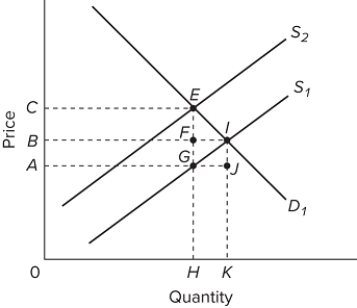 The graph represents the market for a product where D ₁ and S ₁ show the initial supply and demand curves, and supply shifts to S ₂ due to a sales tax. The government's tax revenue is represented by area
 (Multiple Choice)
4.9/5 (86)
(86) The supply of meat is more elastic in the long run than in the short run. Ceteris paribus, as time goes by, the burden of a tax on cattle will increasingly be shouldered by the
(Multiple Choice)
4.9/5 (70)
(70) Suppose that government imposes a specific excise tax on product X of $2 per unit and that the price elasticity of demand for X is unitary (coefficient = 1). If the incidence of the tax is such that the producers of X pay $1.75 of the tax and the consumers pay $0.25, we can conclude that the
(Multiple Choice)
4.9/5 (77)
(77) Which of the following statements about state lotteries is false?
(Multiple Choice)
4.8/5 (60)
(60) If the tax on gasoline is increased, gas stations are most likely to pass most of this increase to the consumer if the demand is
(Multiple Choice)
4.7/5 (80)
(80) 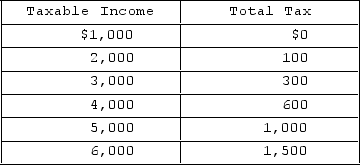 Refer to the income tax schedule given in the table. If your taxable income is $4,000, your average tax rate will be
 (Multiple Choice)
4.8/5 (83)
(83) 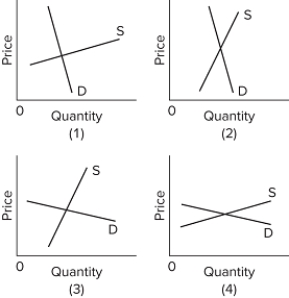 In which of the given market situations will the largest portion of an excise tax of a specified amount per unit of output be borne by buyers?
 (Multiple Choice)
5.0/5 (98)
(98) 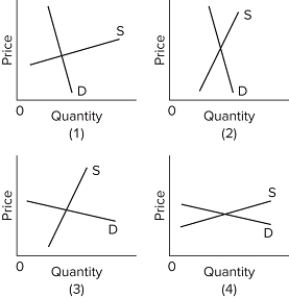 In which of the given market situations will the burden of a tax be borne more or less equally between buyers and sellers?
 (Multiple Choice)
4.9/5 (63)
(63) The tax rates embodied in the federal personal income tax are such that
(Multiple Choice)
4.8/5 (87)
(87) Suppose that government imposes a specific excise tax on product X of $2 per unit and that the price elasticity of supply of X is unitary (coefficient = 1). If the incidence of the tax is such that the consumers of X pay $1.85 of the tax and the producers pay $0.15, we can conclude that the
(Multiple Choice)
4.9/5 (81)
(81) Which of the following statements about specific excise taxes is true?
(Multiple Choice)
5.0/5 (75)
(75) 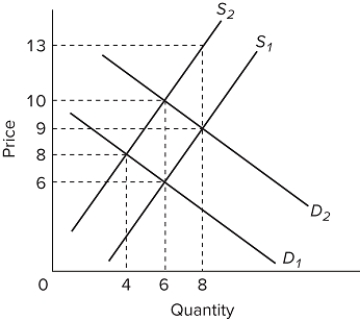 Refer to the graph. Assume the market for this product is in equilibrium at the intersection of D ₂ and S ₁. The shift in supply from S ₁ to S ₂ is due to an excise tax imposed on the product. The incidence of the tax is
 (Multiple Choice)
4.9/5 (80)
(80) Sales taxes on consumer goods are regressive because poor people consume a larger proportion of their incomes than do rich people.
(True/False)
4.8/5 (79)
(79) With a tax of $2,000 on $30,000 of income and $2,000 on $70,000 of income, we can describe the structure of this tax as
(Multiple Choice)
4.9/5 (84)
(84) Which is the most important source of tax revenue for local governments?
(Multiple Choice)
4.9/5 (74)
(74) 
Filters
- Essay(0)
- Multiple Choice(0)
- Short Answer(0)
- True False(0)
- Matching(0)