



 Chat with AI
Exam 20: Public Finance: Expenditures and Taxes

Exam 1: Limits, Alternatives, and Choices107 Questions
Exam 2: The Market System and the Circular Flow287 Questions
Exam 3: Demand, Supply, and Market Equilibrium151 Questions
Exam 4: Market Failures Caused by Externalities Asymmetric Information229 Questions
Exam 5: Public Goods, Public Choice, and Government Failure268 Questions
Exam 6: Elasticity399 Questions
Exam 7: Utility Maximization358 Questions
Exam 8: Behavioral Economics311 Questions
Exam 9: Businesses and the Costs of Production445 Questions
Exam 10: Pure Competition in the Short Run342 Questions
Exam 11: Pure Competition in the Long Run250 Questions
Exam 12: Pure Monopoly407 Questions
Exam 13: Monopolistic Competition279 Questions
Exam 14: Oligopoly and Strategic Behavior362 Questions
Exam 15: Technology, RD, and Efficiency309 Questions
Exam 16: The Demand for Resources359 Questions
Exam 17: Wage Determination168 Questions
Exam 18: Rent, Interest, and Profit305 Questions
Exam 19: Natural Resource and Energy Economics337 Questions
Exam 20: Public Finance: Expenditures and Taxes336 Questions
Exam 21: Antitrust Policy and Regulation264 Questions
Exam 22: Agriculture: Economics and Policy265 Questions
Exam 23: Income Inequality, Poverty, and Discrimination324 Questions
Exam 24: Health Care280 Questions
Exam 25: Immigration259 Questions
Exam 26: International Trade347 Questions
Exam 27: The Balance of Payments, Exchange Rates, and Trade Deficits318 Questions
Exam 28: The Economics of Developing Countries277 Questions
Select questions type


(Advanced analysis)The equations for the demand and supply curves for a particular product are P = 10 − 0.4 Q and P = 2 + 0.4 Q, where P is price and Q is quantity expressed in units of 100. After an excise tax is imposed on the product, the supply equation is P = 3 + 0.4 Q. The equilibrium quantity before the excise tax is imposed is
(Multiple Choice)
4.9/5  (79)
(79) At the state and local levels of the U.S. government, a majority of government employees work in which of the following areas?
(Multiple Choice)
4.8/5 (84)
(84) Assume that in year 1 you pay an average tax rate of 25 percent on a taxable income of $50,000. In year 2, you pay an average tax rate of 30 percent on a taxable income of $75,000. Assuming no change in tax rates, the marginal tax rate on your additional $25,000 of income is
(Multiple Choice)
4.9/5 (83)
(83) Approximately what percentage of the federal government's tax revenues are generated from personal income taxes (in 2018)?
(Multiple Choice)
4.9/5 (68)
(68) The following are government activities that are involved in public finance, except
(Multiple Choice)
4.8/5 (77)
(77) In 2016, U.S. governments (local, state, and federal)employed roughly what percentage of the U.S. labor force?
(Multiple Choice)
4.8/5 (71)
(71) 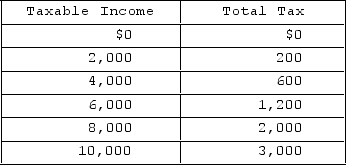 Refer to the personal income tax schedule given in the table. This tax is such that the after-tax distribution of income will be
 (Multiple Choice)
4.8/5 (79)
(79) In 2016, the top 5 percent of income-tax filers paid what portion of the total U.S. federal income tax?
(Multiple Choice)
4.8/5 (73)
(73) What are the major expenditures of state governments? What are the major sources of tax revenue?
(Essay)
4.8/5 (70)
(70) Define public finance. What are the three sources of funding for governments?
(Essay)
4.7/5 (79)
(79) If taxes are $2,000 when income is $15,000 and they are $3,000 when income is $19,000, then the marginal tax rate is
(Multiple Choice)
4.8/5 (72)
(72)  In the diagram, solid arrows reflect real flows, while broken arrows are monetary flows. Flow (3)might represent
 (Multiple Choice)
4.7/5 (74)
(74) Overall, the U.S. tax system (combined federal, state, and local)is
(Multiple Choice)
4.8/5 (77)
(77) In 2012, households in the top income quintile received about
(Multiple Choice)
5.0/5 (86)
(86) In 2018, "Tax-Freedom Day" (the day average workers have earned enough to pay their tax bills)was
(Multiple Choice)
4.8/5 (67)
(67) If the taxes by state and local governments were combined with the federal tax system, the overall tax structure in the U.S. would best be characterized as
(Multiple Choice)
4.8/5 (69)
(69) Entry fees at national parks and monuments are an example of
(Multiple Choice)
4.8/5 (89)
(89) 
Filters
- Essay(0)
- Multiple Choice(0)
- Short Answer(0)
- True False(0)
- Matching(0)