



 Chat with AI
Exam 20: Public Finance: Expenditures and Taxes

Exam 1: Limits, Alternatives, and Choices107 Questions
Exam 2: The Market System and the Circular Flow287 Questions
Exam 3: Demand, Supply, and Market Equilibrium151 Questions
Exam 4: Market Failures Caused by Externalities Asymmetric Information229 Questions
Exam 5: Public Goods, Public Choice, and Government Failure268 Questions
Exam 6: Elasticity399 Questions
Exam 7: Utility Maximization358 Questions
Exam 8: Behavioral Economics311 Questions
Exam 9: Businesses and the Costs of Production445 Questions
Exam 10: Pure Competition in the Short Run342 Questions
Exam 11: Pure Competition in the Long Run250 Questions
Exam 12: Pure Monopoly407 Questions
Exam 13: Monopolistic Competition279 Questions
Exam 14: Oligopoly and Strategic Behavior362 Questions
Exam 15: Technology, RD, and Efficiency309 Questions
Exam 16: The Demand for Resources359 Questions
Exam 17: Wage Determination168 Questions
Exam 18: Rent, Interest, and Profit305 Questions
Exam 19: Natural Resource and Energy Economics337 Questions
Exam 20: Public Finance: Expenditures and Taxes336 Questions
Exam 21: Antitrust Policy and Regulation264 Questions
Exam 22: Agriculture: Economics and Policy265 Questions
Exam 23: Income Inequality, Poverty, and Discrimination324 Questions
Exam 24: Health Care280 Questions
Exam 25: Immigration259 Questions
Exam 26: International Trade347 Questions
Exam 27: The Balance of Payments, Exchange Rates, and Trade Deficits318 Questions
Exam 28: The Economics of Developing Countries277 Questions
Select questions type


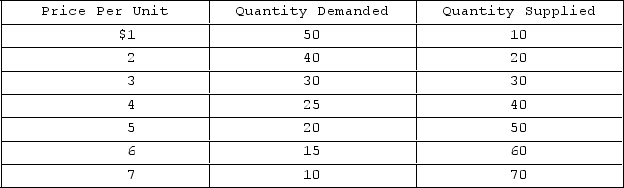 The table gives data for the market for a product. If an excise tax of $3 per unit is imposed on this product, the new equilibrium price with tax will be
 (Multiple Choice)
4.9/5  (80)
(80) Assume that in year 1 you pay an average tax rate of 20 percent on a taxable income of $20,000. In year 2, you pay an average tax rate of 25 percent on a taxable income of $30,000. Assuming no change in tax rates, the marginal tax rate on your additional $10,000 of income is
(Multiple Choice)
4.9/5 (77)
(77) The largest source of tax revenue for the U.S. federal government is
(Multiple Choice)
5.0/5 (90)
(90) Transfer payments are "exhaustive" in that they directly absorb resources, whereas government purchases are "nonexhaustive."
(True/False)
4.9/5 (77)
(77) 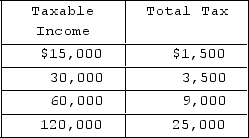 The table represents a personal income tax schedule. If income increases from $15,000 to $30,000, the marginal tax rate is
 (Multiple Choice)
4.9/5 (90)
(90) 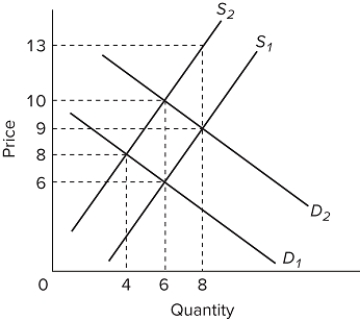 Refer to the graph. Assume the market for this product is initially in equilibrium at the intersection of D ₂ and S ₁. The shift in supply from S ₁ to S ₂ is due to an excise tax imposed on the product. The excise tax revenue collected by the government will be
 (Multiple Choice)
4.9/5 (77)
(77) The probable incidence of the tax on business property is on consumers.
(True/False)
4.9/5 (69)
(69) 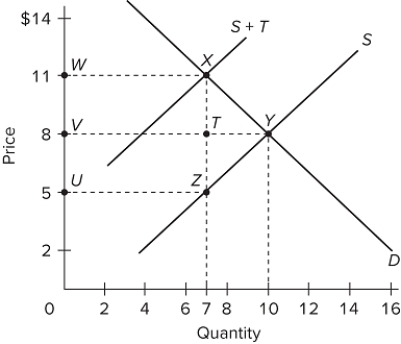 The graph illustrates the market for a product on which an excise tax has been imposed by government. What is the area that represents the portion of the excise tax that is the burden to consumers?
 (Multiple Choice)
4.8/5 (77)
(77) The two largest sources of tax revenue for the U.S. federal government are
(Multiple Choice)
4.8/5 (66)
(66) The overall tax structure of the United States is proportional or slightly regressive.
(True/False)
4.8/5 (72)
(72) The largest expenditure of the U.S. federal government is for
(Multiple Choice)
4.9/5 (80)
(80) 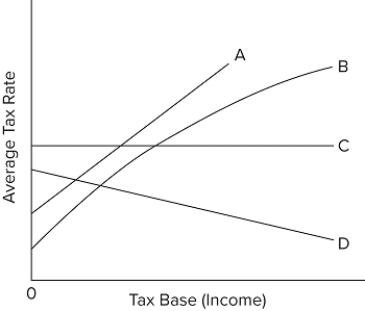 Which of the lines in the diagram represent(s)a progressive tax?
 (Multiple Choice)
4.9/5 (75)
(75) Federal employment in the United States is dominated by what two functions?
(Multiple Choice)
4.7/5 (74)
(74) (Advanced analysis)The equations for the demand and supply curves for a particular product are P = 10 − 0.4 Q and P = 2 + 0.4 Q, where P is price and Q is quantity expressed in units of 100. After an excise tax is imposed on the product, the supply equation is P = 4 + 0.4 Q. The equilibrium quantity before the excise tax is imposed is
(Multiple Choice)
4.8/5 (76)
(76)  In the diagram, solid arrows reflect real flows, while broken arrows are monetary flows. Flow (4)might represent
 (Multiple Choice)
5.0/5 (93)
(93) 
Filters
- Essay(0)
- Multiple Choice(0)
- Short Answer(0)
- True False(0)
- Matching(0)