



 Chat with AI
Exam 20: Public Finance: Expenditures and Taxes

Exam 1: Limits, Alternatives, and Choices107 Questions
Exam 2: The Market System and the Circular Flow287 Questions
Exam 3: Demand, Supply, and Market Equilibrium151 Questions
Exam 4: Market Failures Caused by Externalities Asymmetric Information229 Questions
Exam 5: Public Goods, Public Choice, and Government Failure268 Questions
Exam 6: Elasticity399 Questions
Exam 7: Utility Maximization358 Questions
Exam 8: Behavioral Economics311 Questions
Exam 9: Businesses and the Costs of Production445 Questions
Exam 10: Pure Competition in the Short Run342 Questions
Exam 11: Pure Competition in the Long Run250 Questions
Exam 12: Pure Monopoly407 Questions
Exam 13: Monopolistic Competition279 Questions
Exam 14: Oligopoly and Strategic Behavior362 Questions
Exam 15: Technology, RD, and Efficiency309 Questions
Exam 16: The Demand for Resources359 Questions
Exam 17: Wage Determination168 Questions
Exam 18: Rent, Interest, and Profit305 Questions
Exam 19: Natural Resource and Energy Economics337 Questions
Exam 20: Public Finance: Expenditures and Taxes336 Questions
Exam 21: Antitrust Policy and Regulation264 Questions
Exam 22: Agriculture: Economics and Policy265 Questions
Exam 23: Income Inequality, Poverty, and Discrimination324 Questions
Exam 24: Health Care280 Questions
Exam 25: Immigration259 Questions
Exam 26: International Trade347 Questions
Exam 27: The Balance of Payments, Exchange Rates, and Trade Deficits318 Questions
Exam 28: The Economics of Developing Countries277 Questions
Select questions type


 The table shows four tax schedules for the given base of taxable income. Which of the tax schedules is a regressive tax schedule throughout?
 (Multiple Choice)
4.9/5  (75)
(75)  In the diagram, solid arrows reflect real flows, while broken arrows are monetary flows. Flow (8)might represent
 (Multiple Choice)
4.8/5 (79)
(79) From 1960 to 2018, as percentages of U.S. output, government purchases have
(Multiple Choice)
4.8/5 (74)
(74) 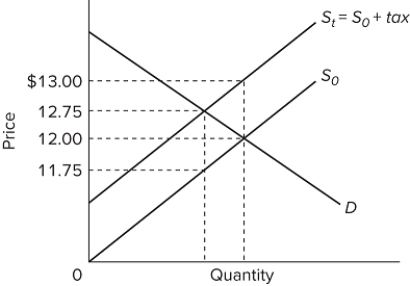 The graph shows the supply curve for a product before tax ( S ₀ )and after an excise tax is imposed ( S ₁). If 500 units of the product are sold after the tax is imposed, the amount of the tax borne by the consumer is
 (Multiple Choice)
5.0/5 (70)
(70) If each taxpayer paid the same lump-sum amount regardless of income level, the tax system would be
(Multiple Choice)
4.9/5 (87)
(87) If everyone pays a fixed dollar amount of tax, then the tax is a
(Multiple Choice)
4.8/5 (94)
(94) A tax that takes a larger proportion of income from low-income groups than from high-income groups is a
(Multiple Choice)
4.8/5 (69)
(69) If you pay a $2,000 tax on $10,000 of taxable income and a $4,000 tax on a taxable income of $16,000, the tax is progressive.
(True/False)
4.8/5 (80)
(80) (Advanced analysis)The equations for the demand and supply curves for a particular product are P = 10 − 0.4 Q and P = 2 + 0.4 Q, where P is price and Q is quantity expressed in units of 100. After an excise tax is imposed on the product, the supply equation is P = 3 + 0.4 Q. The efficiency loss of this tax is
(Multiple Choice)
4.7/5 (74)
(74) What are the problems encountered in a strict application of the benefits-received principle of taxation?
(Essay)
4.9/5 (91)
(91) Sales and excise taxes are levied on retailers, but retailers add these taxes to the prices of their products. This illustrates the
(Multiple Choice)
4.9/5 (67)
(67) Corporate income taxes contribute more to federal tax revenues than do personal income taxes.
(True/False)
4.9/5 (80)
(80) Compare the progressivity of the U.S. tax system to that of other OECD countries.
(Essay)
4.9/5 (89)
(89) Many states in the U.S. acquire significant amounts of funds from the following, except
(Multiple Choice)
4.9/5 (67)
(67) The levying of licensing fees for automobiles is an example of taxation based on the ability-to-pay principle.
(True/False)
4.9/5 (80)
(80) In 2017, based on data from the OECD, the government's total tax revenue as a percentage of total output was highest in which of the following nations?
(Multiple Choice)
4.9/5 (81)
(81) 
Filters
- Essay(0)
- Multiple Choice(0)
- Short Answer(0)
- True False(0)
- Matching(0)