



 Chat with AI
Exam 20: Public Finance: Expenditures and Taxes

Exam 1: Limits, Alternatives, and Choices107 Questions
Exam 2: The Market System and the Circular Flow287 Questions
Exam 3: Demand, Supply, and Market Equilibrium151 Questions
Exam 4: Market Failures Caused by Externalities Asymmetric Information229 Questions
Exam 5: Public Goods, Public Choice, and Government Failure268 Questions
Exam 6: Elasticity399 Questions
Exam 7: Utility Maximization358 Questions
Exam 8: Behavioral Economics311 Questions
Exam 9: Businesses and the Costs of Production445 Questions
Exam 10: Pure Competition in the Short Run342 Questions
Exam 11: Pure Competition in the Long Run250 Questions
Exam 12: Pure Monopoly407 Questions
Exam 13: Monopolistic Competition279 Questions
Exam 14: Oligopoly and Strategic Behavior362 Questions
Exam 15: Technology, RD, and Efficiency309 Questions
Exam 16: The Demand for Resources359 Questions
Exam 17: Wage Determination168 Questions
Exam 18: Rent, Interest, and Profit305 Questions
Exam 19: Natural Resource and Energy Economics337 Questions
Exam 20: Public Finance: Expenditures and Taxes336 Questions
Exam 21: Antitrust Policy and Regulation264 Questions
Exam 22: Agriculture: Economics and Policy265 Questions
Exam 23: Income Inequality, Poverty, and Discrimination324 Questions
Exam 24: Health Care280 Questions
Exam 25: Immigration259 Questions
Exam 26: International Trade347 Questions
Exam 27: The Balance of Payments, Exchange Rates, and Trade Deficits318 Questions
Exam 28: The Economics of Developing Countries277 Questions
Select questions type


The rationale for ability-to-pay taxation and the contention that those with large incomes should pay more taxes both absolutely and relatively is that
(Multiple Choice)
4.9/5  (86)
(86) The three most important sources of federal tax revenue in order of descending importance are
(Multiple Choice)
4.9/5 (69)
(69) Assume you pay a tax of $10,000 on a taxable income of $50,000. If your taxable income were $150,000, your tax payment would be $25,000. This suggests that the tax is
(Multiple Choice)
4.8/5 (85)
(85) Which of the following is correct about the U.S. tax system?
(Multiple Choice)
4.9/5 (75)
(75) Describe the size of government employment as a percentage of the labor force. What is the major type of government employment at the state and local levels and at the federal level?
(Essay)
4.8/5 (77)
(77) 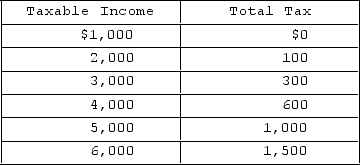 Refer to the income tax schedule given in the table. If your taxable income increases from $4,000 to $5,000, you will encounter a marginal tax rate of
 (Multiple Choice)
4.9/5 (98)
(98) The U.S. federal expenditures for "pensions and income security" are dominated by
(Multiple Choice)
4.9/5 (72)
(72) Indy currently earns $50,000 in taxable income and pays $8,000 in taxes. Suppose that Indy faces a marginal tax rate of 25 percent and his boss offers him a raise of $2,000 per year. Indy should
(Multiple Choice)
4.8/5 (84)
(84) 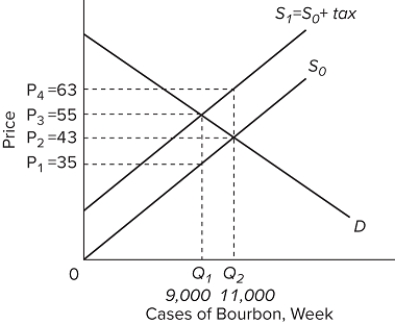 In the graph,S₀ = supply curve for bourbon (seller's supply)D = demand curve for bourbonSₜ = supply for bourbon plus excise tax on bourbon (effective supply as seen by buyers)tax = an excise tax on bourbon (of $20 per case)The excise tax on bourbon as described in the diagram is ultimately paid
 (Multiple Choice)
4.7/5 (83)
(83) 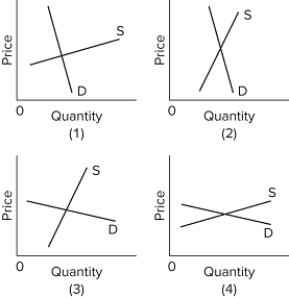 In which of the given market situations will the largest portion of an excise tax of a specified amount per unit of output be borne by producers?
 (Multiple Choice)
4.8/5 (87)
(87) 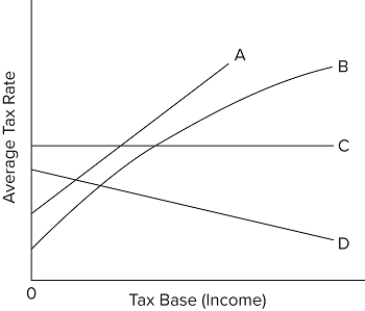 Which of the lines in the diagram represent(s)a proportional tax?
 (Multiple Choice)
4.9/5 (79)
(79) The major sources of funds for the U.S. federal government include the following, except
(Multiple Choice)
4.9/5 (79)
(79) Explain the probable incidence of a general sales tax imposed by a state.
(Essay)
4.9/5 (84)
(84) The greater the elasticity of demand and supply, the greater is the efficiency loss of a tax.
(True/False)
4.9/5 (79)
(79) 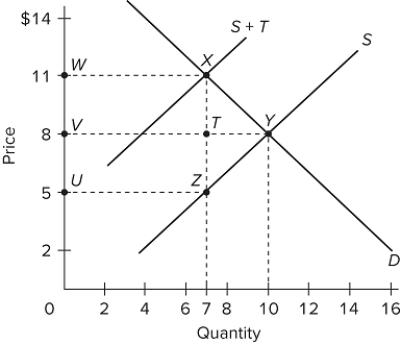 The graph illustrates the market for a product on which an excise tax has been imposed by government. What is the area that represents the efficiency loss due to the tax?
 (Multiple Choice)
4.9/5 (91)
(91) If your income increases from $10,000 per year to $14,000 per year and your tax payment increases from $2,000 to $2,840, the marginal tax rate
(Multiple Choice)
5.0/5 (85)
(85) A progressive tax takes relatively more from the rich than it does from the poor.
(True/False)
4.9/5 (80)
(80) The Social Security tax is regressive because it applies only on income below a "cap" income level.
(True/False)
4.9/5 (78)
(78) Give the most important source of revenue for local governments and their most important expenditure.
(Essay)
4.8/5 (77)
(77) 
Filters
- Essay(0)
- Multiple Choice(0)
- Short Answer(0)
- True False(0)
- Matching(0)