



 Chat with AI
Exam 20: Public Finance: Expenditures and Taxes

Exam 1: Limits, Alternatives, and Choices107 Questions
Exam 2: The Market System and the Circular Flow287 Questions
Exam 3: Demand, Supply, and Market Equilibrium151 Questions
Exam 4: Market Failures Caused by Externalities Asymmetric Information229 Questions
Exam 5: Public Goods, Public Choice, and Government Failure268 Questions
Exam 6: Elasticity399 Questions
Exam 7: Utility Maximization358 Questions
Exam 8: Behavioral Economics311 Questions
Exam 9: Businesses and the Costs of Production445 Questions
Exam 10: Pure Competition in the Short Run342 Questions
Exam 11: Pure Competition in the Long Run250 Questions
Exam 12: Pure Monopoly407 Questions
Exam 13: Monopolistic Competition279 Questions
Exam 14: Oligopoly and Strategic Behavior362 Questions
Exam 15: Technology, RD, and Efficiency309 Questions
Exam 16: The Demand for Resources359 Questions
Exam 17: Wage Determination168 Questions
Exam 18: Rent, Interest, and Profit305 Questions
Exam 19: Natural Resource and Energy Economics337 Questions
Exam 20: Public Finance: Expenditures and Taxes336 Questions
Exam 21: Antitrust Policy and Regulation264 Questions
Exam 22: Agriculture: Economics and Policy265 Questions
Exam 23: Income Inequality, Poverty, and Discrimination324 Questions
Exam 24: Health Care280 Questions
Exam 25: Immigration259 Questions
Exam 26: International Trade347 Questions
Exam 27: The Balance of Payments, Exchange Rates, and Trade Deficits318 Questions
Exam 28: The Economics of Developing Countries277 Questions
Select questions type


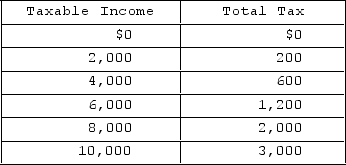 Refer to the personal income tax schedule given in the table. If your taxable income is $8,000, your average tax rate is
 (Multiple Choice)
4.8/5  (67)
(67) The main difference between sales and excise taxes is that
(Multiple Choice)
4.9/5 (79)
(79) If the demand for a product is perfectly inelastic and supply is upsloping, a $1 excise tax per unit on suppliers will
(Multiple Choice)
4.7/5 (84)
(84)  Refer to the personal income tax schedule given in the table. If your taxable income is $4,000, your average tax rate is
 (Multiple Choice)
5.0/5 (91)
(91) 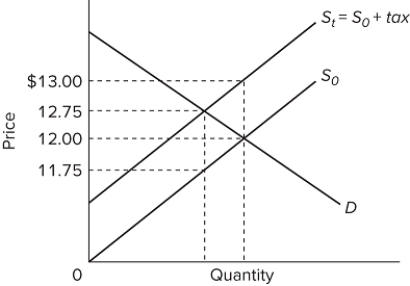 The graph shows the supply curve for a product before tax ( S ₀ )and after an excise tax is imposed ( S ₁). If 500 units of the product are sold after the tax is imposed, the amount of tax revenue going to the government is
 (Multiple Choice)
4.8/5 (77)
(77) Suppose that government imposes a specific excise tax on product X of $2 per unit and that the price elasticity of demand for X is unitary (coefficient = 1). If the incidence of the tax is such that consumers pay $0.20 of the tax and the producers pay $1.80, we can conclude that the
(Multiple Choice)
4.9/5 (71)
(71)  In the diagram, solid arrows reflect real flows, while broken arrows are monetary flows. Flow (1)might represent
 (Multiple Choice)
4.8/5 (88)
(88) Which statement best describes the overall tax and transfer systems of the United States?
(Multiple Choice)
4.7/5 (83)
(83) If the supply of a product is perfectly elastic and demand is downsloping, an excise tax of $2 per unit will increase price by
(Multiple Choice)
4.9/5 (89)
(89) Suppose the Environmental Protection Agency imposes an excise tax on polluting firms. In which of the following situations would we expect the additional costs to be borne most heavily by consumers?
(Multiple Choice)
5.0/5 (77)
(77) "Deficit spending" refers to a situation where the government
(Multiple Choice)
4.9/5 (75)
(75) Assume the demand for automobile tires is highly elastic and that the supply is highly inelastic. The burden of a $2 excise tax on each tire will be
(Multiple Choice)
4.9/5 (85)
(85) The basic source of state government's revenue is the property tax.
(True/False)
4.8/5 (79)
(79) For each dollar paid in taxes, approximately how much do households in the top quintile receive back in the form of government expenditures?
(Multiple Choice)
4.8/5 (72)
(72) Suppose that a $0.75 tax is placed on gasoline. Under what circumstances will gasoline sellers end up shouldering the full burden of the tax?
(Multiple Choice)
4.7/5 (77)
(77) 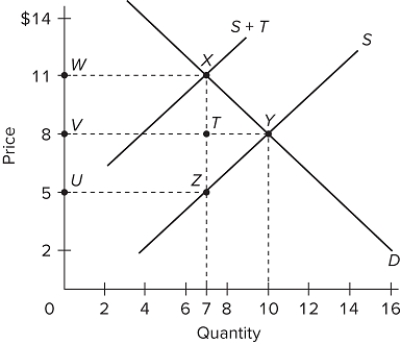 The graph illustrates the market for a product on which an excise tax has been imposed by government. The excise tax on this product as shown in the graph is ultimately paid
 (Multiple Choice)
4.8/5 (93)
(93) The progressive structure of the income-tax system is based on the
(Multiple Choice)
4.7/5 (65)
(65) 
Filters
- Essay(0)
- Multiple Choice(0)
- Short Answer(0)
- True False(0)
- Matching(0)