



 Chat with AI
Exam 20: Public Finance: Expenditures and Taxes

Exam 1: Limits, Alternatives, and Choices107 Questions
Exam 2: The Market System and the Circular Flow287 Questions
Exam 3: Demand, Supply, and Market Equilibrium151 Questions
Exam 4: Market Failures Caused by Externalities Asymmetric Information229 Questions
Exam 5: Public Goods, Public Choice, and Government Failure268 Questions
Exam 6: Elasticity399 Questions
Exam 7: Utility Maximization358 Questions
Exam 8: Behavioral Economics311 Questions
Exam 9: Businesses and the Costs of Production445 Questions
Exam 10: Pure Competition in the Short Run342 Questions
Exam 11: Pure Competition in the Long Run250 Questions
Exam 12: Pure Monopoly407 Questions
Exam 13: Monopolistic Competition279 Questions
Exam 14: Oligopoly and Strategic Behavior362 Questions
Exam 15: Technology, RD, and Efficiency309 Questions
Exam 16: The Demand for Resources359 Questions
Exam 17: Wage Determination168 Questions
Exam 18: Rent, Interest, and Profit305 Questions
Exam 19: Natural Resource and Energy Economics337 Questions
Exam 20: Public Finance: Expenditures and Taxes336 Questions
Exam 21: Antitrust Policy and Regulation264 Questions
Exam 22: Agriculture: Economics and Policy265 Questions
Exam 23: Income Inequality, Poverty, and Discrimination324 Questions
Exam 24: Health Care280 Questions
Exam 25: Immigration259 Questions
Exam 26: International Trade347 Questions
Exam 27: The Balance of Payments, Exchange Rates, and Trade Deficits318 Questions
Exam 28: The Economics of Developing Countries277 Questions
Select questions type


Approximately what percentage of local government expenditures goes to finance education?
(Multiple Choice)
4.7/5  (77)
(77) The burden of a specific sales tax falls entirely on the consumer when the
(Multiple Choice)
4.9/5 (90)
(90)  In the diagram, solid arrows reflect real flows, while broken arrows are monetary flows. Flow (2)might represent
 (Multiple Choice)
4.9/5 (69)
(69) The circular flow model with government included would show that government
(Multiple Choice)
4.9/5 (81)
(81) The benefits-received principle of taxation is most evident in
(Multiple Choice)
4.9/5 (82)
(82) According to the Organization for Economic Cooperation and Development (OECD),
(Multiple Choice)
4.9/5 (75)
(75) Which of the following statements about government borrowing is not true?
(Multiple Choice)
4.8/5 (82)
(82) 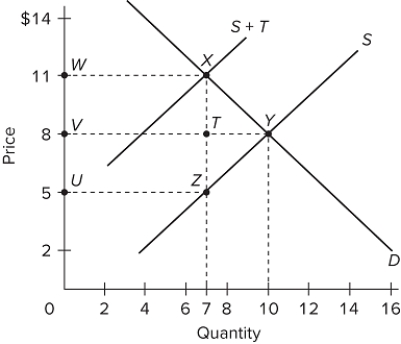 The graph illustrates the market for a product on which an excise tax has been imposed by government. What was the price of the product before the tax was imposed, and what is the price with the tax?
 (Multiple Choice)
5.0/5 (85)
(85) Excise taxes of the federal government include the following items, except a(n)
(Multiple Choice)
4.8/5 (78)
(78) If the demand for a product is perfectly inelastic, the incidence of an excise tax will be
(Multiple Choice)
4.8/5 (92)
(92) Assuming the basic purpose is to raise additional revenue, should government levy an excise tax on cigarettes whose demand is highly inelastic or on a product whose demand is highly elastic? Are there any other reasons to levy such a tax?
(Essay)
4.9/5 (84)
(84) Most of the state and local government employees are in what area?
(Multiple Choice)
4.8/5 (81)
(81) (Advanced analysis)The equations for the demand and supply curves for a particular product are P = 10 − 0.4 Q and P = 2 + 0.4 Q, where P is price and Q is quantity expressed in units of 100. After an excise tax is imposed on the product, the supply equation is P = 3 + 0.4 Q. The equilibrium quantity after the excise tax is imposed is
(Multiple Choice)
4.8/5 (66)
(66) 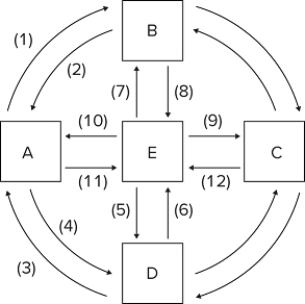 In the diagram, if box E represents government, box C businesses, box D the resource market, and box B the product market, then government purchases of computers, office supplies, and military hardware would be illustrated by arrows
 (Multiple Choice)
4.9/5 (84)
(84) Which of the following claims is not made by defenders of lotteries?
(Multiple Choice)
4.9/5 (76)
(76) The largest category of federal government expenditures is national defense.
(True/False)
4.8/5 (74)
(74) Just like businesses, the public sector uses resources in order to produce goods and services.
(True/False)
4.7/5 (87)
(87) 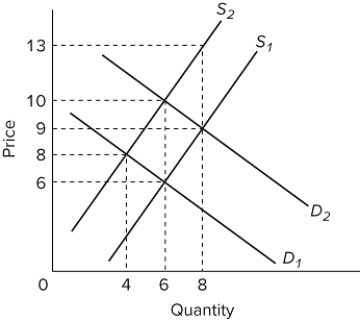 Refer to the graph. Assume the market for this product started out at the intersection of D ₂ and S ₁. Then supply shifted from S ₁ to S ₂ due to an excise tax imposed on the product. If demand subsequently shifts from D ₂ to D ₁, then which of the following will decrease?
 (Multiple Choice)
5.0/5 (92)
(92) 
Filters
- Essay(0)
- Multiple Choice(0)
- Short Answer(0)
- True False(0)
- Matching(0)