



 Chat with AI
Exam 20: Public Finance: Expenditures and Taxes

Exam 1: Limits, Alternatives, and Choices107 Questions
Exam 2: The Market System and the Circular Flow287 Questions
Exam 3: Demand, Supply, and Market Equilibrium151 Questions
Exam 4: Market Failures Caused by Externalities Asymmetric Information229 Questions
Exam 5: Public Goods, Public Choice, and Government Failure268 Questions
Exam 6: Elasticity399 Questions
Exam 7: Utility Maximization358 Questions
Exam 8: Behavioral Economics311 Questions
Exam 9: Businesses and the Costs of Production445 Questions
Exam 10: Pure Competition in the Short Run342 Questions
Exam 11: Pure Competition in the Long Run250 Questions
Exam 12: Pure Monopoly407 Questions
Exam 13: Monopolistic Competition279 Questions
Exam 14: Oligopoly and Strategic Behavior362 Questions
Exam 15: Technology, RD, and Efficiency309 Questions
Exam 16: The Demand for Resources359 Questions
Exam 17: Wage Determination168 Questions
Exam 18: Rent, Interest, and Profit305 Questions
Exam 19: Natural Resource and Energy Economics337 Questions
Exam 20: Public Finance: Expenditures and Taxes336 Questions
Exam 21: Antitrust Policy and Regulation264 Questions
Exam 22: Agriculture: Economics and Policy265 Questions
Exam 23: Income Inequality, Poverty, and Discrimination324 Questions
Exam 24: Health Care280 Questions
Exam 25: Immigration259 Questions
Exam 26: International Trade347 Questions
Exam 27: The Balance of Payments, Exchange Rates, and Trade Deficits318 Questions
Exam 28: The Economics of Developing Countries277 Questions
Select questions type


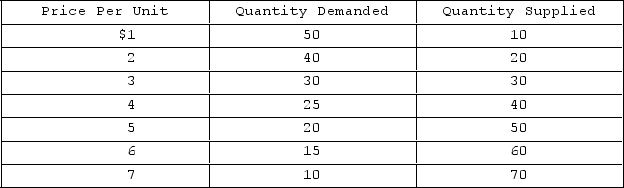 The table gives data for the market for a product. If an excise tax of $3 per unit is imposed on this product, the incidence of the tax will be
 (Multiple Choice)
4.8/5  (74)
(74) From 1960 to 2018, government purchases in the United States have shrunk as a percentage of GDP, but transfer payments have expanded greatly.
(True/False)
4.9/5 (94)
(94) The supply curve for a product has infinite elasticity. An excise tax is levied on the product. The likely effect will be to
(Multiple Choice)
4.8/5 (83)
(83) The largest source of tax revenue for state governments is the property tax.
(True/False)
4.9/5 (71)
(71) Differentiate between government purchases of goods and services and government transfer payments.
(Essay)
4.9/5 (75)
(75) The largest source of local government's revenue is the sales tax.
(True/False)
4.8/5 (75)
(75) 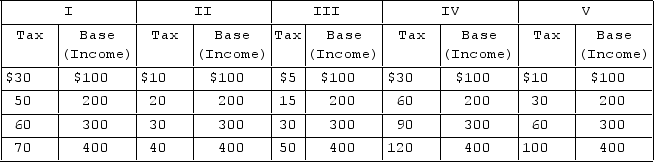 The table contains five tax schedules for an economy. All figures are in billions of dollars. Which of the schedules represent(s)a proportional tax?
 (Multiple Choice)
4.8/5 (70)
(70) Public finance is the subdiscipline of economics that studies the various ways in which
(Multiple Choice)
4.7/5 (81)
(81) 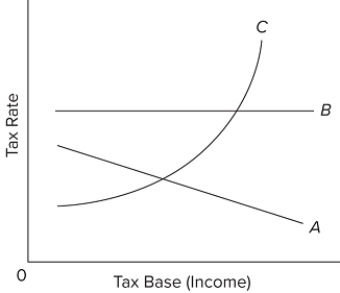 Refer to the graph. A 3-percent general sales tax would have a structure that is illustrated by
 (Multiple Choice)
4.7/5 (71)
(71) The opportunity cost of borrowing funds to finance government deficits is
(Multiple Choice)
5.0/5 (81)
(81) When Supreme Court Justice Oliver Wendell Holmes stated, "Taxes are the price we pay for civilization," he meant that
(Multiple Choice)
4.8/5 (87)
(87) Between the government and households, money or funds tend to flow only in one direction: from households to government.
(True/False)
4.7/5 (82)
(82) 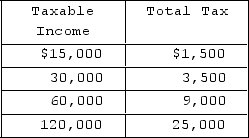 The table represents a personal income tax schedule. As income increases, the marginal tax rate
 (Multiple Choice)
4.8/5 (95)
(95) In 2015, the 20 percent of families with the lowest incomes paid an effective average federal tax rate (on all federal taxes)of about ____, whereas the 20 percent of families with the highest incomes paid an effective average tax rate of about ____.
(Multiple Choice)
4.8/5 (83)
(83) 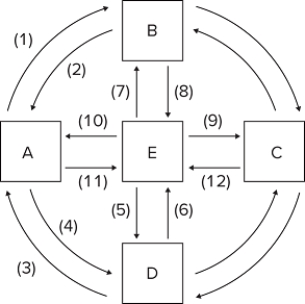 In the diagram, if box E represents government, box C businesses, box D the resource market, and box B the product market, then government hiring of teachers, soldiers, police, and judges would be illustrated by arrows
 (Multiple Choice)
4.9/5 (76)
(76) A progressive tax means that if someone earning $40,000 pays $10,000, someone earning $80,000 must pay
(Multiple Choice)
4.7/5 (71)
(71) 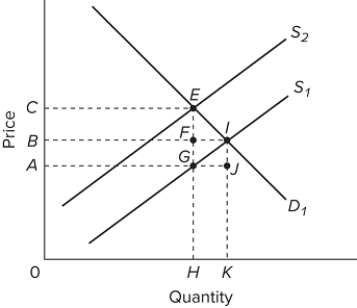 The graph represents the market for a product where D ₁ and S ₁ show the initial supply and demand curves, and supply shifts to S ₂ due to a sales tax. The deadweight loss due to the tax is represented by area
 (Multiple Choice)
4.9/5 (71)
(71) 
Filters
- Essay(0)
- Multiple Choice(0)
- Short Answer(0)
- True False(0)
- Matching(0)