



 Chat with AI
Exam 23: Income Inequality, Poverty, and Discrimination

Exam 1: Limits, Alternatives, and Choices107 Questions
Exam 2: The Market System and the Circular Flow287 Questions
Exam 3: Demand, Supply, and Market Equilibrium151 Questions
Exam 4: Market Failures Caused by Externalities Asymmetric Information229 Questions
Exam 5: Public Goods, Public Choice, and Government Failure268 Questions
Exam 6: Elasticity399 Questions
Exam 7: Utility Maximization358 Questions
Exam 8: Behavioral Economics311 Questions
Exam 9: Businesses and the Costs of Production445 Questions
Exam 10: Pure Competition in the Short Run342 Questions
Exam 11: Pure Competition in the Long Run250 Questions
Exam 12: Pure Monopoly407 Questions
Exam 13: Monopolistic Competition279 Questions
Exam 14: Oligopoly and Strategic Behavior362 Questions
Exam 15: Technology, RD, and Efficiency309 Questions
Exam 16: The Demand for Resources359 Questions
Exam 17: Wage Determination168 Questions
Exam 18: Rent, Interest, and Profit305 Questions
Exam 19: Natural Resource and Energy Economics337 Questions
Exam 20: Public Finance: Expenditures and Taxes336 Questions
Exam 21: Antitrust Policy and Regulation264 Questions
Exam 22: Agriculture: Economics and Policy265 Questions
Exam 23: Income Inequality, Poverty, and Discrimination324 Questions
Exam 24: Health Care280 Questions
Exam 25: Immigration259 Questions
Exam 26: International Trade347 Questions
Exam 27: The Balance of Payments, Exchange Rates, and Trade Deficits318 Questions
Exam 28: The Economics of Developing Countries277 Questions
Select questions type


Census data indicate that, as of 2017, the top fifth of all households receive about ________ times as much income as the bottom fifth.
(Multiple Choice)
4.9/5  (72)
(72) 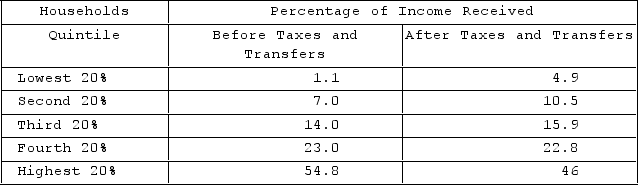 Refer to the table. The decline in percentage of income received from before taxes and transfers to after taxes and transfers is greatest for the
 (Multiple Choice)
4.8/5 (76)
(76) What is universal basic income? List the benefits asserted by the advocates and then the reasons cited by the detractors in the debate about UBI.
(Essay)
4.9/5 (79)
(79) 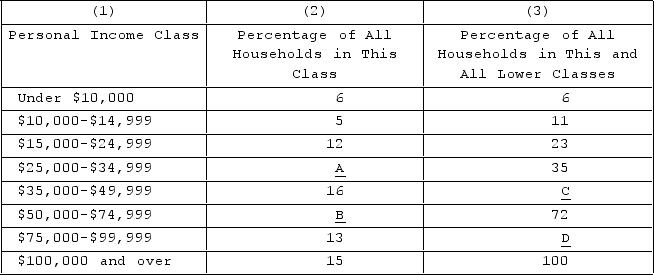 Refer to the table. What percentage of households made less than $15,000?
 (Multiple Choice)
4.9/5 (85)
(85) Of the following groups, which had the highest incidence of poverty in 2017?
(Multiple Choice)
4.9/5 (73)
(73) 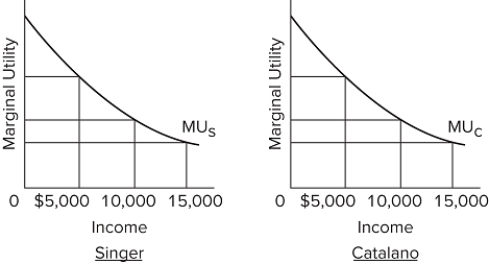 Refer to the diagrams, which show identical marginal utility from income curves for Singer and Catalano. The marginal utility from income curves are drawn on the assumption that
 (Multiple Choice)
4.9/5 (82)
(82) Economic discrimination puts the economy inside its production possibilities curve because discrimination
(Multiple Choice)
4.9/5 (80)
(80) Which of the following countries has the highest Gini ratio, as of 2014?
(Multiple Choice)
4.9/5 (81)
(81) Since 1980, the difference between the earnings of college graduates and high school graduates has
(Multiple Choice)
5.0/5 (80)
(80) Which of the following is an example of a noncash transfer that is typically not included in the income-distribution data?
(Multiple Choice)
4.9/5 (82)
(82) Which of the following measurement issues makes interpretation of U.S. poverty rates difficult?
(Multiple Choice)
4.9/5 (74)
(74) The standard data on income distribution do not include the value of noncash transfers as income.
(True/False)
4.9/5 (83)
(83) 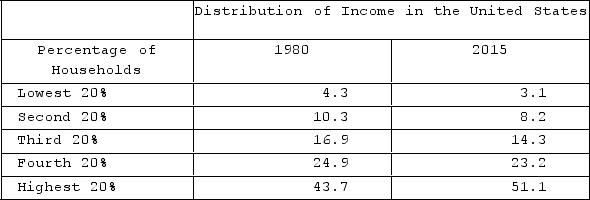 Refer to the income distribution data in the table. Which of the following statements is correct?
 (Multiple Choice)
4.8/5 (75)
(75) Currently over 90 percent of all workers in the United States are covered by Social Security.
(True/False)
4.8/5 (87)
(87) Which of the following contributes most to the reduction in income inequality?
(Multiple Choice)
4.8/5 (78)
(78) Labor market discrimination increases the size of the nation's GDP by promoting specialization on the basis of race.
(True/False)
4.8/5 (92)
(92) According to the standard government definitions, the percentage of the U.S. population now (2017)considered to be living in poverty is about
(Multiple Choice)
4.9/5 (71)
(71) 
Filters
- Essay(0)
- Multiple Choice(0)
- Short Answer(0)
- True False(0)
- Matching(0)