



 Chat with AI
Exam 23: Income Inequality, Poverty, and Discrimination

Exam 1: Limits, Alternatives, and Choices107 Questions
Exam 2: The Market System and the Circular Flow287 Questions
Exam 3: Demand, Supply, and Market Equilibrium151 Questions
Exam 4: Market Failures Caused by Externalities Asymmetric Information229 Questions
Exam 5: Public Goods, Public Choice, and Government Failure268 Questions
Exam 6: Elasticity399 Questions
Exam 7: Utility Maximization358 Questions
Exam 8: Behavioral Economics311 Questions
Exam 9: Businesses and the Costs of Production445 Questions
Exam 10: Pure Competition in the Short Run342 Questions
Exam 11: Pure Competition in the Long Run250 Questions
Exam 12: Pure Monopoly407 Questions
Exam 13: Monopolistic Competition279 Questions
Exam 14: Oligopoly and Strategic Behavior362 Questions
Exam 15: Technology, RD, and Efficiency309 Questions
Exam 16: The Demand for Resources359 Questions
Exam 17: Wage Determination168 Questions
Exam 18: Rent, Interest, and Profit305 Questions
Exam 19: Natural Resource and Energy Economics337 Questions
Exam 20: Public Finance: Expenditures and Taxes336 Questions
Exam 21: Antitrust Policy and Regulation264 Questions
Exam 22: Agriculture: Economics and Policy265 Questions
Exam 23: Income Inequality, Poverty, and Discrimination324 Questions
Exam 24: Health Care280 Questions
Exam 25: Immigration259 Questions
Exam 26: International Trade347 Questions
Exam 27: The Balance of Payments, Exchange Rates, and Trade Deficits318 Questions
Exam 28: The Economics of Developing Countries277 Questions
Select questions type


Which of the following Gini ratios indicates the lowest degree of income inequality?
(Multiple Choice)
5.0/5  (73)
(73) Suppose the members of population A, consisting of Al, Bob, Curt, Doris, and Ellie, receive annual incomes of $5,000, $4,000, $3,000, $2,000, and $1,000, respectively. What percentage of total income is received by the fourth quintile?
(Multiple Choice)
4.8/5 (73)
(73) Suppose the market wage rate for whites is $18 an hour and the monetary value a prejudiced employer attaches to the disutility of hiring African Americans is $3. This employer will be indifferent between hiring African Americans and whites only when the African-American wage rate is
(Multiple Choice)
4.9/5 (75)
(75) About a quarter of all U.S. households had personal incomes of $100,000 or more in 2017.
(True/False)
4.8/5 (75)
(75) One of the provisions of the Temporary Assistance for Needy Families (TANF)program was to
(Multiple Choice)
4.9/5 (93)
(93) 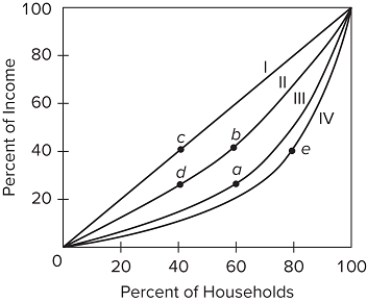 Refer to the figure, which shows four different Lorenz curves (I, II, III, and IV). The movement from point b to point a in the graph would indicate that the
 (Multiple Choice)
4.9/5 (72)
(72) 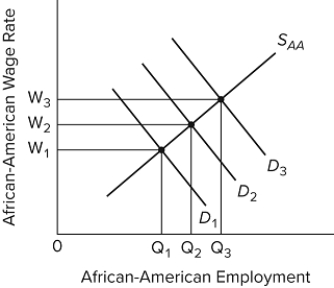 Refer to the diagram. Which of the following would be consistent with an increase in racial prejudice against African Americans and thus an increase in the discrimination coefficients of employers, taken as a group?
 (Multiple Choice)
4.8/5 (72)
(72) In 2017, the fourth quintile of households in the U.S. income distribution received about
(Multiple Choice)
4.8/5 (73)
(73) In 2017, a household with an annual income of $23,000 would find itself in the
(Multiple Choice)
4.9/5 (79)
(79) Two major criticisms of the Bureau of Census data as a portrayal of the degree of income inequality are that the income concept employed is too
(Multiple Choice)
4.7/5 (79)
(79) In the quintile distribution of income, the term "quintile" represents
(Multiple Choice)
4.9/5 (68)
(68) Which of the following statements applies to the Social Security program?
(Multiple Choice)
4.8/5 (86)
(86) Assume that all workers are equally productive, but the wage rate for men is $12, compared to $9 for women. An employer who employs only male workers must have a discrimination coefficient of
(Multiple Choice)
4.9/5 (77)
(77) Which of the following would most likely increase income inequality?
(Multiple Choice)
4.9/5 (90)
(90) Which of the following groups would we expect to have the highest poverty rate?
(Multiple Choice)
4.8/5 (94)
(94) In the taste for discrimination model, the perceived cost for a prejudiced white employer for hiring an African-American worker is
(Multiple Choice)
4.9/5 (75)
(75) 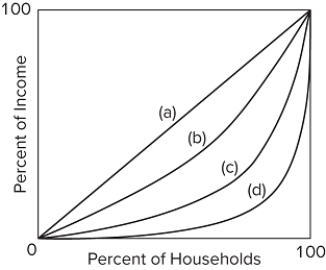 Refer to the graph. If the Lorenz curve shifted from (d)to (b), then the Gini ratio and the degree of income inequality would
 (Multiple Choice)
4.8/5 (65)
(65) 
Filters
- Essay(0)
- Multiple Choice(0)
- Short Answer(0)
- True False(0)
- Matching(0)