



 Chat with AI
Exam 23: Income Inequality, Poverty, and Discrimination

Exam 1: Limits, Alternatives, and Choices107 Questions
Exam 2: The Market System and the Circular Flow287 Questions
Exam 3: Demand, Supply, and Market Equilibrium151 Questions
Exam 4: Market Failures Caused by Externalities Asymmetric Information229 Questions
Exam 5: Public Goods, Public Choice, and Government Failure268 Questions
Exam 6: Elasticity399 Questions
Exam 7: Utility Maximization358 Questions
Exam 8: Behavioral Economics311 Questions
Exam 9: Businesses and the Costs of Production445 Questions
Exam 10: Pure Competition in the Short Run342 Questions
Exam 11: Pure Competition in the Long Run250 Questions
Exam 12: Pure Monopoly407 Questions
Exam 13: Monopolistic Competition279 Questions
Exam 14: Oligopoly and Strategic Behavior362 Questions
Exam 15: Technology, RD, and Efficiency309 Questions
Exam 16: The Demand for Resources359 Questions
Exam 17: Wage Determination168 Questions
Exam 18: Rent, Interest, and Profit305 Questions
Exam 19: Natural Resource and Energy Economics337 Questions
Exam 20: Public Finance: Expenditures and Taxes336 Questions
Exam 21: Antitrust Policy and Regulation264 Questions
Exam 22: Agriculture: Economics and Policy265 Questions
Exam 23: Income Inequality, Poverty, and Discrimination324 Questions
Exam 24: Health Care280 Questions
Exam 25: Immigration259 Questions
Exam 26: International Trade347 Questions
Exam 27: The Balance of Payments, Exchange Rates, and Trade Deficits318 Questions
Exam 28: The Economics of Developing Countries277 Questions
Select questions type


An employer (biased against African Americans)whose discrimination coefficient is $5 will hire only whites if the actual African-American-white wage gap is $7.
(True/False)
5.0/5  (89)
(89) 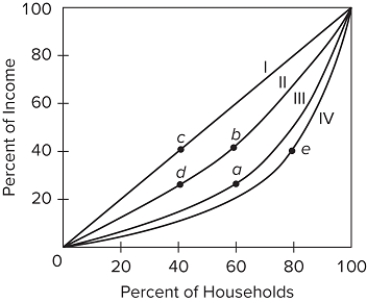 Refer to the figure, which shows four different Lorenz curves (I, II, III, and IV). What point indicates that the lower 60 percent of the households receive only 40 percent of the nation's total income?
 (Multiple Choice)
4.8/5 (89)
(89) Which of the following would be evidence of an increase in income inequality over time in the United States?
(Multiple Choice)
4.8/5 (84)
(84) The percentage of total before-tax household income received by the lowest 20 percent of households in 2017 was about ____ percent, while the top 20 percent received about ___ percent.
(Multiple Choice)
4.7/5 (78)
(78) People's incomes are relatively low when they are young, reach a peak in middle age, and then decline. This fact helps explain
(Multiple Choice)
4.7/5 (75)
(75) The basic reason why the debate between income equality versus inequality is ongoing is because there is a trade-off between income equality and economic efficiency.
(True/False)
4.9/5 (101)
(101) 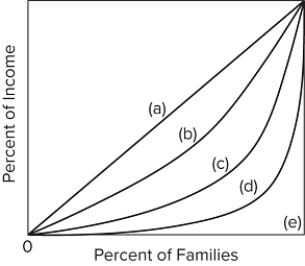 Refer to the diagram, where curves (a)through (e)are for five different countries. The Gini ratio is
 (Multiple Choice)
4.7/5 (76)
(76) "Redistributing income in order to have a more equal distribution in the United States would result in a higher level of total consumer satisfaction." This statement is based on the concept that
(Multiple Choice)
4.7/5 (72)
(72) In 2017, the portion of the U.S. population that lived in poverty was
(Multiple Choice)
4.8/5 (79)
(79) 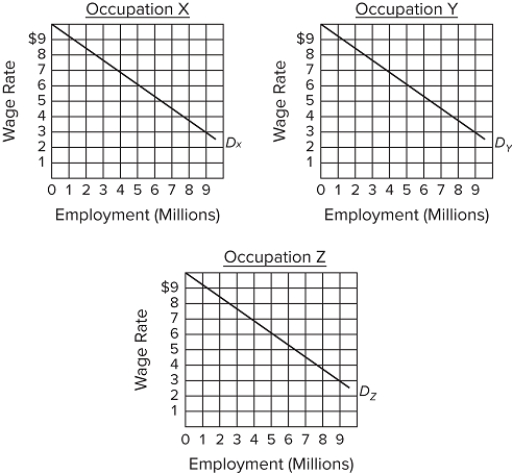 Assumptions: (1)the labor force comprises 9 million men and 9 million women workers; (2)the economy has 3 occupations, X, Y, and Z, each having identical demand curves for labor; (3)male and female workers are homogeneous with respect to their labor-market capabilities; (4)women are discriminated against by being excluded from occupations X and Y and are confined to Z; and (5)aside from discrimination, the economy is competitive, and workers seek to maximize their earnings.Refer to the diagram and list of assumptions. The elimination of gender discrimination
 (Multiple Choice)
5.0/5 (89)
(89) Insurance companies require male drivers under age 25 to pay higher insurance rates than female drivers under age 25. Craig Raymond, however, is a safer driver than the average female driver under age 25. Craig's higher insurance rate reflects
(Multiple Choice)
4.9/5 (82)
(82) 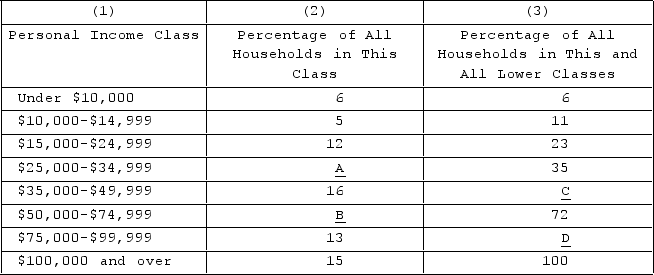 Refer to the table. What percentage of households made $50,000 or more?
 (Multiple Choice)
4.9/5 (62)
(62) Suppose the members of population A, consisting of Al, Bob, Curt, Doris, and Ellie, receive annual incomes of $5,000, $2,500, $1,250, $750, and $500, respectively. What percentage of total income is received by the highest quintile?
(Multiple Choice)
4.9/5 (97)
(97) A progressive income tax would cause the after-tax Lorenz curve, compared with the before-tax Lorenz curve, to be
(Multiple Choice)
4.9/5 (67)
(67) Which of the following is a public assistance or welfare program as opposed to a social insurance program?
(Multiple Choice)
4.8/5 (79)
(79) 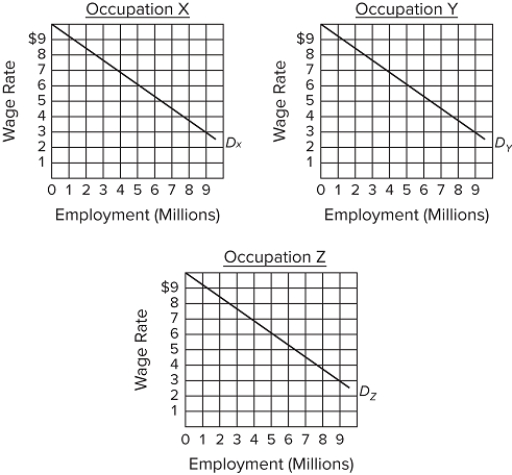 Assumptions: (1)the labor force comprises 9 million men and 9 million women workers; (2)the economy has 3 occupations, X, Y, and Z, each having identical demand curves for labor; (3)male and female workers are homogeneous with respect to their labor-market capabilities; (4)women are discriminated against by being excluded from occupations X and Y and are confined to Z; and (5)aside from discrimination, the economy is competitive, and workers seek to maximize their earnings.Refer to the diagram and list of assumptions. With women confined to occupation Z and men free to choose occupations, how will this affect the wages paid?
 (Multiple Choice)
4.8/5 (77)
(77) The greater the area between the Lorenz curve and the diagonal in the Lorenz curve diagram, the
(Multiple Choice)
4.8/5 (69)
(69) 
Filters
- Essay(0)
- Multiple Choice(0)
- Short Answer(0)
- True False(0)
- Matching(0)