



 Chat with AI
Exam 23: Income Inequality, Poverty, and Discrimination

Exam 1: Limits, Alternatives, and Choices107 Questions
Exam 2: The Market System and the Circular Flow287 Questions
Exam 3: Demand, Supply, and Market Equilibrium151 Questions
Exam 4: Market Failures Caused by Externalities Asymmetric Information229 Questions
Exam 5: Public Goods, Public Choice, and Government Failure268 Questions
Exam 6: Elasticity399 Questions
Exam 7: Utility Maximization358 Questions
Exam 8: Behavioral Economics311 Questions
Exam 9: Businesses and the Costs of Production445 Questions
Exam 10: Pure Competition in the Short Run342 Questions
Exam 11: Pure Competition in the Long Run250 Questions
Exam 12: Pure Monopoly407 Questions
Exam 13: Monopolistic Competition279 Questions
Exam 14: Oligopoly and Strategic Behavior362 Questions
Exam 15: Technology, RD, and Efficiency309 Questions
Exam 16: The Demand for Resources359 Questions
Exam 17: Wage Determination168 Questions
Exam 18: Rent, Interest, and Profit305 Questions
Exam 19: Natural Resource and Energy Economics337 Questions
Exam 20: Public Finance: Expenditures and Taxes336 Questions
Exam 21: Antitrust Policy and Regulation264 Questions
Exam 22: Agriculture: Economics and Policy265 Questions
Exam 23: Income Inequality, Poverty, and Discrimination324 Questions
Exam 24: Health Care280 Questions
Exam 25: Immigration259 Questions
Exam 26: International Trade347 Questions
Exam 27: The Balance of Payments, Exchange Rates, and Trade Deficits318 Questions
Exam 28: The Economics of Developing Countries277 Questions
Select questions type


Differences in skills or ability are one major reason for income differences in the United States.
(True/False)
4.9/5  (84)
(84) The average household income in the United States in 2017 was closest to
(Multiple Choice)
4.8/5 (93)
(93) Reasons for the growing income inequality in the United States since 1980 include the following, except
(Multiple Choice)
4.8/5 (75)
(75) The distribution of household income in the United States becomes more unequal after taxes and transfer payments are taken into account.
(True/False)
5.0/5 (90)
(90) 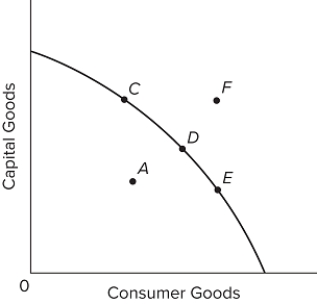 In the diagram, the elimination of discrimination is best represented by
 (Multiple Choice)
4.7/5 (71)
(71) Greater income equality that is achieved through the redistribution of income is thought to
(Multiple Choice)
4.7/5 (84)
(84) All social insurance programs are welfare or public charity programs.
(True/False)
4.8/5 (82)
(82) 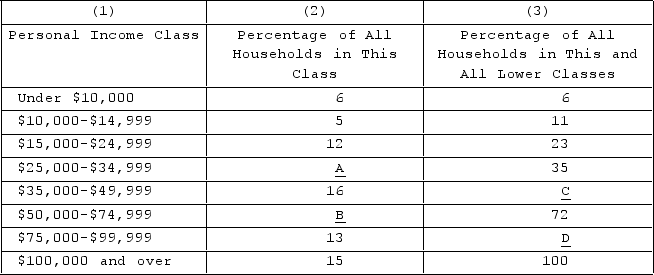 Refer to the table. What percentage should be reported in blank A of column 2?
 (Multiple Choice)
4.9/5 (84)
(84) 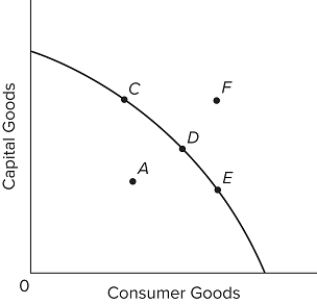 In the diagram, economic discrimination is best represented by point
 (Multiple Choice)
4.8/5 (88)
(88) 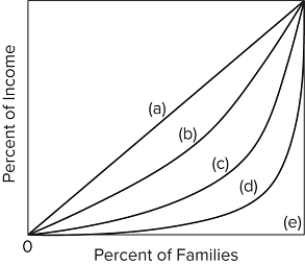 Refer to the diagram, where curves (a)through (e)are for five different countries. Of the countries listed below, income is most unequally distributed in country
 (Multiple Choice)
4.7/5 (91)
(91) Which of the following Gini ratios indicates the highest degree of income inequality?
(Multiple Choice)
4.8/5 (85)
(85) In 2017, the percentage of the total U.S. population that lived in poverty was approximately
(Multiple Choice)
4.9/5 (72)
(72) 
Filters
- Essay(0)
- Multiple Choice(0)
- Short Answer(0)
- True False(0)
- Matching(0)