



 Chat with AI
Exam 23: Income Inequality, Poverty, and Discrimination

Exam 1: Limits, Alternatives, and Choices107 Questions
Exam 2: The Market System and the Circular Flow287 Questions
Exam 3: Demand, Supply, and Market Equilibrium151 Questions
Exam 4: Market Failures Caused by Externalities Asymmetric Information229 Questions
Exam 5: Public Goods, Public Choice, and Government Failure268 Questions
Exam 6: Elasticity399 Questions
Exam 7: Utility Maximization358 Questions
Exam 8: Behavioral Economics311 Questions
Exam 9: Businesses and the Costs of Production445 Questions
Exam 10: Pure Competition in the Short Run342 Questions
Exam 11: Pure Competition in the Long Run250 Questions
Exam 12: Pure Monopoly407 Questions
Exam 13: Monopolistic Competition279 Questions
Exam 14: Oligopoly and Strategic Behavior362 Questions
Exam 15: Technology, RD, and Efficiency309 Questions
Exam 16: The Demand for Resources359 Questions
Exam 17: Wage Determination168 Questions
Exam 18: Rent, Interest, and Profit305 Questions
Exam 19: Natural Resource and Energy Economics337 Questions
Exam 20: Public Finance: Expenditures and Taxes336 Questions
Exam 21: Antitrust Policy and Regulation264 Questions
Exam 22: Agriculture: Economics and Policy265 Questions
Exam 23: Income Inequality, Poverty, and Discrimination324 Questions
Exam 24: Health Care280 Questions
Exam 25: Immigration259 Questions
Exam 26: International Trade347 Questions
Exam 27: The Balance of Payments, Exchange Rates, and Trade Deficits318 Questions
Exam 28: The Economics of Developing Countries277 Questions
Select questions type


Which of the following would be considered part of income?
(Multiple Choice)
4.8/5  (70)
(70) 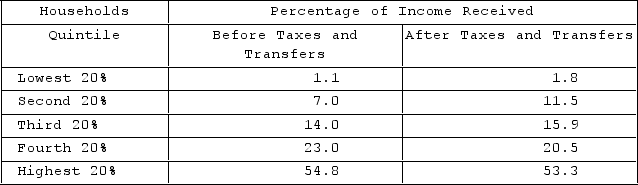 Refer to the table. The decline in percentage of income received from before taxes and transfers to after taxes and transfers is greatest for the
 (Multiple Choice)
4.9/5 (64)
(64) If a prejudiced white employer behaves as if there is a disutility from hiring an African-American worker, then this disutility is measured by the
(Multiple Choice)
4.9/5 (81)
(81) 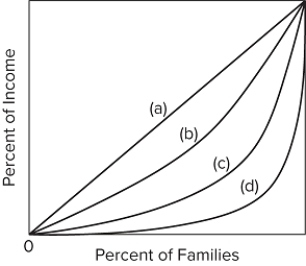 Refer to the diagram. If line (c)represents the pretax and transfer distribution of income in the United States, the posttax and transfer distribution is best represented by
 (Multiple Choice)
4.8/5 (74)
(74) A cause of the unequal distribution of income in the United States is
(Multiple Choice)
4.8/5 (83)
(83) The distribution of wealth in the United States is such that it
(Multiple Choice)
4.9/5 (85)
(85) 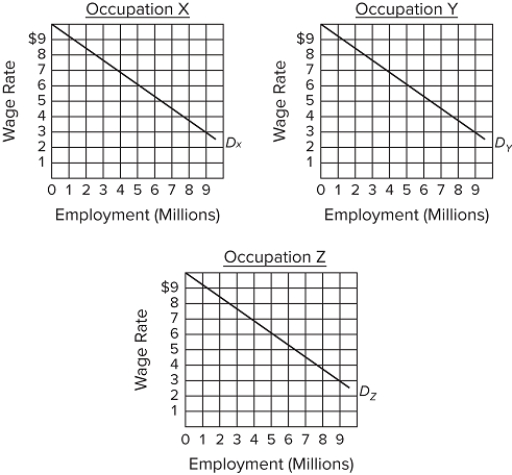 Assumptions: (1)the labor force comprises 9 million men and 9 million women workers; (2)the economy has 3 occupations, X, Y, and Z, each having identical demand curves for labor; (3)male and female workers are homogeneous with respect to their labor-market capabilities; (4)women are discriminated against by being excluded from occupations X and Y and are confined to Z; and (5)aside from discrimination, the economy is competitive, and workers seek to maximize their earnings.Refer to the diagram and list of assumptions. If discrimination is ended,
 (Multiple Choice)
4.8/5 (76)
(76) The top 20 percent of U.S. income earners receive nearly 80 percent of total U.S. income.
(True/False)
4.7/5 (77)
(77) 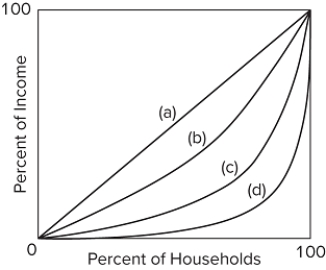 Refer to the figure. A nation that has an income distribution of perfect equality would be represented by curve
 (Multiple Choice)
4.8/5 (73)
(73) If there is a widespread bias against African-American workers, an increase in the collective discrimination coefficients of employers will
(Multiple Choice)
4.8/5 (64)
(64) Since the implementation of TANF in 1996, the U.S. welfare rolls have fallen by roughly one-half and participation remains low in 2017.
(True/False)
4.8/5 (81)
(81) Which of the following is a major reason for the growing income inequality in the United States since 1980?
(Multiple Choice)
5.0/5 (93)
(93) A particular woman is denied on-the-job training because women on average are more likely to drop out of the workforce than men. This illustrates
(Multiple Choice)
4.8/5 (80)
(80) The equality-efficiency trade-off would be most closely associated with which one of the following statements?
(Multiple Choice)
4.9/5 (77)
(77) An employer is prejudiced, prefers to hire white rather than Hispanic workers, and is willing to pay higher wages to obtain white workers. This illustrates
(Multiple Choice)
4.9/5 (79)
(79) Each of the following contributes to income inequality except
(Multiple Choice)
4.9/5 (81)
(81) 
Filters
- Essay(0)
- Multiple Choice(0)
- Short Answer(0)
- True False(0)
- Matching(0)