



 Chat with AI
Exam 23: Income Inequality, Poverty, and Discrimination

Exam 1: Limits, Alternatives, and Choices107 Questions
Exam 2: The Market System and the Circular Flow287 Questions
Exam 3: Demand, Supply, and Market Equilibrium151 Questions
Exam 4: Market Failures Caused by Externalities Asymmetric Information229 Questions
Exam 5: Public Goods, Public Choice, and Government Failure268 Questions
Exam 6: Elasticity399 Questions
Exam 7: Utility Maximization358 Questions
Exam 8: Behavioral Economics311 Questions
Exam 9: Businesses and the Costs of Production445 Questions
Exam 10: Pure Competition in the Short Run342 Questions
Exam 11: Pure Competition in the Long Run250 Questions
Exam 12: Pure Monopoly407 Questions
Exam 13: Monopolistic Competition279 Questions
Exam 14: Oligopoly and Strategic Behavior362 Questions
Exam 15: Technology, RD, and Efficiency309 Questions
Exam 16: The Demand for Resources359 Questions
Exam 17: Wage Determination168 Questions
Exam 18: Rent, Interest, and Profit305 Questions
Exam 19: Natural Resource and Energy Economics337 Questions
Exam 20: Public Finance: Expenditures and Taxes336 Questions
Exam 21: Antitrust Policy and Regulation264 Questions
Exam 22: Agriculture: Economics and Policy265 Questions
Exam 23: Income Inequality, Poverty, and Discrimination324 Questions
Exam 24: Health Care280 Questions
Exam 25: Immigration259 Questions
Exam 26: International Trade347 Questions
Exam 27: The Balance of Payments, Exchange Rates, and Trade Deficits318 Questions
Exam 28: The Economics of Developing Countries277 Questions
Select questions type


If a law firm prefers to hire men over women because the firm has found men to be more productive, on average, then the firm is practicing
(Multiple Choice)
4.8/5  (88)
(88) Statistical discrimination is also known as occupational discrimination.
(True/False)
4.9/5 (71)
(71) Which of the following would likely reduce income inequality?
(Multiple Choice)
4.7/5 (81)
(81) Which of the following terms describes a system of subsidized health insurance available to the aged?
(Multiple Choice)
4.8/5 (72)
(72) 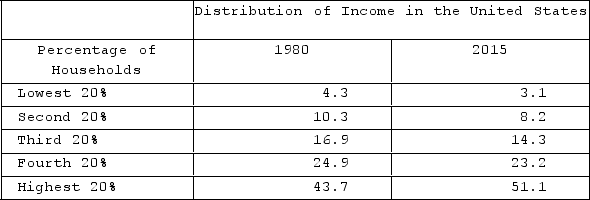 An examination of the quintile distribution of before-tax household income data for 1980 and 2015 given in the table suggests a trend of
 (Multiple Choice)
4.8/5 (80)
(80) Proponents of a Universal Basic Income (UBI)argue that it would
(Multiple Choice)
4.8/5 (74)
(74) 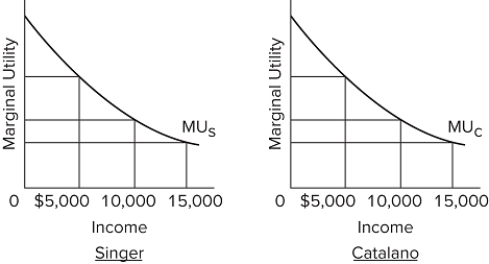 Refer to the diagrams, which show identical marginal utility from income curves for Singer and Catalano. If a given income of $20,000 is initially distributed so that Singer receives $15,000 and Catalano $5,000,
 (Multiple Choice)
4.8/5 (75)
(75) Suppose the members of population A, consisting of Al, Bob, Curt, Doris, and Ellie, receive annual incomes of $5,000, $2,500, $1,250, $750, and $500, respectively. What percentage of total income is received by the highest 60 percent of the income receivers in population A?
(Multiple Choice)
4.7/5 (69)
(69) In the U.S., the top 20 percent of households received a little more than 50 percent of total pretax income in 2017.
(True/False)
4.8/5 (81)
(81) The Lorenz curve is a graph that relates income to household spending.
(True/False)
4.8/5 (81)
(81) The crowding of women and minorities into a restricted number of occupations
(Multiple Choice)
4.7/5 (81)
(81) Eligibility for social insurance programs is largely on the basis of need and "means tests."
(True/False)
4.8/5 (83)
(83) 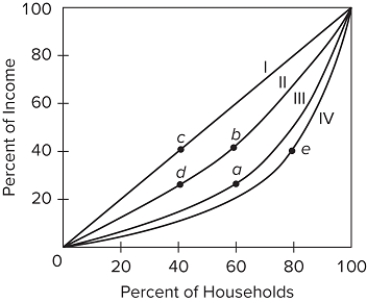 Refer to the figure, which shows four different Lorenz curves (I, II, III, and IV). Which point would indicate that the top 40 percent of households earned 60 percent of the nation's total income?
 (Multiple Choice)
4.8/5 (75)
(75) Suppose the members of population A, consisting of Al, Bob, Curt, Doris, and Ellie, receive annual incomes of $5,000, $2,500, $1,250, $750, and $500, respectively. What percentage of total income is received by the lowest 60 percent of the income receivers in population A?
(Multiple Choice)
4.9/5 (81)
(81) The greater the degree of inequality in the distribution of income, the more bowed will be the Lorenz curve toward the
(Multiple Choice)
4.8/5 (71)
(71) Suppose Rita obtains 16 units of utility from the last dollar of income received by her, and Joseph obtains 12 units of utility from the last dollar of his income. Assume both Joseph and Rita have the same capacity to derive utility from income. Those who favor an equal distribution of income would
(Multiple Choice)
4.9/5 (78)
(78) In the United States since 1980, the poor have gotten poorer and the rich have gotten richer in both relative and absolute terms.
(True/False)
4.8/5 (83)
(83) 
Filters
- Essay(0)
- Multiple Choice(0)
- Short Answer(0)
- True False(0)
- Matching(0)