



 Chat with AI
Exam 23: Income Inequality, Poverty, and Discrimination

Exam 1: Limits, Alternatives, and Choices107 Questions
Exam 2: The Market System and the Circular Flow287 Questions
Exam 3: Demand, Supply, and Market Equilibrium151 Questions
Exam 4: Market Failures Caused by Externalities Asymmetric Information229 Questions
Exam 5: Public Goods, Public Choice, and Government Failure268 Questions
Exam 6: Elasticity399 Questions
Exam 7: Utility Maximization358 Questions
Exam 8: Behavioral Economics311 Questions
Exam 9: Businesses and the Costs of Production445 Questions
Exam 10: Pure Competition in the Short Run342 Questions
Exam 11: Pure Competition in the Long Run250 Questions
Exam 12: Pure Monopoly407 Questions
Exam 13: Monopolistic Competition279 Questions
Exam 14: Oligopoly and Strategic Behavior362 Questions
Exam 15: Technology, RD, and Efficiency309 Questions
Exam 16: The Demand for Resources359 Questions
Exam 17: Wage Determination168 Questions
Exam 18: Rent, Interest, and Profit305 Questions
Exam 19: Natural Resource and Energy Economics337 Questions
Exam 20: Public Finance: Expenditures and Taxes336 Questions
Exam 21: Antitrust Policy and Regulation264 Questions
Exam 22: Agriculture: Economics and Policy265 Questions
Exam 23: Income Inequality, Poverty, and Discrimination324 Questions
Exam 24: Health Care280 Questions
Exam 25: Immigration259 Questions
Exam 26: International Trade347 Questions
Exam 27: The Balance of Payments, Exchange Rates, and Trade Deficits318 Questions
Exam 28: The Economics of Developing Countries277 Questions
Select questions type


The Gini coefficient or ratio is a summary measure of income inequality derived from the Lorenz curve.
(True/False)
4.8/5  (77)
(77) 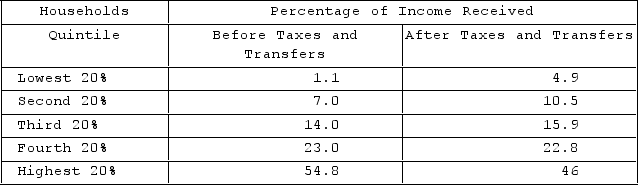 Refer to the table. The rise in percentage of income received from before taxes and transfers to after taxes and transfers is greatest for the
 (Multiple Choice)
4.9/5 (74)
(74) Which of the following provides public assistance to those who are blind and otherwise disabled?
(Multiple Choice)
4.8/5 (85)
(85) Statistical discrimination occurs when employers base hiring decisions on individual workers' previous employment records and statistics.
(True/False)
4.9/5 (76)
(76) Suppose an employer is biased against African Americans. If his discrimination coefficient is $2, the employer will
(Multiple Choice)
4.9/5 (81)
(81) As the area between the Lorenz curve and diagonal gets larger, the Gini ratio
(Multiple Choice)
4.8/5 (93)
(93) The crowding model of occupational segregation shows how white males earn higher incomes at the expense of women and minorities who are restricted to a limited number of occupations.
(True/False)
4.9/5 (94)
(94) The taste-for-discrimination model examines an employer's prejudice and discrimination in hiring by using tools of
(Multiple Choice)
4.8/5 (69)
(69) The unequal distribution of wealth among households in the United States is one of the causes of income inequality.
(True/False)
4.8/5 (92)
(92) Suppose that a prejudiced white employer is willing to hire white workers at a rate of $16/hour, and this employer has a discrimination coefficient of $4. This implies that the employer would
(Multiple Choice)
4.9/5 (68)
(68) The eligibility basis for the Supplemental Nutrition Assistance Program (or SNAP, formerly called the food-stamp program)is
(Multiple Choice)
4.8/5 (87)
(87) The movement of individuals and households from one income quintile to another over time is called
(Multiple Choice)
4.8/5 (90)
(90) African-American worker Jackson earns $30,000 per year; white worker Johnson earns $40,000 per year. On the basis of this information, we can conclude that
(Multiple Choice)
4.8/5 (76)
(76) The degree of inequality in income distribution based on single-year data is
(Multiple Choice)
4.7/5 (77)
(77) 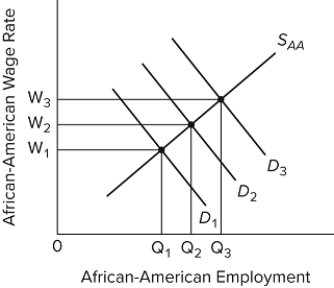 Refer to the diagram. Which of the following would be consistent with a decrease in racial prejudice against African Americans and thus a decrease in the discrimination coefficients of employers, taken as a group?
 (Multiple Choice)
4.8/5 (80)
(80) 
Filters
- Essay(0)
- Multiple Choice(0)
- Short Answer(0)
- True False(0)
- Matching(0)