



 Chat with AI
Exam 23: Income Inequality, Poverty, and Discrimination

Exam 1: Limits, Alternatives, and Choices107 Questions
Exam 2: The Market System and the Circular Flow287 Questions
Exam 3: Demand, Supply, and Market Equilibrium151 Questions
Exam 4: Market Failures Caused by Externalities Asymmetric Information229 Questions
Exam 5: Public Goods, Public Choice, and Government Failure268 Questions
Exam 6: Elasticity399 Questions
Exam 7: Utility Maximization358 Questions
Exam 8: Behavioral Economics311 Questions
Exam 9: Businesses and the Costs of Production445 Questions
Exam 10: Pure Competition in the Short Run342 Questions
Exam 11: Pure Competition in the Long Run250 Questions
Exam 12: Pure Monopoly407 Questions
Exam 13: Monopolistic Competition279 Questions
Exam 14: Oligopoly and Strategic Behavior362 Questions
Exam 15: Technology, RD, and Efficiency309 Questions
Exam 16: The Demand for Resources359 Questions
Exam 17: Wage Determination168 Questions
Exam 18: Rent, Interest, and Profit305 Questions
Exam 19: Natural Resource and Energy Economics337 Questions
Exam 20: Public Finance: Expenditures and Taxes336 Questions
Exam 21: Antitrust Policy and Regulation264 Questions
Exam 22: Agriculture: Economics and Policy265 Questions
Exam 23: Income Inequality, Poverty, and Discrimination324 Questions
Exam 24: Health Care280 Questions
Exam 25: Immigration259 Questions
Exam 26: International Trade347 Questions
Exam 27: The Balance of Payments, Exchange Rates, and Trade Deficits318 Questions
Exam 28: The Economics of Developing Countries277 Questions
Select questions type


As applied to gender discrimination, the crowding model of occupational segregation
(Multiple Choice)
4.9/5  (81)
(81) A major difference between social insurance and welfare is that social insurance
(Multiple Choice)
4.8/5 (72)
(72) Assume that there is a supply and demand market for nonpreferred workers. If prejudice against these workers among employers increases, then there will be a(n)
(Multiple Choice)
4.8/5 (80)
(80) If discrimination based on gender and race was eliminated, we would expect the
(Multiple Choice)
4.9/5 (72)
(72) When the occupational choices of women or minorities are restricted, this results in
(Multiple Choice)
4.8/5 (98)
(98) Suppose Rita obtains 10 units of utility from the last dollar of income received by her, and Joseph obtains 6 units of utility from the last dollar of his income. Assume both Joseph and Rita have the same capacity to derive utility from income. Those who favor an equal distribution of income would
(Multiple Choice)
4.8/5 (74)
(74) Which of the following is a cause of growing income inequality in the United States since 1980?
(Multiple Choice)
4.9/5 (87)
(87) Since 1980, the distribution of household income in the United States has
(Multiple Choice)
4.7/5 (76)
(76) 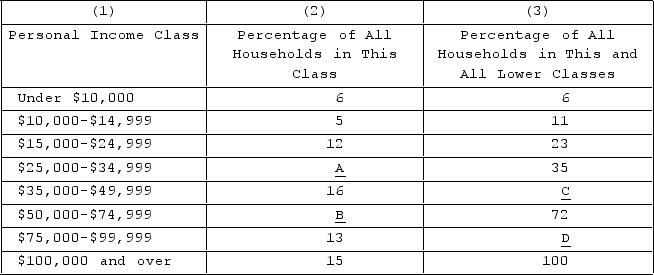 Refer to the table. What percentage should be reported in blank C of column 3?
 (Multiple Choice)
4.9/5 (69)
(69) The U.S. income-maintenance program consists of two kinds of programs. They are
(Multiple Choice)
4.9/5 (76)
(76) The lowest quintile of households in the income distribution (as of 2017)receives about
(Multiple Choice)
4.9/5 (86)
(86) 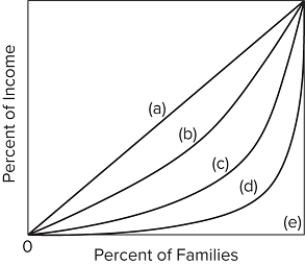 Refer to the diagram, where curves (a)through (e)are for five different countries. The Gini ratio is lowest in country
 (Multiple Choice)
4.8/5 (80)
(80) The incidence of poverty is very high among the elderly (65 years or older).
(True/False)
4.8/5 (83)
(83) The exercise of market power by suppliers in resource markets tends to
(Multiple Choice)
4.9/5 (77)
(77) Social insurance is distinguished from public assistance, or welfare, by the fact that
(Multiple Choice)
4.7/5 (72)
(72) The Supplemental Nutrition Assistance Program (formerly the food-stamp program)mostly pays out cash-vouchers to eligible households.
(True/False)
4.9/5 (83)
(83) The U.S. poverty rate for the elderly (65 and over)is higher than for the general population.
(True/False)
4.9/5 (78)
(78) 
Filters
- Essay(0)
- Multiple Choice(0)
- Short Answer(0)
- True False(0)
- Matching(0)