



 Chat with AI
Exam 6: Microbial Nutrition and Growth

Exam 1: A Brief History of Microbiology73 Questions
Exam 2: The Chemistry of Microbiology76 Questions
Exam 3: Cell Structure and Function80 Questions
Exam 4: Microscopy, Staining, and Classification80 Questions
Exam 5: Microbial Metabolism77 Questions
Exam 6: Microbial Nutrition and Growth75 Questions
Exam 7: Microbial Genetics75 Questions
Exam 8: Recombinant DNA Technology75 Questions
Exam 9: Controlling Microbial Growth in the Environment75 Questions
Exam 10: Controlling Microbial Growth in the Body: Antimicrobial Drugs75 Questions
Exam 11: Characterizing and Classifying Prokaryotes75 Questions
Exam 12: Characterizing and Classifying Eukaryotes75 Questions
Exam 13: Characterizing and Classifying Viruses, Viroids, and Prions75 Questions
Exam 14: Infection, Infectious Diseases, and Epidemiology76 Questions
Exam 15: Innate Immunity75 Questions
Exam 16: Adaptive Immunity75 Questions
Exam 17: Immunization and Immune Testing75 Questions
Exam 18: Immune Disorders75 Questions
Exam 19: Pathogenic Gram Positive Bacteria75 Questions
Exam 20: Pathogenic Gram-Negative Cocci and Bacilli77 Questions
Exam 21: Rickettsias, Chlamydias, Spirochetes, and Vibrios75 Questions
Exam 22: Pathogenic Fungi75 Questions
Exam 23: Parasitic Protozoa, Helminths, and Arthropod Vectors75 Questions
Exam 24: Pathogenic DNA Viruses75 Questions
Exam 25: Pathogenic RNA Viruses75 Questions
Exam 26: Applied and Environmental Microbiology74 Questions
Select questions type


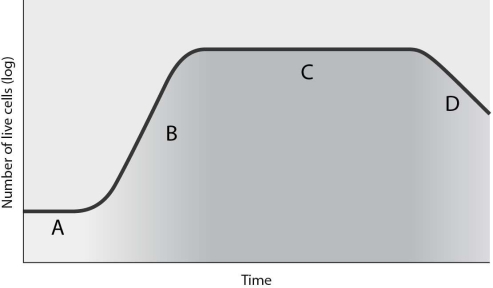 Which of the following statements is CORRECT regarding Figure 6.1?
 (Multiple Choice)
4.9/5  (68)
(68) A microorganism grows in the lab on medium containing mineral salts but no organic compounds.The organism is likely to be a(n)
(Multiple Choice)
4.8/5 (78)
(78) A (Coulter/Petroff-Hauser chamber/spectrophotometer)counter is used to count cells on a light microscope.
(Short Answer)
4.8/5 (95)
(95) Explain the similarities and differences between direct and indirect methods of measuring microbial growth,and give examples of each.
(Essay)
4.8/5 (82)
(82) A laboratory protocol lists the following ingredients: 1 g sucrose,16.4 g Na2HPO4,1.5 g (NH4)3PO4,0.02 g CaCO3,KNO3,water to 1 liter and autoclave.This recipe is for a ________ medium.
(Multiple Choice)
4.8/5 (74)
(74) What types of media are commonly used to isolate anaerobic microbes?
(Multiple Choice)
4.9/5 (85)
(85) A microbiologist inoculates a flask of broth with 1 ml of 100 bacterial cells/ml.The generation time of the species is 1 hour,and there is no lag phase.How long will it be before the culture contains more than 6,000 cells/ml?
(Multiple Choice)
4.7/5 (68)
(68) Compare and contrast the streak-plate method of isolation with the pour-plate method of isolation.
(Essay)
4.9/5 (86)
(86) In the process of ________,microbes detect the presence and density of other microbes and modify their metabolic activity in response.
(Multiple Choice)
4.9/5 (84)
(84) An organism that requires chemical nutrients which serve as final electron acceptors is a(n)
(Multiple Choice)
4.9/5 (88)
(88) Which of the following is an indirect method for estimating the number of microbes in a sample?
(Multiple Choice)
4.9/5 (83)
(83) A capnophile is a microorganism that thrives in conditions of high
(Multiple Choice)
4.8/5 (66)
(66) ________ are complex communities of various types of microbes that adhere to surfaces.
(Multiple Choice)
4.9/5 (73)
(73) Serial dilution can be used in combination with pour plates as a method for isolating pure cultures.
(True/False)
4.8/5 (74)
(74) Which of the following methods provides information about the number of living cells in a sample of bacterial culture?
(Multiple Choice)
4.8/5 (78)
(78) 
Filters
- Essay(0)
- Multiple Choice(0)
- Short Answer(0)
- True False(0)
- Matching(0)