



 Chat with AI
Exam 11: The Case for Free Markets: the Price System

Exam 1: What Is Economics254 Questions
Exam 2: The Economony: Myth and Reality184 Questions
Exam 3: The Fundamental Economic Problem: Scarcity and Choice278 Questions
Exam 4: Supply and Demand: an Initial Look297 Questions
Exam 5: Consumer Choice: Individual and Market Demand213 Questions
Exam 6: Demand and Elasticity247 Questions
Exam 7: Production, Inputs, and Cost: Building Blocks for Supply Analysis246 Questions
Exam 8: Output, Price, and Profit: the Importance of Marginal Analysis232 Questions
Exam 9: The Financial Markets and the Economy: the Tail That Wags the Dog225 Questions
Exam 10: The Firm and the Industry Under Perfect Competition219 Questions
Exam 11: The Case for Free Markets: the Price System251 Questions
Exam 12: Monopoly236 Questions
Exam 13: Between Competition and Monopoly248 Questions
Exam 14: Limiting Market Power: Antitrust and Regulation152 Questions
Exam 15: The Shortcomings of Free Markets210 Questions
Exam 16: The Economics of the Environment, and Natural Resources218 Questions
Exam 17: Taxation and Resource Allocation218 Questions
Exam 18: Pricing the Factors of Production230 Questions
Exam 19: Labor and Entrepreneurship: the Human Inputs267 Questions
Exam 20: Poverty, Inequality, and Discrimination167 Questions
Exam 21: An Introduction to Macroeconomics212 Questions
Exam 22: The Goals of Macroeconomic Policy212 Questions
Exam 23: Economic Growth: Theory and Policy226 Questions
Exam 24: Aggregate Demand and the Powerful Consumer216 Questions
Exam 25: Demand-Side Equilibrium: Unemployment or Inflation215 Questions
Exam 26: Bringing in the Supply Side: Unemployment and Inflation228 Questions
Exam 27: Managing Aggregate Demand: Fiscal Policy207 Questions
Exam 28: Money and the Banking System222 Questions
Exam 29: Monetary Policy: Conventional and Unconventional208 Questions
Exam 30: The Financial Crisis and the Great Recession64 Questions
Exam 31: The Debate Over Monetary and Fiscal Policy216 Questions
Exam 32: Budget Deficits in the Short and Long Run214 Questions
Exam 33: The Trade-Off Between Inflation and Unemployment218 Questions
Exam 34: International Trade and Comparative Advantage215 Questions
Exam 35: The International Monetary System: Order or Disorder216 Questions
Exam 36: Exchange Rates and the Macroeconomy215 Questions
Exam 37: Contemporary Issues in the Useconomy23 Questions
Select questions type


Which of the following carries out the distribution process by rationing goods on the basis of preferences and relative incomes?
(Multiple Choice)
4.8/5  (72)
(72) Perfect central planning is nearly impossible for all of these reasons except
(Multiple Choice)
4.8/5 (89)
(89) With a monopoly, the total surplus is lower than it would be with a perfectly competitive industry.
(True/False)
4.8/5 (90)
(90) Under laissez-faire, the allocation of resources among different products depends on
(Multiple Choice)
4.8/5 (65)
(65) Free markets produce relatively high levels of efficiency but low rates of growth.
(True/False)
4.8/5 (77)
(77) In many cities, the price of summer pops concerts has risen.In Charlotte, North Carolina, and Columbus, Ohio, for example, concerts that were once free now cost $5.If there are only fixed costs and no variable costs nor marginal costs in an orchestra concert, what is the efficient price? Explain the reason why some people will find the efficient price unfair.
(Essay)
5.0/5 (71)
(71) In the case of the production of electronic calculators, introduced in the United States in the 1960s,
(Multiple Choice)
4.8/5 (83)
(83) In a competitive market economy, a resource in short supply will be allocated
(Multiple Choice)
4.9/5 (81)
(81) Figure 11-2
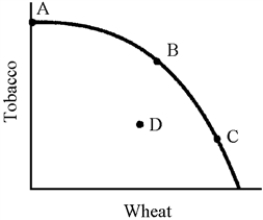 -In Figure 11-2, which movement would represent an improvement for all individuals?
 (Multiple Choice)
4.9/5 (79)
(79) Higher prices can discourage use/consumption, which in turn may better allocate scarce resources.
(True/False)
4.7/5 (79)
(79) Any increase in efficiency increases output available for distribution.
(True/False)
4.7/5 (79)
(79) Central planning systems were used in the former Soviet Union but since this union dissolved no other nations now use this allocation process.
(True/False)
4.8/5 (67)
(67) How does a laissez-faire economy decide which consumer gets each of the goods that has been produced?
(Essay)
4.7/5 (73)
(73) The free-market system coordinates output decisions by pushing
(Multiple Choice)
4.8/5 (77)
(77) The metaphor used to describe the working of the price system to achieve efficiency in a free market is
(Multiple Choice)
4.7/5 (78)
(78) Under laissez-faire, the force that drives the economy toward an efficient outcome is
(Multiple Choice)
5.0/5 (87)
(87) What is the rule for efficient output selection and how does the competitive market achieve it?
(Essay)
4.9/5 (87)
(87) In a classic administrative snafu, the Army assigns trained classical musicians to kitchen duty and places trained cooks in the military band.This is an example of inefficiency in
(Multiple Choice)
4.8/5 (80)
(80) 
Filters
- Essay(0)
- Multiple Choice(0)
- Short Answer(0)
- True False(0)
- Matching(0)