



 Chat with AI
Exam 11: The Case for Free Markets: the Price System

Exam 1: What Is Economics254 Questions
Exam 2: The Economony: Myth and Reality184 Questions
Exam 3: The Fundamental Economic Problem: Scarcity and Choice278 Questions
Exam 4: Supply and Demand: an Initial Look297 Questions
Exam 5: Consumer Choice: Individual and Market Demand213 Questions
Exam 6: Demand and Elasticity247 Questions
Exam 7: Production, Inputs, and Cost: Building Blocks for Supply Analysis246 Questions
Exam 8: Output, Price, and Profit: the Importance of Marginal Analysis232 Questions
Exam 9: The Financial Markets and the Economy: the Tail That Wags the Dog225 Questions
Exam 10: The Firm and the Industry Under Perfect Competition219 Questions
Exam 11: The Case for Free Markets: the Price System251 Questions
Exam 12: Monopoly236 Questions
Exam 13: Between Competition and Monopoly248 Questions
Exam 14: Limiting Market Power: Antitrust and Regulation152 Questions
Exam 15: The Shortcomings of Free Markets210 Questions
Exam 16: The Economics of the Environment, and Natural Resources218 Questions
Exam 17: Taxation and Resource Allocation218 Questions
Exam 18: Pricing the Factors of Production230 Questions
Exam 19: Labor and Entrepreneurship: the Human Inputs267 Questions
Exam 20: Poverty, Inequality, and Discrimination167 Questions
Exam 21: An Introduction to Macroeconomics212 Questions
Exam 22: The Goals of Macroeconomic Policy212 Questions
Exam 23: Economic Growth: Theory and Policy226 Questions
Exam 24: Aggregate Demand and the Powerful Consumer216 Questions
Exam 25: Demand-Side Equilibrium: Unemployment or Inflation215 Questions
Exam 26: Bringing in the Supply Side: Unemployment and Inflation228 Questions
Exam 27: Managing Aggregate Demand: Fiscal Policy207 Questions
Exam 28: Money and the Banking System222 Questions
Exam 29: Monetary Policy: Conventional and Unconventional208 Questions
Exam 30: The Financial Crisis and the Great Recession64 Questions
Exam 31: The Debate Over Monetary and Fiscal Policy216 Questions
Exam 32: Budget Deficits in the Short and Long Run214 Questions
Exam 33: The Trade-Off Between Inflation and Unemployment218 Questions
Exam 34: International Trade and Comparative Advantage215 Questions
Exam 35: The International Monetary System: Order or Disorder216 Questions
Exam 36: Exchange Rates and the Macroeconomy215 Questions
Exam 37: Contemporary Issues in the Useconomy23 Questions
Select questions type


Explain how the free-market mechanism adjusts prices so that resource allocation is economically efficient.
(Essay)
4.7/5  (76)
(76) In a laissez-faire system, the price mechanism dictates the production planning decisions.
(True/False)
4.7/5 (73)
(73) Distribution is a major question to be answered by any economic system.
(True/False)
5.0/5 (80)
(80) To be efficient, outputs should be produced that minimize total cost.
(True/False)
4.9/5 (86)
(86) Under a pure system of laissez-faire, the government would not do which of the following?
(Multiple Choice)
4.8/5 (82)
(82) Input-output analysis is a technique used to solve complicated market equations.
(True/False)
4.8/5 (79)
(79) Mutually beneficial trade is impossible when different persons have different preferences about goods and services.
(True/False)
5.0/5 (58)
(58) When an economy is operating with maximum efficiency, the production of more of commodity A will entail the production of less of commodity B because
(Multiple Choice)
4.9/5 (70)
(70) What is the order in which an economy tries to solve the issue of resource allocation?
(Multiple Choice)
4.7/5 (78)
(78) The price system automatically leads to an efficient allocation of inputs among the different production processes.
(True/False)
4.9/5 (57)
(57) Differentiate between consumer's surplus and producer's surplus.For a rational consumer, consumer's surplus will never be a negative number.Why?
(Essay)
4.8/5 (69)
(69) Figure 11-2
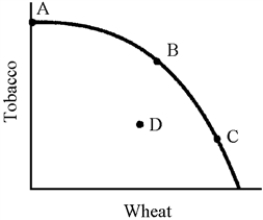 -As we move down the production possibilities schedule in Figure 11-2, each successive point is
 (Multiple Choice)
4.7/5 (80)
(80) When the price of a good is below its equilibrium level under perfect competition,
(Multiple Choice)
4.9/5 (82)
(82) The MU of computers is initially larger than the MC of producing them in a free market.We may expect output of computers to
(Multiple Choice)
4.9/5 (85)
(85) 
Filters
- Essay(0)
- Multiple Choice(0)
- Short Answer(0)
- True False(0)
- Matching(0)