



 Chat with AI
Exam 20: Poverty, Inequality, and Discrimination

Exam 1: What Is Economics254 Questions
Exam 2: The Economony: Myth and Reality184 Questions
Exam 3: The Fundamental Economic Problem: Scarcity and Choice278 Questions
Exam 4: Supply and Demand: an Initial Look297 Questions
Exam 5: Consumer Choice: Individual and Market Demand213 Questions
Exam 6: Demand and Elasticity247 Questions
Exam 7: Production, Inputs, and Cost: Building Blocks for Supply Analysis246 Questions
Exam 8: Output, Price, and Profit: the Importance of Marginal Analysis232 Questions
Exam 9: The Financial Markets and the Economy: the Tail That Wags the Dog225 Questions
Exam 10: The Firm and the Industry Under Perfect Competition219 Questions
Exam 11: The Case for Free Markets: the Price System251 Questions
Exam 12: Monopoly236 Questions
Exam 13: Between Competition and Monopoly248 Questions
Exam 14: Limiting Market Power: Antitrust and Regulation152 Questions
Exam 15: The Shortcomings of Free Markets210 Questions
Exam 16: The Economics of the Environment, and Natural Resources218 Questions
Exam 17: Taxation and Resource Allocation218 Questions
Exam 18: Pricing the Factors of Production230 Questions
Exam 19: Labor and Entrepreneurship: the Human Inputs267 Questions
Exam 20: Poverty, Inequality, and Discrimination167 Questions
Exam 21: An Introduction to Macroeconomics212 Questions
Exam 22: The Goals of Macroeconomic Policy212 Questions
Exam 23: Economic Growth: Theory and Policy226 Questions
Exam 24: Aggregate Demand and the Powerful Consumer216 Questions
Exam 25: Demand-Side Equilibrium: Unemployment or Inflation215 Questions
Exam 26: Bringing in the Supply Side: Unemployment and Inflation228 Questions
Exam 27: Managing Aggregate Demand: Fiscal Policy207 Questions
Exam 28: Money and the Banking System222 Questions
Exam 29: Monetary Policy: Conventional and Unconventional208 Questions
Exam 30: The Financial Crisis and the Great Recession64 Questions
Exam 31: The Debate Over Monetary and Fiscal Policy216 Questions
Exam 32: Budget Deficits in the Short and Long Run214 Questions
Exam 33: The Trade-Off Between Inflation and Unemployment218 Questions
Exam 34: International Trade and Comparative Advantage215 Questions
Exam 35: The International Monetary System: Order or Disorder216 Questions
Exam 36: Exchange Rates and the Macroeconomy215 Questions
Exam 37: Contemporary Issues in the Useconomy23 Questions
Select questions type


How does the idea of a leaky bucket relate to the study of income distribution?
(Essay)
5.0/5  (72)
(72) For most welfare recipients, the negative income tax plan would increase incentives to work.
(True/False)
4.8/5 (69)
(69) How do income redistribution programs affect equality and efficiency?
(Essay)
4.8/5 (82)
(82) With a negative income tax providing a minimum of $20,000 and a tax rate of 25 percent, what amount of supplement would the government pay to a household earning $10,000?
(Multiple Choice)
4.8/5 (73)
(73) The national poverty rate in the United States reached a low in the
(Multiple Choice)
4.9/5 (87)
(87) Susan argues that she is the victim of economic discrimination.The primary technical difficulty for an economist investigating her claim will be
(Multiple Choice)
4.8/5 (83)
(83) There are several reasons why incomes are unequal, including differences in luck, experience, and schooling.
(True/False)
4.9/5 (65)
(65) Japanese employers tend to hire employees right out of college and train them for a lifetime job with the company.Over time they found that women often, but not always, married after a few years and left the company so they were not good training investments.Based on this experience, and despite the exceptions, firms stopped hiring any women for jobs that require substantial training.This practice is called
(Multiple Choice)
4.9/5 (80)
(80) Figure 21-1 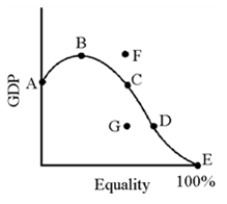 -In Figure 21-1, the optimal amount of equality lies only between which points?
 (Multiple Choice)
4.8/5 (75)
(75) In 2017, approximately what percent of Americans were below the poverty line?
(Multiple Choice)
4.7/5 (95)
(95) The lowest-income fifth of the U.S.population ordinarily earns about 20 percent of the income.
(True/False)
4.8/5 (77)
(77) In 2017, the median income for a household of four was about
(Multiple Choice)
4.9/5 (93)
(93) The existence of differences between the average earnings of men and women
(Multiple Choice)
4.9/5 (84)
(84) 
Filters
- Essay(0)
- Multiple Choice(0)
- Short Answer(0)
- True False(0)
- Matching(0)