



 Chat with AI
Exam 20: Poverty, Inequality, and Discrimination

Exam 1: What Is Economics254 Questions
Exam 2: The Economony: Myth and Reality184 Questions
Exam 3: The Fundamental Economic Problem: Scarcity and Choice278 Questions
Exam 4: Supply and Demand: an Initial Look297 Questions
Exam 5: Consumer Choice: Individual and Market Demand213 Questions
Exam 6: Demand and Elasticity247 Questions
Exam 7: Production, Inputs, and Cost: Building Blocks for Supply Analysis246 Questions
Exam 8: Output, Price, and Profit: the Importance of Marginal Analysis232 Questions
Exam 9: The Financial Markets and the Economy: the Tail That Wags the Dog225 Questions
Exam 10: The Firm and the Industry Under Perfect Competition219 Questions
Exam 11: The Case for Free Markets: the Price System251 Questions
Exam 12: Monopoly236 Questions
Exam 13: Between Competition and Monopoly248 Questions
Exam 14: Limiting Market Power: Antitrust and Regulation152 Questions
Exam 15: The Shortcomings of Free Markets210 Questions
Exam 16: The Economics of the Environment, and Natural Resources218 Questions
Exam 17: Taxation and Resource Allocation218 Questions
Exam 18: Pricing the Factors of Production230 Questions
Exam 19: Labor and Entrepreneurship: the Human Inputs267 Questions
Exam 20: Poverty, Inequality, and Discrimination167 Questions
Exam 21: An Introduction to Macroeconomics212 Questions
Exam 22: The Goals of Macroeconomic Policy212 Questions
Exam 23: Economic Growth: Theory and Policy226 Questions
Exam 24: Aggregate Demand and the Powerful Consumer216 Questions
Exam 25: Demand-Side Equilibrium: Unemployment or Inflation215 Questions
Exam 26: Bringing in the Supply Side: Unemployment and Inflation228 Questions
Exam 27: Managing Aggregate Demand: Fiscal Policy207 Questions
Exam 28: Money and the Banking System222 Questions
Exam 29: Monetary Policy: Conventional and Unconventional208 Questions
Exam 30: The Financial Crisis and the Great Recession64 Questions
Exam 31: The Debate Over Monetary and Fiscal Policy216 Questions
Exam 32: Budget Deficits in the Short and Long Run214 Questions
Exam 33: The Trade-Off Between Inflation and Unemployment218 Questions
Exam 34: International Trade and Comparative Advantage215 Questions
Exam 35: The International Monetary System: Order or Disorder216 Questions
Exam 36: Exchange Rates and the Macroeconomy215 Questions
Exam 37: Contemporary Issues in the Useconomy23 Questions
Select questions type


Competition reduces some but not all discrimination.Where can one expect competition to reduce discrimination, and where is discrimination likely to go on even if there is competition?
(Essay)
4.8/5  (79)
(79) Affirmative action laws require employers to search for qualified minority applicants but not to necessarily give them jobs.
(True/False)
4.7/5 (92)
(92) Figure 21-1 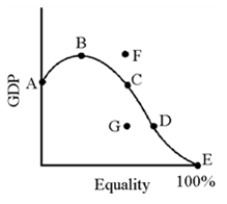 -In Figure 21-1, a reform in the distribution system that achieves the same distribution with less damage to work incentives is represented by a move from which points?
 (Multiple Choice)
4.9/5 (98)
(98) Large income differences will be eradicated if the market mechanism is working well.
(True/False)
4.7/5 (79)
(79) Economists generally agree that in reducing poverty, policies should be sought that do the
(Multiple Choice)
4.7/5 (62)
(62) The difference between the earnings of construction workers who work on bridges and skyscrapers and those who work on highways is probably due to
(Multiple Choice)
4.8/5 (78)
(78) Figure 21-1
-In Figure 21-1, if the existing antipoverty program were replaced by a negative income tax, most economists believe that it would result in a move like which of the following?
-In Figure 21-1, if the existing antipoverty program were replaced by a negative income tax, most economists believe that it would result in a move like which of the following? (Multiple Choice)
4.7/5 (79)
(79) Compensating wage differentials explain some income differences.
(True/False)
4.8/5 (82)
(82) Is wage discrimination more likely in competitive or monopolistic markets?
(Essay)
4.9/5 (100)
(100) Which of the following countries has the most equal income distribution?
(Multiple Choice)
4.9/5 (86)
(86) Table 21-1 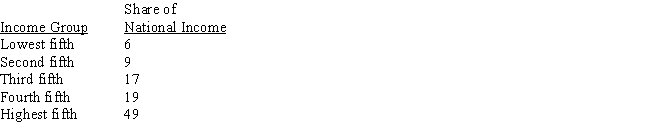
-The distribution of income in the United States
-The distribution of income in the United States (Multiple Choice)
4.7/5 (73)
(73) The factor accounting for most of the earnings difference between equally educated and experienced men and women is that women
(Multiple Choice)
5.0/5 (82)
(82) Define discrimination.Why does discrimination occur, and what evidence exists that it does occur?
(Essay)
4.8/5 (74)
(74) In 2017, the U.S.median income for a family of four was about $61,000.
(True/False)
4.7/5 (86)
(86) The relative concept of poverty is based on how far behind average income a particular family gets.
(True/False)
4.8/5 (65)
(65) Which of the following is not part of a negative income tax?
(Multiple Choice)
4.7/5 (91)
(91) Poverty is defined in two ways: the absolute concept of poverty and the relative concept of poverty.
(True/False)
5.0/5 (80)
(80) 
Filters
- Essay(0)
- Multiple Choice(0)
- Short Answer(0)
- True False(0)
- Matching(0)