



 Chat with AI
Exam 33: The Trade-Off Between Inflation and Unemployment

Exam 1: What Is Economics254 Questions
Exam 2: The Economony: Myth and Reality184 Questions
Exam 3: The Fundamental Economic Problem: Scarcity and Choice278 Questions
Exam 4: Supply and Demand: an Initial Look297 Questions
Exam 5: Consumer Choice: Individual and Market Demand213 Questions
Exam 6: Demand and Elasticity247 Questions
Exam 7: Production, Inputs, and Cost: Building Blocks for Supply Analysis246 Questions
Exam 8: Output, Price, and Profit: the Importance of Marginal Analysis232 Questions
Exam 9: The Financial Markets and the Economy: the Tail That Wags the Dog225 Questions
Exam 10: The Firm and the Industry Under Perfect Competition219 Questions
Exam 11: The Case for Free Markets: the Price System251 Questions
Exam 12: Monopoly236 Questions
Exam 13: Between Competition and Monopoly248 Questions
Exam 14: Limiting Market Power: Antitrust and Regulation152 Questions
Exam 15: The Shortcomings of Free Markets210 Questions
Exam 16: The Economics of the Environment, and Natural Resources218 Questions
Exam 17: Taxation and Resource Allocation218 Questions
Exam 18: Pricing the Factors of Production230 Questions
Exam 19: Labor and Entrepreneurship: the Human Inputs267 Questions
Exam 20: Poverty, Inequality, and Discrimination167 Questions
Exam 21: An Introduction to Macroeconomics212 Questions
Exam 22: The Goals of Macroeconomic Policy212 Questions
Exam 23: Economic Growth: Theory and Policy226 Questions
Exam 24: Aggregate Demand and the Powerful Consumer216 Questions
Exam 25: Demand-Side Equilibrium: Unemployment or Inflation215 Questions
Exam 26: Bringing in the Supply Side: Unemployment and Inflation228 Questions
Exam 27: Managing Aggregate Demand: Fiscal Policy207 Questions
Exam 28: Money and the Banking System222 Questions
Exam 29: Monetary Policy: Conventional and Unconventional208 Questions
Exam 30: The Financial Crisis and the Great Recession64 Questions
Exam 31: The Debate Over Monetary and Fiscal Policy216 Questions
Exam 32: Budget Deficits in the Short and Long Run214 Questions
Exam 33: The Trade-Off Between Inflation and Unemployment218 Questions
Exam 34: International Trade and Comparative Advantage215 Questions
Exam 35: The International Monetary System: Order or Disorder216 Questions
Exam 36: Exchange Rates and the Macroeconomy215 Questions
Exam 37: Contemporary Issues in the Useconomy23 Questions
Select questions type


An increase in the price of foreign oil can shift the economy's aggregate supply curve _____ resulting in inflation.
(Multiple Choice)
4.9/5  (78)
(78) Recessionary gaps lead to falling inflation and falling unemployment.
(True/False)
4.8/5 (77)
(77) Economist A.W.Phillips found a negative correlation between wage inflation and unemployment.
(True/False)
4.8/5 (84)
(84) If you believe that expectations react slowly, you are likely
(Multiple Choice)
4.8/5 (87)
(87) In the short run, fiscal and monetary policy cause unemployment and inflation to move in opposite directions because
(Multiple Choice)
4.7/5 (83)
(83) Many economists think that, in the long run, the economy tends to move toward
(Multiple Choice)
4.9/5 (72)
(72) Most economists now agree that the Phillips curve demonstrates that there is
(Multiple Choice)
4.8/5 (70)
(70) If fluctuations in economic activity emanate from the supply side, higher rates of inflation will be associated with higher rates of unemployment, and lower rates of inflation will be associated with lower rates of unemployment.
(True/False)
4.8/5 (78)
(78) If strong fiscal policy stimulus is used to combat a recessionary gap, what will happen?
(Multiple Choice)
4.8/5 (80)
(80) If policymakers do nothing in response to a recessionary gap, what will happen?
(Multiple Choice)
5.0/5 (88)
(88) Figure 33-1
 -Which of the following is true about the economy depicted in Figure 33-1?
 (Multiple Choice)
4.8/5 (72)
(72) Figure 33-4
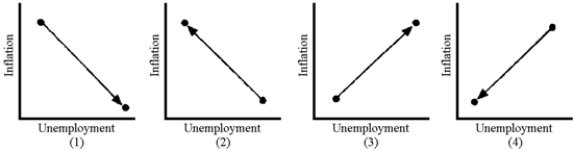 -Figure 33-4 shows four movements of the inflation rate and the unemployment rate.Which panel shows the movement associated with a "supply shock" like those of the 1970s?
 (Multiple Choice)
4.7/5 (100)
(100) If aggregate demand grows faster than aggregate supply, the equilibrium price level will rise.
(True/False)
4.9/5 (77)
(77) If you believe that expectations react quickly, you are likely a
(Multiple Choice)
4.7/5 (75)
(75) What reasons would economists give for an increase in the natural rate of unemployment that could have occurred from 2007 to 2011? What argument would suggest that the natural rate of unemployment may not have risen?
(Essay)
4.8/5 (83)
(83) 
Filters
- Essay(0)
- Multiple Choice(0)
- Short Answer(0)
- True False(0)
- Matching(0)