



 Chat with AI
Exam 33: The Trade-Off Between Inflation and Unemployment

Exam 1: What Is Economics254 Questions
Exam 2: The Economony: Myth and Reality184 Questions
Exam 3: The Fundamental Economic Problem: Scarcity and Choice278 Questions
Exam 4: Supply and Demand: an Initial Look297 Questions
Exam 5: Consumer Choice: Individual and Market Demand213 Questions
Exam 6: Demand and Elasticity247 Questions
Exam 7: Production, Inputs, and Cost: Building Blocks for Supply Analysis246 Questions
Exam 8: Output, Price, and Profit: the Importance of Marginal Analysis232 Questions
Exam 9: The Financial Markets and the Economy: the Tail That Wags the Dog225 Questions
Exam 10: The Firm and the Industry Under Perfect Competition219 Questions
Exam 11: The Case for Free Markets: the Price System251 Questions
Exam 12: Monopoly236 Questions
Exam 13: Between Competition and Monopoly248 Questions
Exam 14: Limiting Market Power: Antitrust and Regulation152 Questions
Exam 15: The Shortcomings of Free Markets210 Questions
Exam 16: The Economics of the Environment, and Natural Resources218 Questions
Exam 17: Taxation and Resource Allocation218 Questions
Exam 18: Pricing the Factors of Production230 Questions
Exam 19: Labor and Entrepreneurship: the Human Inputs267 Questions
Exam 20: Poverty, Inequality, and Discrimination167 Questions
Exam 21: An Introduction to Macroeconomics212 Questions
Exam 22: The Goals of Macroeconomic Policy212 Questions
Exam 23: Economic Growth: Theory and Policy226 Questions
Exam 24: Aggregate Demand and the Powerful Consumer216 Questions
Exam 25: Demand-Side Equilibrium: Unemployment or Inflation215 Questions
Exam 26: Bringing in the Supply Side: Unemployment and Inflation228 Questions
Exam 27: Managing Aggregate Demand: Fiscal Policy207 Questions
Exam 28: Money and the Banking System222 Questions
Exam 29: Monetary Policy: Conventional and Unconventional208 Questions
Exam 30: The Financial Crisis and the Great Recession64 Questions
Exam 31: The Debate Over Monetary and Fiscal Policy216 Questions
Exam 32: Budget Deficits in the Short and Long Run214 Questions
Exam 33: The Trade-Off Between Inflation and Unemployment218 Questions
Exam 34: International Trade and Comparative Advantage215 Questions
Exam 35: The International Monetary System: Order or Disorder216 Questions
Exam 36: Exchange Rates and the Macroeconomy215 Questions
Exam 37: Contemporary Issues in the Useconomy23 Questions
Select questions type


Figure 33-6
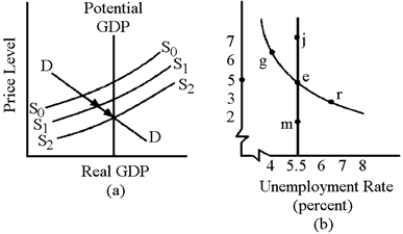 -The short-run Phillips curve in Figure 33-6 would include which of the following points?
 (Multiple Choice)
4.8/5  (73)
(73) Supply-side inflation is the rise in price level caused by slow growth (or decline) of aggregate supply.
(True/False)
4.9/5 (68)
(68) Which of the following could trigger demand-side inflation?
(Multiple Choice)
4.7/5 (84)
(84) Adverse shocks such as the crop failures of 1972-1973 and the oil price increases of 1974 and 1979 pushed the economy's
(Multiple Choice)
4.8/5 (85)
(85) Figure 33-7
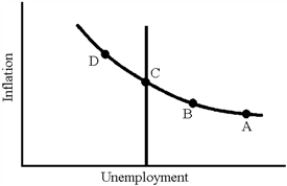 -In Figure 33-7, the case for expansionary monetary policy and fiscal policy is strongest at point
 (Multiple Choice)
4.9/5 (80)
(80) The unemployment rate for the U.S.economy in 2014 averaged about
(Multiple Choice)
4.8/5 (82)
(82) If employees and employers always accurately predict inflation, what is the shape of the Phillips curve?
(Multiple Choice)
4.8/5 (86)
(86) Figure 33-8
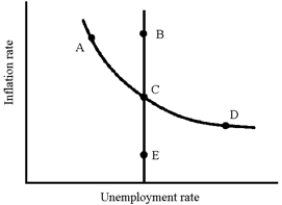 -In Figure 33-8, which of the following points illustrate the expansionary monetary policies of the mid-1990s and the accompanying favorable supply shocks?
 (Multiple Choice)
4.9/5 (87)
(87) Which of the following is most likely to result in inflation?
(Multiple Choice)
4.8/5 (62)
(62) The cost of reducing unemployment more rapidly by expansionary fiscal and monetary policies is a permanently higher inflation rate.
(True/False)
4.9/5 (94)
(94) Figure 33-4
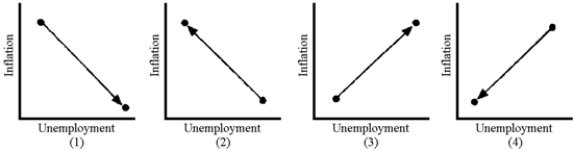 -Which panel in Figure 33-4 shows what happened in 2007-2009?
 (Multiple Choice)
4.8/5 (85)
(85) In what way do policymakers have to face a trade-off between inflation and unemployment?
(Multiple Choice)
4.7/5 (81)
(81) An example of indexing is a "cost of living" adjustment clause in a wage contract.
(True/False)
4.7/5 (76)
(76) If policymakers do nothing in response to an inflationary gap, what will happen?
(Multiple Choice)
4.8/5 (71)
(71) If expectations are rational, forecasting errors are pure random numbers.
(True/False)
4.8/5 (74)
(74) If unemployment and inflation move inversely, then we can infer that business fluctuations are
(Multiple Choice)
4.7/5 (86)
(86) Which of the following terms refers to provisions in a law or a contract whereby monetary payments are automatically adjusted whenever a specified price index changes?
(Multiple Choice)
4.7/5 (91)
(91) 
Filters
- Essay(0)
- Multiple Choice(0)
- Short Answer(0)
- True False(0)
- Matching(0)