



 Chat with AI
Exam 33: The Trade-Off Between Inflation and Unemployment

Exam 1: What Is Economics254 Questions
Exam 2: The Economony: Myth and Reality184 Questions
Exam 3: The Fundamental Economic Problem: Scarcity and Choice278 Questions
Exam 4: Supply and Demand: an Initial Look297 Questions
Exam 5: Consumer Choice: Individual and Market Demand213 Questions
Exam 6: Demand and Elasticity247 Questions
Exam 7: Production, Inputs, and Cost: Building Blocks for Supply Analysis246 Questions
Exam 8: Output, Price, and Profit: the Importance of Marginal Analysis232 Questions
Exam 9: The Financial Markets and the Economy: the Tail That Wags the Dog225 Questions
Exam 10: The Firm and the Industry Under Perfect Competition219 Questions
Exam 11: The Case for Free Markets: the Price System251 Questions
Exam 12: Monopoly236 Questions
Exam 13: Between Competition and Monopoly248 Questions
Exam 14: Limiting Market Power: Antitrust and Regulation152 Questions
Exam 15: The Shortcomings of Free Markets210 Questions
Exam 16: The Economics of the Environment, and Natural Resources218 Questions
Exam 17: Taxation and Resource Allocation218 Questions
Exam 18: Pricing the Factors of Production230 Questions
Exam 19: Labor and Entrepreneurship: the Human Inputs267 Questions
Exam 20: Poverty, Inequality, and Discrimination167 Questions
Exam 21: An Introduction to Macroeconomics212 Questions
Exam 22: The Goals of Macroeconomic Policy212 Questions
Exam 23: Economic Growth: Theory and Policy226 Questions
Exam 24: Aggregate Demand and the Powerful Consumer216 Questions
Exam 25: Demand-Side Equilibrium: Unemployment or Inflation215 Questions
Exam 26: Bringing in the Supply Side: Unemployment and Inflation228 Questions
Exam 27: Managing Aggregate Demand: Fiscal Policy207 Questions
Exam 28: Money and the Banking System222 Questions
Exam 29: Monetary Policy: Conventional and Unconventional208 Questions
Exam 30: The Financial Crisis and the Great Recession64 Questions
Exam 31: The Debate Over Monetary and Fiscal Policy216 Questions
Exam 32: Budget Deficits in the Short and Long Run214 Questions
Exam 33: The Trade-Off Between Inflation and Unemployment218 Questions
Exam 34: International Trade and Comparative Advantage215 Questions
Exam 35: The International Monetary System: Order or Disorder216 Questions
Exam 36: Exchange Rates and the Macroeconomy215 Questions
Exam 37: Contemporary Issues in the Useconomy23 Questions
Select questions type


A nonpolicy reason for the reduction in the natural rate of unemployment is the
(Multiple Choice)
4.9/5  (80)
(80) One of the reasons why the Phillips curve is no longer viewed as a "menu" of possible choices available to policymakers is that
(Multiple Choice)
4.8/5 (72)
(72) Figure 33-3
 -Given the situation in graph (1) in Figure 33-3, what movement would be expected in graph (2) from the economy's self-correcting mechanism?
 (Multiple Choice)
5.0/5 (77)
(77) Figure 33-7
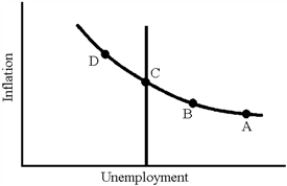 -In Figure 33-7, the case for restrictive monetary and fiscal policy is strongest at point
 (Multiple Choice)
4.8/5 (67)
(67) If AS increases at a faster rate than AD, the result will be
(Multiple Choice)
5.0/5 (81)
(81) The rapid advance in computer technology is one of the reasons given for the shift of the
(Multiple Choice)
4.9/5 (81)
(81) Figure 33-7
-In Figure 33-7, the only sustainable long-run equilibrium position is at point
-In Figure 33-7, the only sustainable long-run equilibrium position is at point (Multiple Choice)
4.9/5 (100)
(100) Figure 33-8
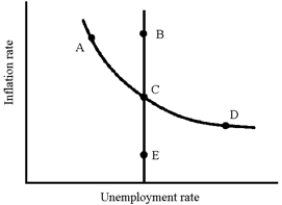 -In Figure 33-8, which of the following movements reflects the Fed's anti-inflationary policy of the early 1980s and the following market adjustment?
 (Multiple Choice)
4.9/5 (86)
(86) Figure 33-8
-In Figure 33-8, which of the following movements reflects the closing of a recessionary gap with an expansionary monetary and fiscal policy?
-In Figure 33-8, which of the following movements reflects the closing of a recessionary gap with an expansionary monetary and fiscal policy? (Multiple Choice)
4.8/5 (79)
(79) If the favorable supply shocks of the 1990s were reversed in the future, we should expect a(n)
(Multiple Choice)
4.9/5 (80)
(80) Many economists think that, in the long run, the Phillips curve is
(Multiple Choice)
4.8/5 (71)
(71) One explanation for the increase in the natural rate of unemployment in 2010 was a mismatch between the skills of the American labor force and the skills that the modern job market demanded.
(True/False)
4.7/5 (86)
(86) What is the effect of supply-side inflation on the short-run Phillips curve?
(Essay)
4.9/5 (88)
(88) Figure 33-8
-In Figure 33-8, which of the following movements reflects the closing of a recessionary gap through the economy's self-correcting mechanism?
-In Figure 33-8, which of the following movements reflects the closing of a recessionary gap through the economy's self-correcting mechanism? (Multiple Choice)
4.8/5 (87)
(87) Figure 33-6
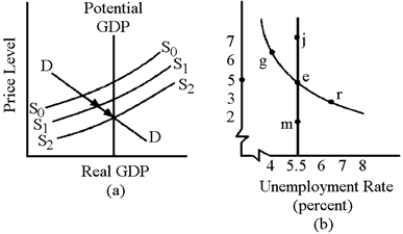 -If Figure 33-6 (a) illustrates the elimination of a recessionary gap, then the economy should move to what point on the curves shown in Figure 33-6 (b)?
 (Multiple Choice)
4.8/5 (83)
(83) If the fluctuations in the economy's real growth rate from year to year are caused primarily by variations in the rate at which aggregate demand increases, then data would show the
(Multiple Choice)
4.8/5 (74)
(74) Figure 33-5
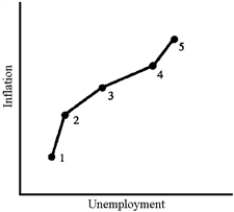 -Over a five-year period, economists observed that the unemployment-inflation relationship appeared as in Figure 33-5.Economic theory would conclude that the period
 (Multiple Choice)
4.8/5 (74)
(74) Policymakers who believe that the costs of inflation are very high will tend to favor which of the following during an inflationary gap?
(Multiple Choice)
4.8/5 (78)
(78) Inflationary gaps lead to rising unemployment and rising inflation.
(True/False)
4.7/5 (86)
(86) 
Filters
- Essay(0)
- Multiple Choice(0)
- Short Answer(0)
- True False(0)
- Matching(0)